Framework · Decision-making
Decision trees
Lay out choices, uncertain events, and consequences so a decision can be compared before commitment
Make uncertainty visible before choosing.
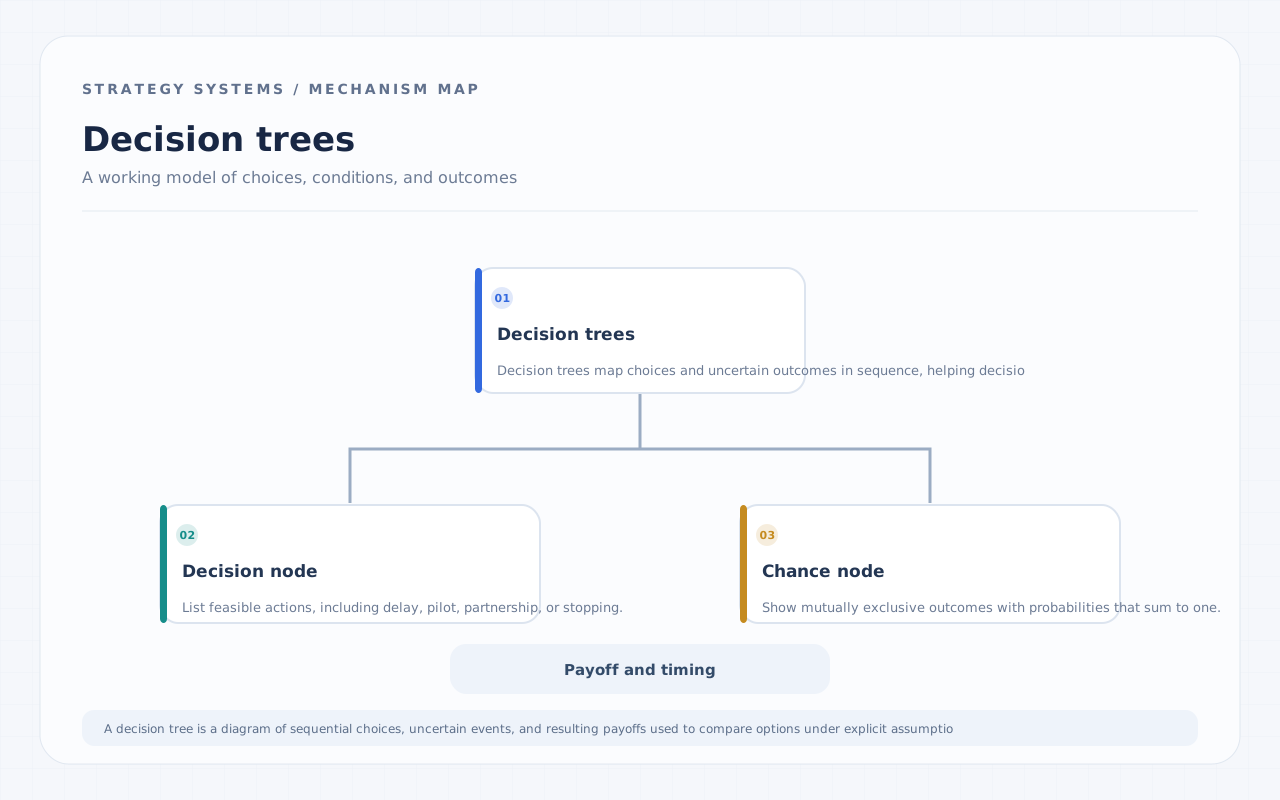
A decision tree makes a decision's sequence explicit. Decision nodes represent actions the organization controls; chance nodes represent uncertain events; terminal branches record outcomes or payoffs. Working backward, a decision maker can compare expected monetary value at a chance node—sum of each payoff multiplied by its probability—and select a preferred action at a decision node, subject to strategy, risk tolerance, and other constraints.
A decision tree is a diagram of sequential choices, uncertain events, and resulting payoffs used to compare options under explicit assumptions.
For a staged project, let c be the initial pilot cost and s an informative signal with probability πs. After observing s, let a be a feasible continuation action and Vs(a) its incremental net value at the common decision-date present value. The staged value is −c + Σs πs maxa Vs(a), if the objective is expected monetary value and probabilities sum to one. Include stop as an action only when it is feasible, with its actual closure commitments. Count each cash flow once; a terminal net value that already deducts follow-on spending must not be charged for it again.
Decision trees are useful when choices are sequential and information arrives over time. They can represent the option to stop, learn, or expand after a pilot. They are less useful when probabilities are invented to give false precision, outcomes are hard to define, or the decision depends on interactions too complex for a simple tree. Keep assumptions visible and compare expected value with downside, timing, and strategic options.
Work backward from each terminal outcome: compare feasible continuation actions conditional on the information then available, probability-weight chance outcomes and then compare the initial actions. This makes the timing of knowledge decisive. Selecting the best action separately in every state is valid only when the signal actually reveals that state before commitment. Otherwise it assumes information the manager does not have.
Elements of a tree
Make controllable actions distinct from uncertain events and final outcomes.
 Decision node
List feasible actions, including delay, pilot, partnership, or stopping.
01
List feasible actions, including delay, pilot, partnership, or stopping.
List feasible actions, including delay, pilot, partnership, or stopping. Chance node
Show mutually exclusive outcomes with probabilities that sum to one.
02
Show mutually exclusive outcomes with probabilities that sum to one.
 Payoff and timing
Record incremental cost, benefit, timing, and who bears each risk.
03
Record incremental cost, benefit, timing, and who bears each risk.
A continuum, not a switch
A decision tree makes sequential options and uncertainties explicit; sensitivity analysis shows whether its recommendation depends on fragile estimates.
“The arithmetic is only as credible as the options, probabilities, and payoffs in the tree.”
Why it matters
A tree can reveal the value of waiting for information, the consequences of a pilot, and where a project can be stopped before larger commitments. It helps teams challenge a single-point forecast and make disagreements about likelihood or payoff explicit. Use ranges and sensitivity analysis when estimates are uncertain; the preferred path may change under a modest assumption shift.
The Toyota–Idemitsu sequence illustrates the structure without valuing it. A later full-scale-production study is based on earlier pilot results. To turn that sequence into a decision analysis, the team would need the evidence produced by the pilot, feasible subsequent actions, commitments already signed and a consistent cash-flow horizon.
Compare the pilot with the best action available without it. The value of learning is the improvement from information-enabled decisions, less the pilot and delay costs. An informative test has little decision value when every possible result leaves the preferred action unchanged. A test can also be technically informative while arriving too late to avoid a binding purchase or contractual obligation.
Real-world examples
The same concept shows up in different ways across industries.

When it breaks
A tree can produce a precise expected value from weak estimates and hide severe downside behind an average. Probabilities may be correlated, outcomes may be non-monetary, and participants may disagree about which options are feasible. Include worst-case exposure, liquidity constraints, strategic consequences, and the chance to learn or change course.
Avoid building a tree so large that no one can inspect it. Model only uncertainties that can change the decision, document where probabilities come from, and check whether a pilot can actually resolve them. Use decision trees alongside judgment and scenario planning, not as an automated answer.
Expected monetary value is not a complete rule when a losing path violates a liquidity, safety or other hard constraint. Show path exposure and feasibility before averaging. Correlated uncertainties need conditional probabilities or joint branches, rather than an independence assumption hidden in multiplication.
Key takeaways
- 01
Which actions can the decision maker control, and which outcomes are uncertain?
- 02
Are probabilities and payoffs based on evidence, consistent timing, and incremental costs?
- 03
Would a pilot or new information change the choice enough to justify delaying full commitment?
Related concepts
See all → Scenario planningPrepare for several plausible worlds, not one forecast.
 Capital allocationFund the best next use of capital.
 Exploration versus exploitationFund discovery and make the current system better.
 Break-even analysisFind the volume that covers the cost base.
 Theory of changeShow the path from action to outcome.
Related cases
See all →Sources
- Finance Theory II, Lecture 19: Real Options, Spring 2003 · MIT OpenCourseWare. PDF index 2, conditions for real options; indexes 19–20, taxonomy and “Is There An Option?”; index 15, distinction between static and dynamic commitment in decision trees.
- Idemitsu and Toyota Announce Beginning of Cooperation toward Mass Production of All-Solid-State Batteries for BEVs · Toyota Motor Corporation. October 12 2023, Details of collaboration, Phase 1, Phase 2 and Phase 3 headings; study of future full-scale production based on Phase 2 results.