Concept · Economics
Capital allocation
Choose where scarce financial resources can earn the best risk-adjusted return
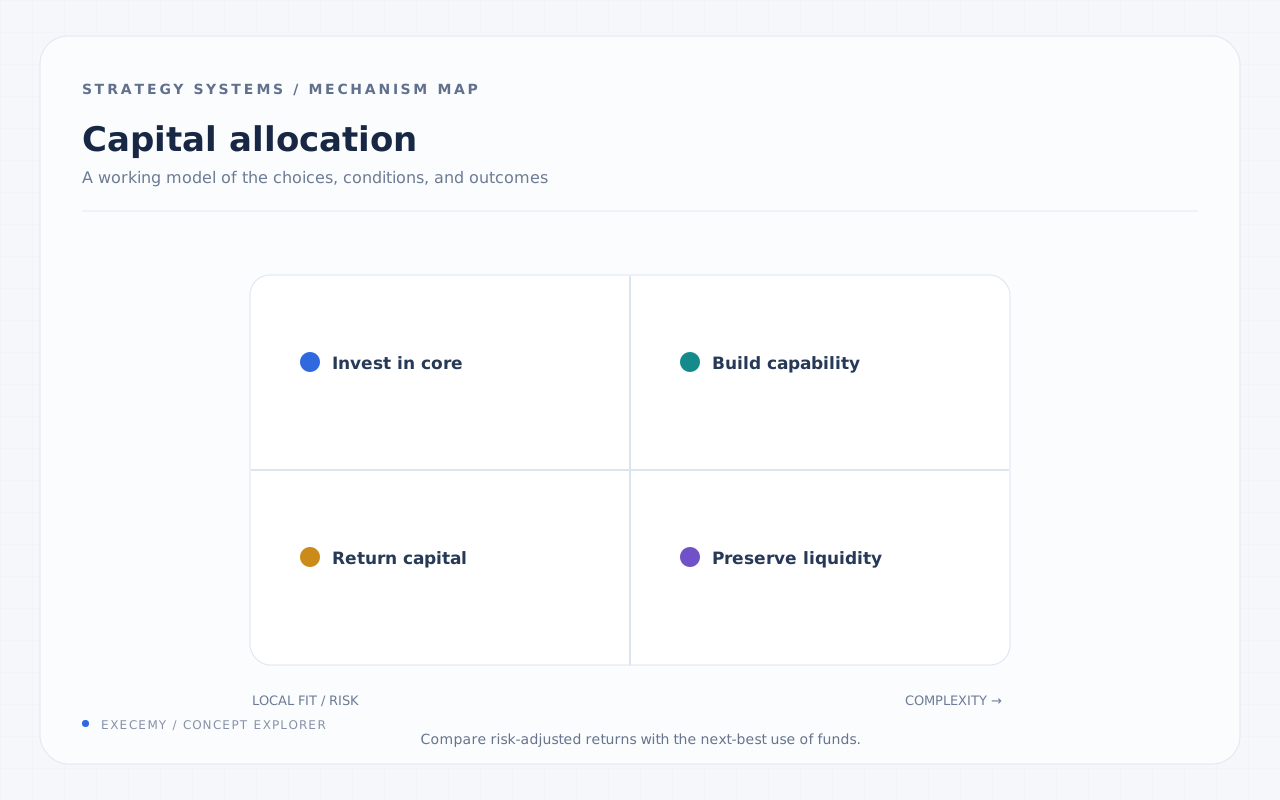
Fund the best next use of capital.
Capital allocation is a portfolio of choices about the company’s money and financing capacity. Managers can reinvest in existing operations, build new capacity, develop products, acquire a business, reduce debt, hold liquidity, or return capital through dividends and repurchases. The right mix depends on expected incremental cash flows, risk, timing, strategic fit, and the company’s ability to execute.
Capital allocation is the process of choosing how a company deploys financial resources among operations, investment, acquisitions, debt, reserves, and shareholder distributions.
Compare incremental cash flows on aligned dates, with project-specific risks stated explicitly. An unlevered operating valuation includes taxes, working capital, capital maintenance and incremental investment, and discounts at a compatible cost of capital without also subtracting interest from those flows. An equity valuation instead uses cash flows after debt effects and a compatible required equity return. Mixing the two can charge financing twice. Learning and resilience require identifiable decision consequences, not invented values.
Capital allocation is not a single executive’s spreadsheet. It includes governance, incentives, decision rights, and the ability to stop projects. A highly centralized firm may direct capital consistently but become dependent on a few decision makers; decentralization can put decisions close to customers while fragmenting the portfolio. The process should clarify who proposes, evaluates, approves, and reviews each use.
Common uses of capital
Compare investment inside the business with financing and return alternatives.
 Reinvestment
Fund product, capacity, technology, people, or maintenance that improves future operating cash flow.
01
Fund product, capacity, technology, people, or maintenance that improves future operating cash flow.
Fund product, capacity, technology, people, or maintenance that improves future operating cash flow. Acquisition or partnership
Buy or access capabilities, customers, technology, or markets, including integration and risk costs.
02
Buy or access capabilities, customers, technology, or markets, including integration and risk costs.
 Balance sheet and returns
Reduce debt, hold liquidity, pay dividends, or repurchase shares when those uses compare favorably.
03
Reduce debt, hold liquidity, pay dividends, or repurchase shares when those uses compare favorably.
A continuum, not a switch
Capital allocation improves when alternatives use consistent assumptions, decisions have accountable owners, and realized results inform the next funding choice.
“Every funded project competes with another use of the same capital.”
Why it matters
Companies can grow revenue and destroy value if they invest below the return required for risk. Conversely, a mature firm may create value by returning cash when attractive projects are scarce, while retaining enough liquidity for resilience. Track incremental return on invested capital, cash conversion, and progress against the case that justified the expenditure.
Amazon’s 1997 shareholder letter describes long-term customer and market-leadership priorities, analytical assessment of programs and readiness to discontinue investments that do not provide acceptable returns. It also describes a willingness to make bold choices with uncertain results. This documents a stated allocation policy, not a project-level valuation or proof that every commitment was justified.
A scarce-resource decision needs the best feasible alternative, including leaving capacity uncommitted when that preserves a valuable later choice. Include the cash required through the downside, obligations that cannot be reversed and who has authority to change course. A high corporate average return cannot value the next project or justify a funding gap.
Real-world examples
The same concept shows up in different ways across industries.

When it breaks
A return-on-investment estimate can look precise while relying on optimistic demand, synergy, terminal value, or integration assumptions. Separate base and downside cases, identify the assumptions that drive most of the value, and stage commitments when learning can reduce uncertainty. Track realized results against the original case rather than rewriting the hurdle afterward.
Capital can flow toward projects that improve a manager’s status, preserve a legacy, or meet a short-term metric. A business may also underinvest in maintenance because benefits accrue beyond the current planning cycle. Independent challenge, clear owner accountability, and post-investment reviews help expose these distortions. Do not treat debt reduction, cash reserves, or dividends as automatically inferior to growth.
Key takeaways
- 01
What is the next-best use of this capital, and what incremental cash flow or strategic capability distinguishes the proposal?
- 02
Which assumptions drive the return, and what evidence or milestone would cause the company to stop or change course?
- 03
How much liquidity and financial flexibility should remain after the decision, including under the downside case?
- 04
Keep operating and equity valuation perimeters consistent so financing is not counted twice.
Related concepts
See all → Capital intensityCapital required for each unit of activity.
 Mergers and acquisitionsThe deal is the start of the work.
 Opportunity costEvery commitment closes another available path.
 Scenario planningPrepare for several plausible worlds, not one forecast.
 Sunk cost fallacyPast cost explains history; it cannot improve the next decision.
Related cases
See all →Sources
- Economic Value Added · Aswath Damodaran, NYU Stern School of Business. Opening equation; Calculating EVA, paragraphs on invested capital, after-tax operating income, and market-value cost-of-capital weights; Economic Value Added and Firm Value, assumptions about future investments.
- Amazon's original 1997 letter to shareholders · Amazon.com, Inc. / About Amazon; reprinted from 1997 Annual Report. Opening 1997 milestones; investment approach bullets on customer focus, long-term leadership, measurement, cash flows, losses, and stated limitations