Concept · Decision-making
Sunk cost fallacy
Judge the next commitment by its future costs and benefits, not by what has already been spent
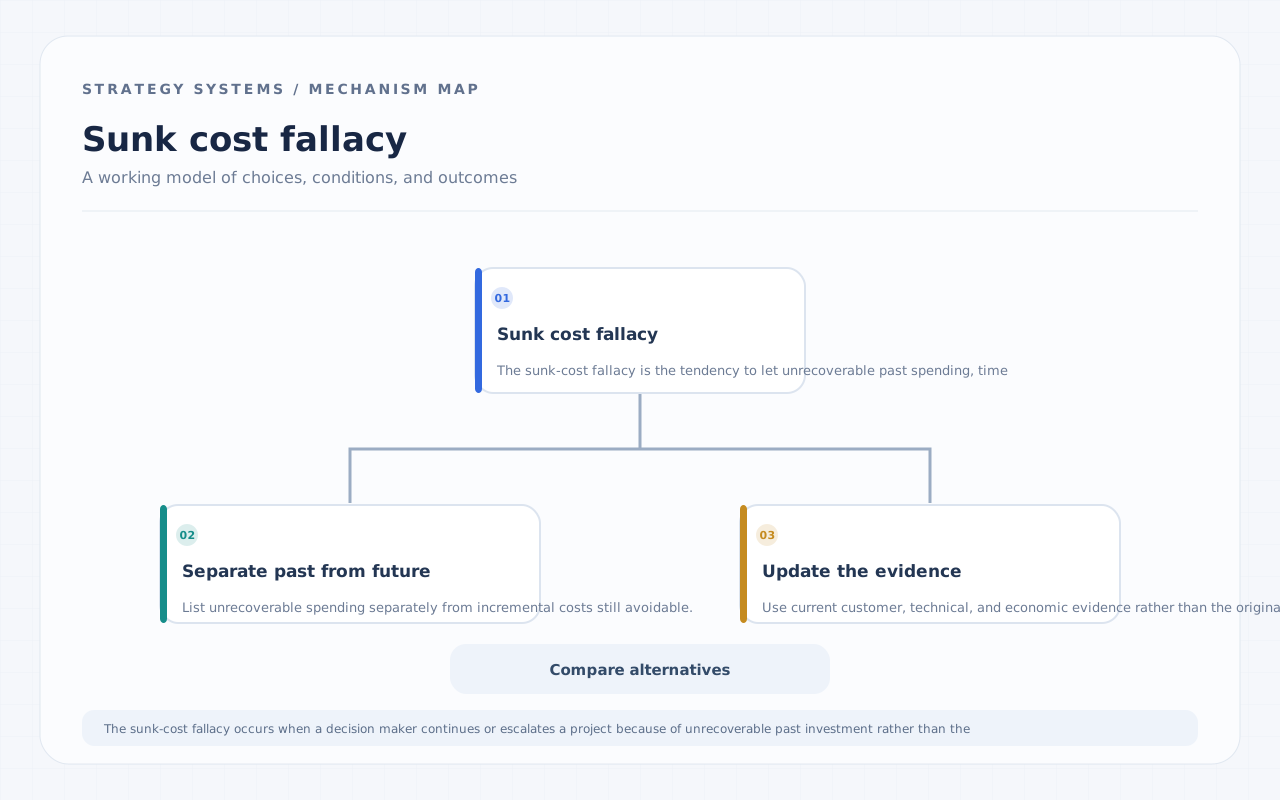
Past cost explains history; it cannot improve the next decision.
A sunk cost is a cost already incurred that cannot be recovered by the current choice. The rational comparison for a forward-looking decision is between the incremental future costs and benefits of continuing, changing, or stopping. Past spending can still provide evidence about what was learned or the condition of an asset, but the mere fact that the company spent money or effort does not make another dollar more valuable.
The sunk-cost fallacy occurs when a decision maker continues or escalates a project because of unrecoverable past investment rather than the expected future value of available choices.
Continuing after prior investment is not enough to diagnose sunk-cost pressure. A forward-looking choice may still be attractive because of learning, usable assets, transition obligations or customer commitments. Separate evidence about future consequences from the desire to vindicate a past decision. The unrecoverable amount is not a benefit of spending more; the current state it helped create can still affect the available choices.
Use a continuation memo that starts with the current state and future choices: what further spending is required, what evidence has changed, what alternative uses exist for people and capital, and what outcome would justify stopping? The decision may still be to continue if future expected value is positive. The goal is to choose on prospective value, not to stop automatically whenever a project has a loss.
A forward-looking review
Make the current decision independent of an attempt to justify earlier commitment.
 Separate past from future
List unrecoverable spending separately from incremental costs still avoidable.
01
List unrecoverable spending separately from incremental costs still avoidable.
List unrecoverable spending separately from incremental costs still avoidable. Update the evidence
Use current customer, technical, and economic evidence rather than the original forecast.
02
Use current customer, technical, and economic evidence rather than the original forecast.
 Compare alternatives
Evaluate continuation, redesign, sale, pause, and stop against the same future horizon.
03
Evaluate continuation, redesign, sale, pause, and stop against the same future horizon.
A continuum, not a switch
A sound review recognizes history as evidence where relevant but compares only consequences that the next decision can still change.
“Keep the ledger of the future separate from the ledger of what is already gone.”
Why it matters
Large projects create pressure to keep spending because stopping makes a loss visible and may challenge the judgment of sponsors. A regular independent review can surface changed assumptions earlier, protect scarce resources, and preserve trust when leadership explains a stop decision with evidence. Explicit stop rules are easier to apply when agreed before the results arrive.
Google announced in 2022 that it would wind down the Stadia consumer service after it had not gained the traction expected, while identifying possible future uses for parts of the underlying technology. The company described refunds and transition details as well. This is an example of stopping one use while preserving other options; it does not prove that earlier investments were irrational or that sunk-cost bias was absent.
Cancellation does not erase every future obligation. Include refunds, support, shutdown and redeployment that differ across choices, and include salvage or alternate use of an existing asset. Those amounts are prospective because the decision changes them. A common past expenditure can be omitted from both alternatives without ignoring learning or treating exit as free.
Real-world examples
The same concept shows up in different ways across industries.

When it breaks
The phrase can be misused to dismiss legitimate transition costs, contractual commitments, learning, or strategic dependencies. A future cost remains relevant if the company can still avoid or change it. A past asset may have salvage value, and past research may update the probability of success. Include these forward-looking consequences rather than treating all history as irrelevant.
Stopping is not automatically superior. A project with low current value may still create valuable options, meet legal duties, or support a profitable adjacent product. Compare the best available alternatives using consistent time horizons, include shutdown and customer-transition costs, and make uncertainty visible. A review should change decisions when facts change, not serve as a ritual designed to justify the original sponsor.
Apply the same comparison to a project that looks successful. Past acclaim can protect an obsolete activity just as past losses can motivate escalation. State the current feasible alternative and evidence that would alter continuation; public announcements about stopping cannot reveal whether an internal review was free of bias.
Key takeaways
- 01
Which costs are truly unrecoverable, and which future costs can still be avoided?
- 02
What do current evidence and updated assumptions imply about continuing, changing, or stopping?
- 03
What alternative use of capital, talent, assets, or customer trust is available from today forward?
Related concepts
See all → Capital allocationFund the best next use of capital.
 Decision treesMake uncertainty visible before choosing.
 Exploration versus exploitationFund discovery and make the current system better.
 Break-even analysisFind the volume that covers the cost base.
 Strategic diagnosisFind the constraint that makes the situation hard.
Sources
- 14.01 Principles of Microeconomics — Full Lecture Summaries, Fall 2023 · MIT OpenCourseWare. PDF index 0, opportunity cost and demand; index 2, preferences and budget constraints; index 6, elasticity and demand shifts; index 11, fixed/variable costs.
- A message about Stadia and our long term streaming strategy, September 29 2022 · Google. Consumer wind-down and lower-than-expected traction paragraphs; refunds, prospective uses of underlying technology and staff redeployment paragraphs.