Concept · Strategy
Exploration versus exploitation
Balance learning about new possibilities with improving the capabilities that already work
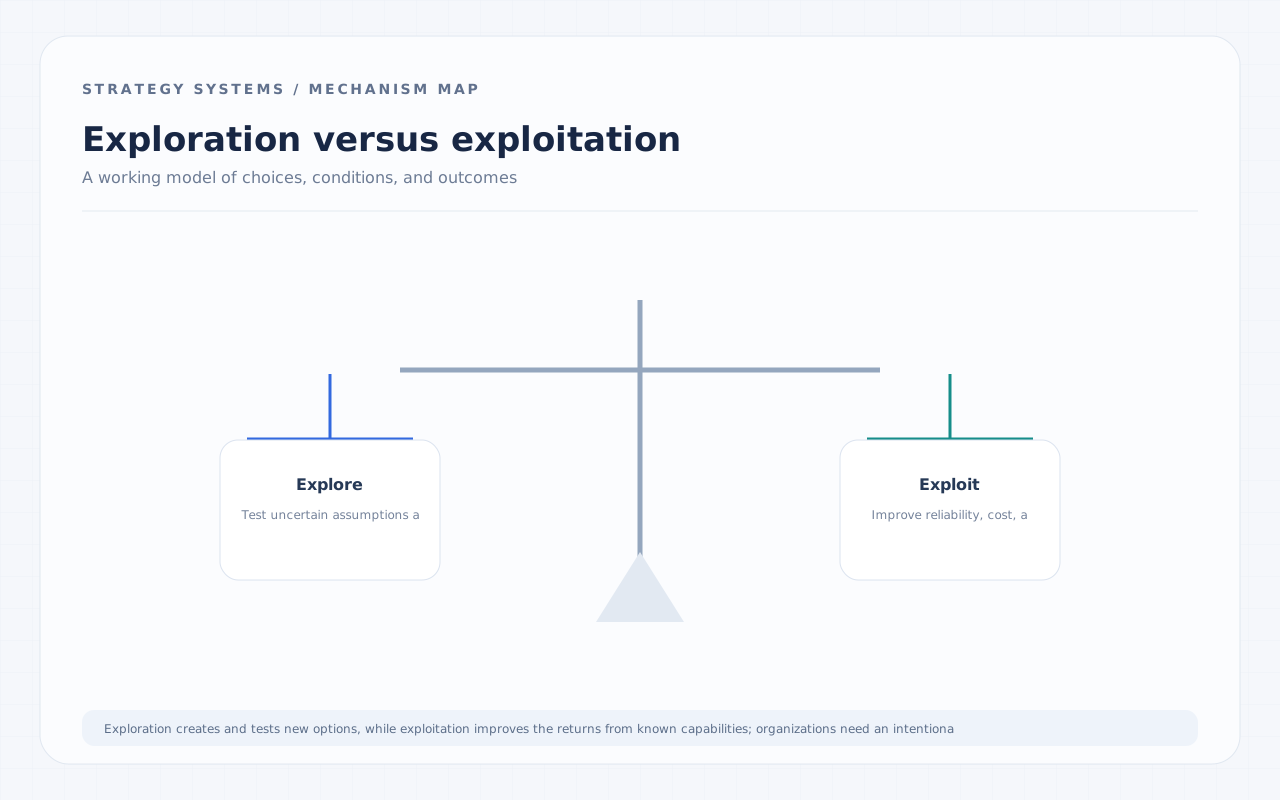
Fund discovery and make the current system better.
Exploration searches uncertain possibilities; exploitation refines and uses established knowledge. Both consume resources and can contribute to the business. Their balance depends on what must be learned, what already works and how long the firm can fund the work.
Exploration creates and tests new options, while exploitation improves the returns from known capabilities; organizations need an intentional balance across resources and time.
The decision is which uncertainty to reduce while preserving reliable current delivery. An exploratory project should name a question whose answer can change a commitment. An operating improvement should identify the known task and the change in reliability or cost it seeks.
The activities can inform each other. A new experiment can expose a weakness in current operations, while a deployed process produces information for another test. Distinct purposes need suitable evidence rather than a universal budget ratio.
Two kinds of work
Label the learning mode before choosing the governance and measures.
 Explore
Test uncertain assumptions and search for a new customer, product, or capability.
01
Test uncertain assumptions and search for a new customer, product, or capability.
Test uncertain assumptions and search for a new customer, product, or capability. Exploit
Improve reliability, cost, adoption, and return from a proven offer or method.
02
Improve reliability, cost, adoption, and return from a proven offer or method.
 Rebalance
Use evidence and strategic time horizons to shift resources as uncertainty falls.
03
Use evidence and strategic time horizons to shift resources as uncertainty falls.
A continuum, not a switch
Exploration and exploitation are complementary work modes. Their balance should reflect uncertainty, cash, competitive pace, and the time required to learn and scale.
“What works now can crowd out the learning needed for what comes next.”
Why it matters
March’s publisher abstract addresses allocation between new possibilities and existing knowledge. The complete model remains unverified here, so no simulation or optimal allocation is imported. The edition uses the distinction to frame concrete work choices.
Exploratory work can look inefficient under current-product targets because its output is evidence. It can also become an excuse to avoid a meaningful test. Define what would redirect, continue or stop the work and which operating capability is needed if the answer is favorable.
Near-term demand and resource constraints can justify exploitation without proving exploration is unimportant. Conversely, attractive novelty can distract from delivery failures. Evaluate timing and opportunity cost in the particular business rather than assume a fixed balance is best.
Real-world examples
The same concept shows up in different ways across industries.

Netflix’s artwork account describes controlled exploration with recorded selection probabilities, offline evaluation and a later online comparison. The actual technical design tries alternatives while retaining the information needed to interpret the resulting observations. It addresses a conflict between selecting what currently appears attractive and collecting evidence about choices the current policy seldom shows. A policy that always repeats its apparent winner can create a biased record of exposure. Exploration changes that record but may also displace a choice expected to work. The account’s quality-engagement target further distinguishes immediate attraction from satisfactory viewing. Its reported improvement and rollout do not establish an optimal organization-wide budget or a universal amount of exploration. The manager’s decision is what uncertainty matters, what exposure can address it and what cost or guardrail bounds the attempt. Exploitation can then use a better-supported choice; exploration still needs a path into a decision. Treat both as specified work rather than equating experimentation with learning or routine execution with stagnation.

Toyota’s announcement combines existing powertrain improvement with next-generation BEV plans and a proposed specialized unit. The record documents intended parallel work. It does not show the actual allocation or whether leadership resolved every resource conflict.
When it breaks
A hypothetical project remains labeled exploratory while testing no assumption that can change the next decision. Novel work can consume resources without producing learning. Clarify the question and exit condition before protecting the label.
An experiment can succeed under conditions the core cannot support. Learning and rollout require separate decisions. A useful result should be translated into the capabilities, responsibilities and economics needed for wider delivery.
Key takeaways
- 01
Which initiatives refine known economics, and which reduce uncertainty about a new opportunity?
- 02
Are short-term evaluation rules causing uncertain but important learning to be abandoned too early?
- 03
What result will graduate, redirect, or stop each experiment, and who can move resources when evidence changes?
Related concepts
See all → Organizational ambidexterityDesign the connection between delivery and discovery.
 Dynamic capabilitiesNotice change, commit, and reorganize to act.
 Open innovationUseful ideas can cross the firm’s boundary in both directions.
 Real optionsMake the later choice feasible before valuing it.
 Capital allocationFund the best next use of capital.
Related cases
See all →Sources
- Exploration and Exploitation in Organizational Learning · James March; Organization Science / INFORMS. February 1991 publisher indexed abstract: allocation between new possibilities and existing knowledge
- Artwork Personalization · Netflix TechBlog. Contextual bandit approach, model training and performance evaluation, December 2017
- New Management Policy & Direction Announcement · Toyota Global. Hiroki Nakajima: multi-pathway products, proposed specialized unit under empowered leader; Yoichi Miyazaki: regional foundation and future investment