Concept · Organization
Organizational ambidexterity
Protect reliable delivery while developing new options. The management problem is how the work connects, competes for resources and earns the next commitment.
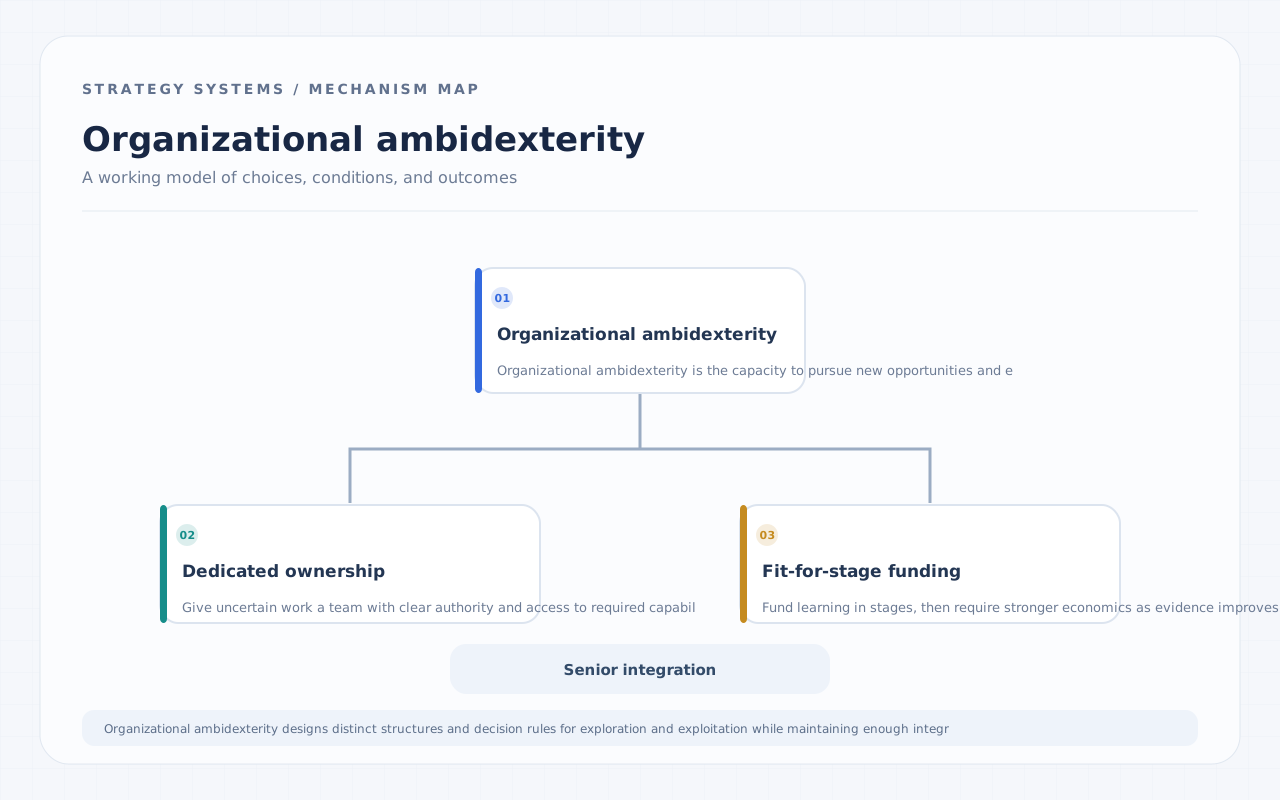
Separate the work. Connect the direction.
Consider a management team maintaining a dependable service while testing a different way to deliver it. Refinement rewards predictable quality, repeatability and efficient use of known methods. Exploration addresses uncertain demand, technical feasibility and a business model that may not yet work. Requiring both efforts to meet the same immediate output target can suppress discovery or weaken current delivery.
Organizational ambidexterity combines exploitation of established activities with exploration of new possibilities while managing their different demands and shared constraints.
Ambidexterity names the organizational ability to pursue both kinds of work. Ando uses the coexistence of exploitation and exploration in a study of workplace interpretations. The paper helps separate the concept from a universal claim that the activities always oppose each other. A positive association in reported activities, however, does not remove the practical cost of allocating a shared engineer, machine or management hour. [Ando, pp. 159–160](https://www.jstage.jst.go.jp/article/abas/20/5/20_0210830a/_pdf)
The decision is a design choice, not a demand for permanent balance. Specify which uncertainty exploration must resolve, which current commitments need protection and what must eventually connect. An isolated innovation team can discover an attractive idea yet lack a path to production. A fully integrated team can have access to customers yet never find time to investigate an uncertain offer.
Ways to arrange the work
These are practical design alternatives to examine, not a ranking established by the workplace survey.
 Separate teams, shared integration decisions
Give exploratory work distinct goals and authority while defining access to shared assets and who decides when the new activity moves into regular delivery.
01
Give exploratory work distinct goals and authority while defining access to shared assets and who decides when the new activity moves into regular delivery.
Give exploratory work distinct goals and authority while defining access to shared assets and who decides when the new activity moves into regular delivery. Both activities within a team
Use explicit priorities and capacity protection where the same people improve current work and test alternatives. Shared context helps transfer knowledge but does not create unlimited time.
02
Use explicit priorities and capacity protection where the same people improve current work and test alternatives. Shared context helps transfer knowledge but does not create unlimited time.
 Sequence the commitments
Stage experiments and operating changes when simultaneous work is impractical. Preserve learning across stages and specify what evidence permits the next commitment.
03
Stage experiments and operating changes when simultaneous work is impractical. Preserve learning across stages and specify what evidence permits the next commitment.
A continuum, not a switch
An ambidextrous design specifies which work shares people and resources, which needs separation, and how evidence changes funding and integration decisions.
“A new unit needs protection from the old metrics and a route to the assets it still needs.”
Why it matters
The mechanism is differentiation plus connection. Exploration needs permission to challenge assumptions and report an unsuccessful test. Current delivery needs clear standards and accountable execution. Shared leadership must resolve customer access, scarce expertise, transfer of learning and conflicts over investment. Separation protects a different learning process; integration determines whether the learning can become an operating capability.
Ando surveyed 1,650 full-time white-collar employees in the Tokyo metropolitan region in November 2020. The survey combined individual and workplace reports and classified respondents by exploitation and exploration scores. The open-ended office-perception subset contained 1,012 respondents. The study reports an association between the activity classifications and how respondents described the office, not an experiment allocating work or measuring objective productivity. [Ando, method and Tables 1–3, pp. 158–164](https://www.jstage.jst.go.jp/article/abas/20/5/20_0210830a/_pdf)
Among respondents in the open-ended subset, the high-both group mentioned communication at a reported rate of 9.2%, compared with 3.7% for the neither group. The exhibit retains every group and its denominator. Word mentions are a narrow measure of interpretation; they are not a performance gain, a workplace attendance preference or a causal benefit from putting teams together. [Ando, Table 3, p. 164](https://www.jstage.jst.go.jp/article/abas/20/5/20_0210830a/_pdf)
The paper notes that job type and office ambience were not directly questioned, leaving competing explanations for the differences. Data were cross-sectional and self-reported, and the project was funded by Mitsui Fudosan Building Management with additional research support acknowledged. Those facts matter when drawing workplace-policy implications. A stronger design claim would need evidence about the work, constraints and outcomes under alternative arrangements. [Ando, pp. 155, 158 and 165](https://www.jstage.jst.go.jp/article/abas/20/5/20_0210830a/_pdf)
The practical use is to form a testable design hypothesis. If exploration stalls because current output targets consume shared specialists, protect time and assess whether the uncertainty is resolved. If a separate unit cannot deploy discoveries, investigate interfaces and authority. Choose indicators suited to the problem: unresolved assumptions for an experiment, reliable delivery for operations, and transfer quality for integration. These are proposed measures, not invented results.
Real-world examples
The same concept shows up in different ways across industries.

Toyota's management-policy announcement sets out continuing powertrain paths alongside new battery-electric development and an organizational commitment for that work. It presents the design problem of maintaining existing activities while building a different capability. The announcement does not establish that the structure succeeded, that shared-resource conflicts were resolved or that future targets were achieved. Those outcomes require subsequent evidence. [Toyota management-policy announcement](https://global.toyota/en/newsroom/corporate/39013233.html)

Adobe's 2013 filing describes its move toward Creative Cloud subscriptions and the effects of the transition on reported economics and delivery. The choice requires developing a recurring service while managing customers and products tied to the prior model. It illustrates a coupled transition, not proof that an ideal permanent split exists between old and new businesses. Revenue recognition, customer adoption and product changes can affect reported results independently of organizational design. [Adobe fiscal 2013 filing, transition and subscription discussion](https://www.sec.gov/Archives/edgar/data/796343/000079634314000004/adbe10kfy13.htm)
When it breaks
Two budgets do not create ambidexterity. If incentives punish candid experimental failure, exploratory teams may present certainty they have not earned. If operating teams lack resources for existing commitments, experimentation can be blamed for avoidable delivery failures. Specify authority and constraints, not just organizational labels.
The workplace study offers a counterexample to assuming exploitation and exploration are always negatively associated. It does not show that every resource allocation lacks trade-offs. Survey scales partly combine personal and workplace attributes, and improvement-oriented activity can contribute to both. Observed coexistence and a feasible budget allocation are different propositions.
The appropriate arrangement depends on the degree of coupling. A new product relying on the same regulated operations may need careful integration earlier than an independent channel experiment. In an unnumbered hypothetical small organization, creating separate units can duplicate scarce expertise. Shared work with protected time may be more feasible, but that is a design hypothesis to test.
A successful new activity may replace rather than coexist indefinitely with the old one. Keeping a declining business alive solely to demonstrate balance can waste resources. Define transition, scaling and stopping conditions using customer needs, reliability and evidence of the new model. Ambidexterity does not prescribe a fixed allocation or guarantee long-term survival.
Key takeaways
- 01
Define the current commitment and the specific uncertainty that new work must resolve.
- 02
Design different learning conditions with explicit access, integration and resource decisions.
- 03
Distinguish coexistence, survey association and causal performance evidence; revise the arrangement when the work or transition changes.
Related concepts
See all → Exploration versus exploitationFund discovery and make the current system better.
 Dynamic capabilitiesNotice change, commit, and reorganize to act.
 Open innovationUseful ideas can cross the firm’s boundary in both directions.
 Corporate restructuringTrace what moves, stays and must be rebuilt.
 Capital allocationFund the best next use of capital.
Sources
- Fumie Ando: Individual and organizational ambidexterity and interpretations of the workplace · Annals of Business Administrative Science. Method pp. 158–159; Tables 1–3 pp. 160–164; limitations and funding pp. 155, 158 and 165
- New Management Policy & Direction Announcement · Toyota Global. Hiroki Nakajima: multi-pathway products, proposed specialized unit under empowered leader; Yoichi Miyazaki: regional foundation and future investment
- Adobe FY2013 Form 10-K: May 2013 creative-product decision · Adobe / SEC. Item 7, Overview of 2013, printed p. 39, paragraph beginning “In May 2013 we announced”: future creative innovation exclusive to subscribers; CS6 last major perpetual update, with CS6 still offered perpetually.
- Adobe FY2013 Form 10-K: transition explanation · Adobe / SEC. Item 7, Overview of 2013, printed pp. 38–40: Creative Cloud transition; paragraphs on declining perpetual revenue and expenses not declining with revenue; ARR definition and warning; Financial Performance Summary.