Concept · Strategy
Corporate restructuring
Choose a new corporate boundary by tracing the cash, obligations and capabilities that move or remain.
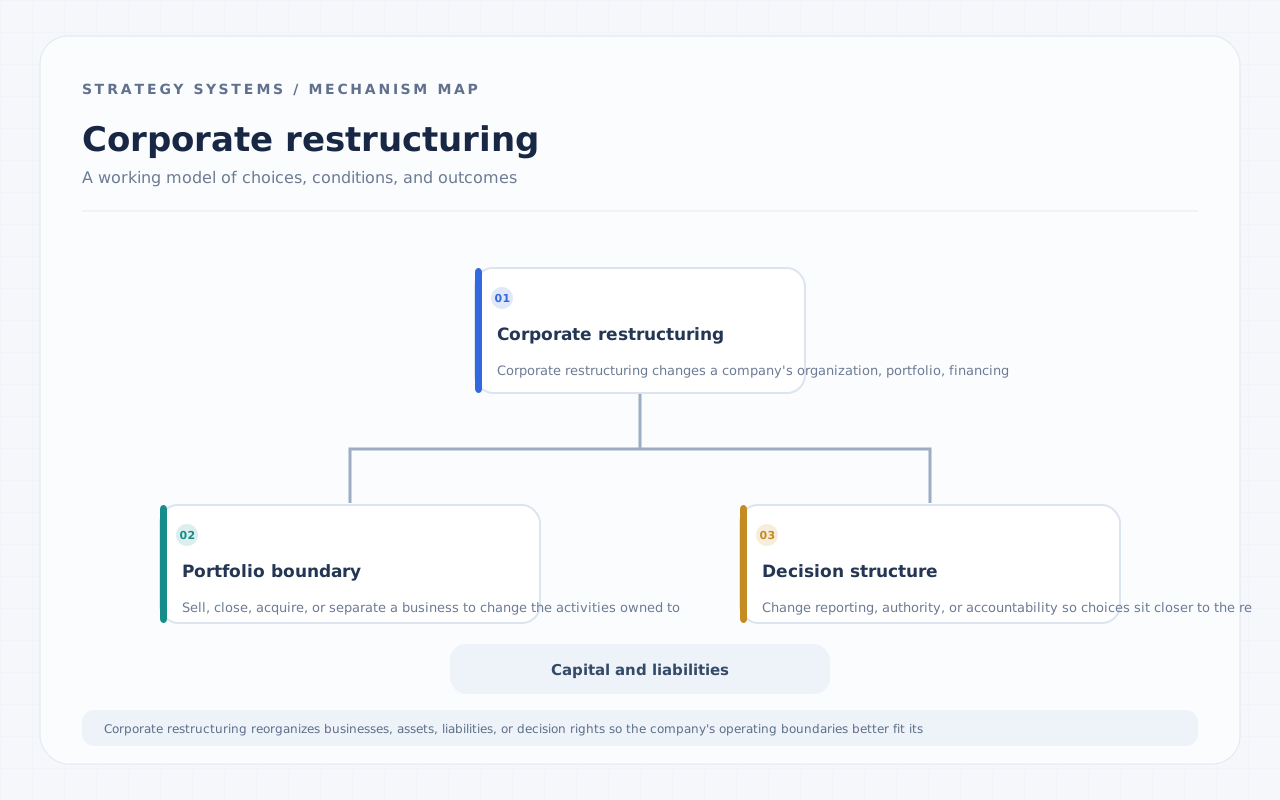
Change the structure to change the work.
A company decides to sell a business, but the seller’s payroll, systems and obligations do not disappear at the closing date. The board approves a smaller portfolio; operations must still make it smaller in practice. Corporate restructuring is useful only if the new boundary changes the constraint the company is trying to solve. An ownership chart is the beginning of that work.
Corporate restructuring changes a company’s boundaries, responsibilities or commitments to address a specific constraint, with benefits tested against transition and recurring consequences.
This article uses restructuring to mean a material change in corporate ownership, operating responsibilities or financial commitments. The intervention might sell control, close a business, separate a division, combine operating units or renegotiate obligations. Start with the diagnosed constraint: insufficient cash, costly duplication, conflicting priorities or an inability to invest. Choosing a transaction before explaining the constraint invites a mismatch between what the company needs and what the transaction can do.
Separate three questions. What changes legally? What changes operationally? What changes economically? Legal ownership can transfer immediately while systems and contracts remain shared. Removing a division can reduce revenue while leaving overhead behind. A debt renegotiation can improve near-term liquidity without fixing weak customer economics. Each question needs its own evidence and time horizon.
Three boundaries must be redesigned
The economic result depends on what actually changes after closing.
 Ownership boundary
Identify control sold, retained interests and contracts that preserve or remove access.
01
Identify control sold, retained interests and contracts that preserve or remove access.
Identify control sold, retained interests and contracts that preserve or remove access. Operating responsibilities
Identify systems, people and overhead that leave, remain or must be duplicated.
02
Identify systems, people and overhead that leave, remain or must be duplicated.
 Capital and obligations
Identify when cash arrives, what one-time costs are paid and which liabilities persist.
03
Identify when cash arrives, what one-time costs are paid and which liabilities persist.
A continuum, not a switch
Legal completion and operating improvement are different milestones. This is a conceptual distinction, not a score.
“A business can leave the portfolio while its costs remain.”
Why it matters
Define the gross recurring cost pool targeted for removal as T. Let S be the part of that existing pool that remains stranded after separation. Actual recurring removal is T−S, not T. Let D be newly duplicated support cost and B a recurring benefit lost with the separation. A simple net-benefit expression is T−S−D−B. This symbolic bridge prevents retained existing cost from being deducted twice from an amount already labeled avoided cost. Estimating the benefit requires evidence about the targeted, retained, duplicated and lost cost amounts.
Let K represent one-time separation cash. A simple undiscounted payback expression is K/(T−S−D−B) only when the denominator is positive and the timing convention fits the decision. A non-positive recurring benefit does not yield a finite payback from that stream. Discounting, tax, proceeds, investment and changing operations require a fuller analysis. Missing actual cost and cash inputs remain missing.
Calling overhead stranded does not make it temporary. Identify the obligation, who can change it, the notice period and the feasible action needed to remove or redeploy it. Legal completion can arrive before operating systems, people and contracts separate. A transaction can release cash while leaving the original operating constraint unresolved.
Compare a separation with targeted cost removal, different decision rights, a partnership or a smaller asset sale. These are analytical alternatives, not claims about options considered by LEGO. If a narrower intervention addresses the constraint with less capability loss and cash cost, a broad separation needs a stronger justification. Urgent liquidity can also make a delayed long-run alternative impractical.
LEGO’s reported earnings bridge is the exhibit. It distinguishes continuing results, discontinuing results and special-item movements using actual signed figures. It does not identify avoided recurring costs, stranded overhead or profit caused by the parks sale. An earnings recovery and a successful ownership redesign are different propositions.
Real-world examples
The same concept shows up in different ways across industries.

When it breaks
A successful transaction is not the same outcome as a successful business redesign. Sale proceeds are a one-time cash event; recurring operating improvement must survive after that event. A company can report a large earnings recovery when impairments or restructuring charges fall, even if underlying operations improve less. Reconcile continuing activities, special items and the discontinued perimeter before interpreting the headline.
Capability loss is the other boundary. A business may share customers, data, engineering or distribution with the core. Removing ownership can require contracts to preserve those connections. A partnership can preserve access while weakening control, and a retained minority interest can preserve exposure without day-to-day authority. Model what the new owner can decide and what the seller can enforce; do not assume the old cooperation will continue because both sides want it today.
Measure the intervention against the diagnosed constraint. For liquidity, examine when cash becomes available and which liabilities persist. For operational focus, examine decision rights, service continuity and the actual cost base. For growth, examine the capacity to invest and serve customers. None can be established by a transaction announcement alone.
The strongest counterexample to a simple “sell the non-core business” rule is a valuable shared capability that disappears with it. The opposite counterexample is a superficially related business that absorbs capital the core needs urgently. The label “related” cannot decide either case. Trace the actual resource connection, then compare it with its cost and the alternatives.
Key takeaways
- 01
Name the resource or coordination constraint before choosing a restructuring.
- 02
Separate one-time proceeds from recurring benefits and stranded costs.
- 03
Compare control, retained exposure and lost capabilities under the new boundary.
Related concepts
See all → DiversificationExpand the portfolio with a reason.
 Strategic diagnosisFind the constraint that makes the situation hard.
Related cases
See all →Sources
- LEGO Group Annual Report 2004 · LEGO Group. PDF index 11 (printed p. 10), strategy/LEGOLAND ownership; PDF index 23 (printed p. 22), Financial report, core focus and planned 2005 disposal; PDF index 40 (printed p. 39), Note 8 Discontinuing activities.
- LEGO Group Annual Report 2005 · LEGO Group. PDF index 2, Financial Highlights (2005 and adjusted 2004 columns); PDF index 8 (printed p. 7), Revenue and profit; PDF index 26 (printed p. 25), Financial report, total and continuing/discontinuing pre-tax results; PDF index 54 (printed p. 53), Note 23 Related parties, July sale and ownership. PDF index 40 (printed p. 39), Cash Flow Statement: Group 2005/2004 pre-tax discontinuing activities 246/(451); also PDF index 45 (printed p. 44), Note 7.