Concept · Strategy
Diversification
Expand into additional products, markets, or businesses and test whether the whole is worth more
Expand the portfolio with a reason.
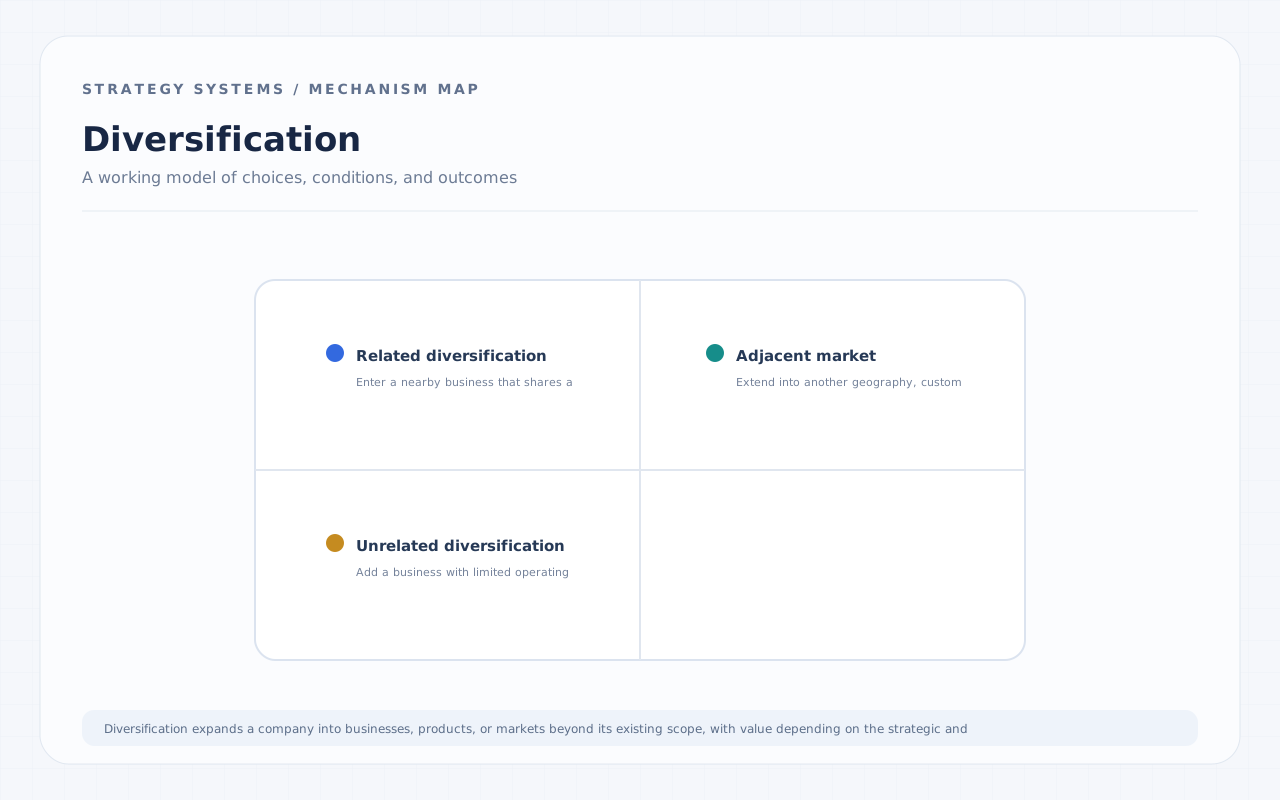
Diversification moves a company into additional product-market territory or business activities. Related diversification shares customers, technology, capabilities, distribution, or operating knowledge with the core. Unrelated diversification enters businesses with fewer direct operational links and relies more on capital allocation, governance, or portfolio balance to create value. The label depends on the unit of analysis: a new use case may be market development for one product and a new business for another.
Diversification expands a company into businesses, products, or markets beyond its existing scope, with value depending on the strategic and economic connection between them.
Potential reasons include finding new growth, reusing an underused capability, accessing complementary assets, reducing dependence on one source of demand, or creating economies across businesses. Each rationale needs a test. Shared overhead is not synergy unless it reduces total cost without harming performance; cross-selling is not value until customers buy and remain; a lower volatility portfolio does not guarantee higher enterprise value.
Diversification adds capital, talent and coordination demands. Investors can spread financial exposure without operating each business. A parent therefore needs an ownership comparison: what can its governance, capability sharing or resource allocation improve, at what cost, relative to independent operation or another feasible owner? Lower demand correlation is different from operating synergy.
Kinds of portfolio expansion
Identify which capabilities transfer and which must be learned; product or customer distance alone does not measure that requirement.
 Related diversification
Enter a nearby business that shares a customer, capability, technology, channel, or supply base.
01
Enter a nearby business that shares a customer, capability, technology, channel, or supply base.
Enter a nearby business that shares a customer, capability, technology, channel, or supply base. Adjacent market
Extend into another geography, customer group, or use while reusing parts of the current offer.
02
Extend into another geography, customer group, or use while reusing parts of the current offer.
 Unrelated diversification
Add a business with limited operating links, relying on portfolio judgment and corporate governance.
03
Add a business with limited operating links, relying on portfolio judgment and corporate governance.
A continuum, not a switch
Diversification expands the company boundary. Its value depends on a real parenting or portfolio benefit that exceeds added capital, coordination, and governance costs.
“A broader portfolio is not automatically a better business.”
Why it matters
The decision should compare the standalone value of the target business with the value of ownership inside the parent. Include purchase price or build cost, integration, capital needs, shared costs, and the possibility that the new unit competes for resources with the core. A clear exit rule prevents a portfolio rationale from protecting a business indefinitely after its assumptions fail.
General Electric separated GE HealthCare in 2023 and GE Vernova in 2024, leaving GE Aerospace as a focused public company. GE described the plan as creating three independent companies; the separations involved transition agreements and continuing commercial ties. The example shows portfolio scope changing through divestiture rather than acquisition and illustrates that separation itself creates dependencies and costs.
GE’s separation agreements provide contrary evidence to a simple shared-services ownership story. Reciprocal transition services, systems access and facilities can continue under contracts after scope changes. That does not show contracts are always cheaper, but it establishes an alternative mechanism the ownership case must compare.
Real-world examples
The same concept shows up in different ways across industries.

When it breaks
A company may mistake low correlation for synergy or assume that cash from one business can smoothly support another. Different cycles, regulation, talent markets, and capital intensity can make oversight harder. If central leadership cannot improve the operating units or allocate resources better than shareholders could, the parent may impose a conglomerate discount in attention as well as valuation.
Related businesses can still be a poor fit if the shared capability is weak or customers see no benefit. Unrelated businesses can work under a capable holding-company model, but performance depends on governance, capital discipline, and leadership succession. Identify what the parent uniquely contributes and measure that contribution separately from the results of the underlying businesses.
Specify the transferable resource and its opportunity cost. A broadly similar customer or technology label can conceal different buyers, regulation and operating requirements. Expansion should not be credited with a risk benefit while correlated funding, geography or inputs remain unexamined.
Key takeaways
- 01
What is new in the portfolio, and which customers, capabilities, channels, or cash flows connect it to the current business?
- 02
What advantage can the parent provide that an independent owner or investor could not provide as well?
- 03
What capital, management attention, and exit cost does the move require, and what evidence would justify continuing?
Related concepts
See all → Corporate restructuring
Related cases
See all →Sources
- Corporate Strategy · Institute for Strategy and Competitiveness, Harvard Business School. Opening Corporate Strategy and Creating Corporate Value Added; Disney activity sharing and weaker interrelationships in acquisitions/start-ups.
- GE Aerospace 2024 Form 10-K · General Electric Company / SEC. Printed p. 48, Note 2 Discontinued Operations, GE Vernova separation, continuing involvement and post-separation sales/cash paragraph.
- Transition Services Agreement, April 1 2024 · General Electric Company and GE Vernova / SEC. Preamble and Recital B: reciprocal transitional services, access to systems, use of facilities and assistance; Article II §2.01.