Framework · Strategy
Real options
Staging creates value only when the information and the later choice are usable.

Stage commitment so information can change the next move.
A project sponsor wants to spend a little now so a larger investment can wait for evidence. That can be rational, but only if the first stage changes a later choice. A pilot that produces a presentation while the full project is already politically committed has no abandonment option in practice. Real-options reasoning begins with a right the organization can actually use.
Real-options reasoning recognizes that future information can change a feasible later commitment, and compares that flexibility with its full cost.
The investment sequence has three parts: a commitment made now, information that may arrive, and a later decision with feasible alternatives. Management may wait, expand, shrink, switch or stop. The initial spending can create a capability as well as information, so distinguish what the pilot delivers from what its decision right is worth. Simply writing “phase two” into a plan does not establish either value.
The underlying idea is that future information can affect decisions taken after that information arrives. MIT’s finance lecture distinguishes identifying a managerial option from valuing it. This article uses a symbolic decision tree and actual programme funding records. It supplies no invented probabilities, payoffs or valuation. [Finance Theory II, Real Options, PDF indexes 19–20](https://ocw.mit.edu/courses/15-402-finance-theory-ii-spring-2003/08859528c9762f0b55cc78d7e9d3b3ca_lec19brealoptions.pdf).
Identify the later choice
Each form needs informative evidence and a feasible action.
 Defer or stage
Preserve a later commitment until informative evidence arrives; count the cost of delay.
01
Preserve a later commitment until informative evidence arrives; count the cost of delay.
Preserve a later commitment until informative evidence arrives; count the cost of delay. Expand or switch
Keep a feasible alternative capacity, product or input choice whose use can change after learning.
02
Keep a feasible alternative capacity, product or input choice whose use can change after learning.
 Contract or abandon
Ensure authority and contracts allow stopping; count exit costs and remaining obligations.
03
Ensure authority and contracts allow stopping; count exit costs and remaining obligations.
A continuum, not a switch
This is a conceptual distinction between a schedule and a decision right, not a numeric value or project rating.
“A stage gate matters only if evidence can change the next action.”
Why it matters
Let K be a commitment cost and V(s) the project value in state s, measured on the same present-value date. Immediate commitment compares expected V(s)−K with the other feasible actions. A stage that produces a signal z lets the decision maker choose an action after observing that signal. Its value depends on the actions and information actually available. Valuing the choice requires evidence about the states, their probabilities, project values and commitment costs.
A symbolic staged comparison is expected best feasible net payoff conditional on z, less the cost of obtaining the signal and any delay, duplicated work or exit cost not already counted in that payoff. Count each cost once. If the tree already includes the choice to stop or continue, do not add another unsupported option premium. The symbolic expression cannot be evaluated without evidence about signals, states, payoffs, timing and authority.
Flexibility can exist without making staging worthwhile. Waiting may lose customers, capacity or an investment opportunity; a pilot may require assets that cannot be reused. A contract may continue to impose payments after the operational work stops. Compare these consequences with the commitment that learning could avoid. No claim about the typical success rate or monetary benefit of pilots follows from the framework.
Information is rarely perfect. A signal can be noisy, biased or too narrow to predict scale. Identify how evidence changes the action and whether the organization can obtain it in time. If signal reliability or feasible alternatives are unknown, state the research needed instead of presenting a precise valuation.
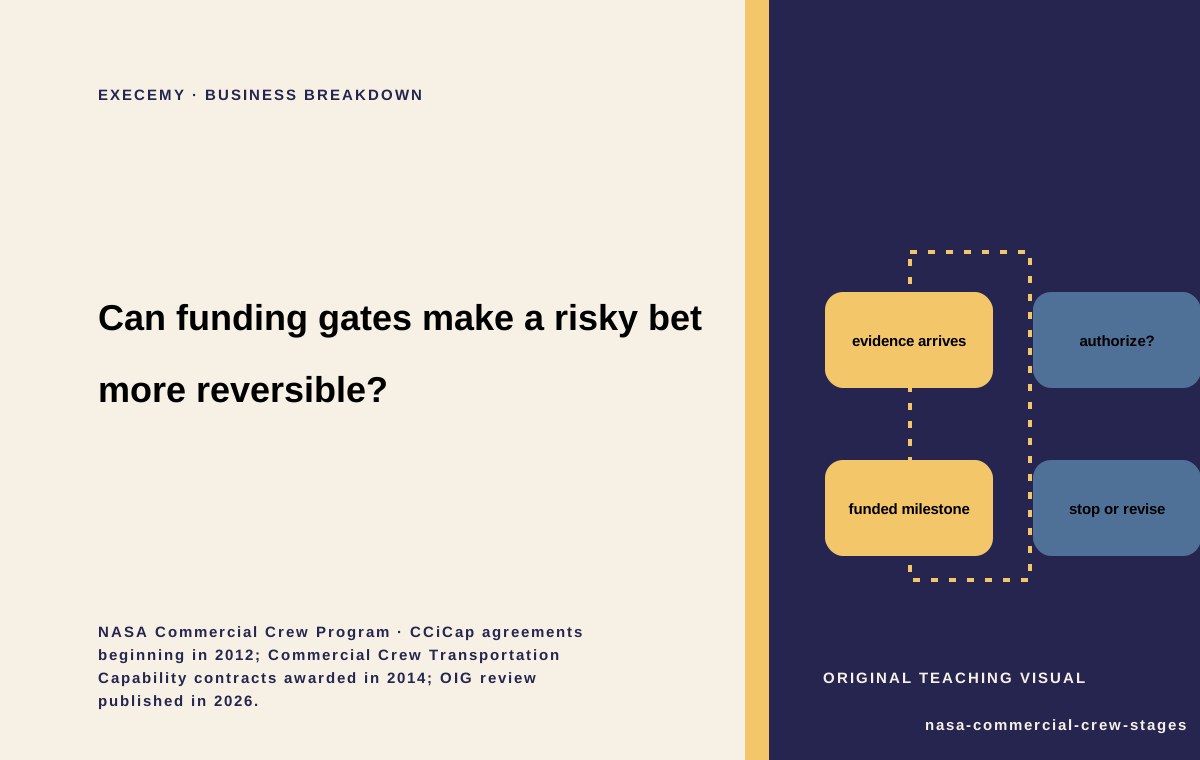
NASA’s actual CCiCap funding amounts and later optional increments form the reported-data exhibit. They document a funded choice within a specific programme phase. They are agreement amounts, not measured option value, actual spending or a full project return. Later certification contracts and oversight findings answer different questions.
Real-world examples
The same concept shows up in different ways across industries.
When it breaks
The right must remain usable. A contractual exit can be undermined by a supply dependency, a shortage of alternatives, a regulatory obligation or a mission that cannot be abandoned. Budget authorization for the pilot does not guarantee follow-on funding. A stage gate should specify who can decide, what evidence they need and which alternative is actually available.
The paired [NASA case](/en/breakdowns/nasa-commercial-crew-stages) offers a concrete caution. NASA exercised optional milestones during capability development, but the June 2026 OIG release also reports failures to exercise limited simulator-data access rights. A formal right did not automatically become useful information. The source does not establish that using that right would have prevented the later technical difficulties. [OIG release, oversight findings](https://oig.nasa.gov/news/nasas-commercial-crew-program-faces-schedule-delays-cost-increases-and-safety-challenges/).
Do not equate risk reduction with value creation. A pilot can reduce uncertainty about a weak project and appropriately lead to stopping. It can also cost more than the avoided mistake. Compare staging with immediate action, a smaller permanent scope and declining the project entirely. Use the same objective and valuation date in each path.
Avoid importing financial-option assumptions without checking their fit. A non-traded project may lack a replicating asset, stable volatility or a price process resembling a security. A transparent decision tree can be more informative for management than a precise-looking option price whose probabilities and market analogues are unsupported.
Key takeaways
- 01
Name the later decision and the evidence that could change it.
- 02
Value the conditional action inside the tree rather than adding an unsupported premium.
- 03
Subtract pilot, delay and exit costs; check that decision and information rights can be used.
Related concepts
See all → Opportunity cost
Related cases
See all →Sources
- Finance Theory II, Lecture 19: Real Options, Spring 2003 · MIT OpenCourseWare. PDF index 2, conditions for real options; indexes 19–20, taxonomy and “Is There An Option?”; index 15, distinction between static and dynamic commitment in decision trees.
- Commercial Crew Program — Essentials · NASA. Heading Commercial Crew Integrated Capability (CCiCap): August 2012 three initial funded agreements and paragraph on optional pre-negotiated milestones; heading Supporting NASA’s Mission Needs through Contracts.
- NASA’s Commercial Crew Program Faces Schedule Delays, Cost Increases, and Safety Challenges · NASA Office of Inspector General. June 30, 2026 release; paragraphs 2–7 below video: original awards, amended values above $8bn, extra resources, provider certification divergence, unrealistic schedules and simulator-data rights.