Open visual reader →
Why outsource the making of your main product?
A fabless company avoids owning fabrication plants, but it still carries the hard work of design, qualification, forecasting, supplier capacity, and delivery coordination.
Explore NVIDIA →
The question
Why outsource the making of your main product?
NVIDIA's disclosed fabless contracting manufacturing strategy, supplier network, and manufacturing-capacity risks · FY2024, year ended 28 January 2024. NVIDIA describes a fabless and contracting model. Its suppliers handle wafer fabrication, assembly, testing, and packaging while NVIDIA concentrates resources on product design, quality assurance, marketing, and customer support. A fabless company avoids owning fabrication plants, but it still carries the hard work of design, qualification, forecasting, supplier capacity, and delivery coordination. NVIDIA's disclosed fabless contracting manufacturing strategy, supplier network, and manufacturing-capacity risks FY2024, year ended 28 January 2024
- NVIDIA Corporation FY2024 Form 10-K — Printed pp. 7–8 developer programs and Manufacturing; pp. 15–16 Risks Related to Demand, Supply and Manufacturing, supply not guaranteed and forecasting/commitment risks.
Mechanism 1 · The chip company does not need to own every factory
The chip company does not need to own every factory.
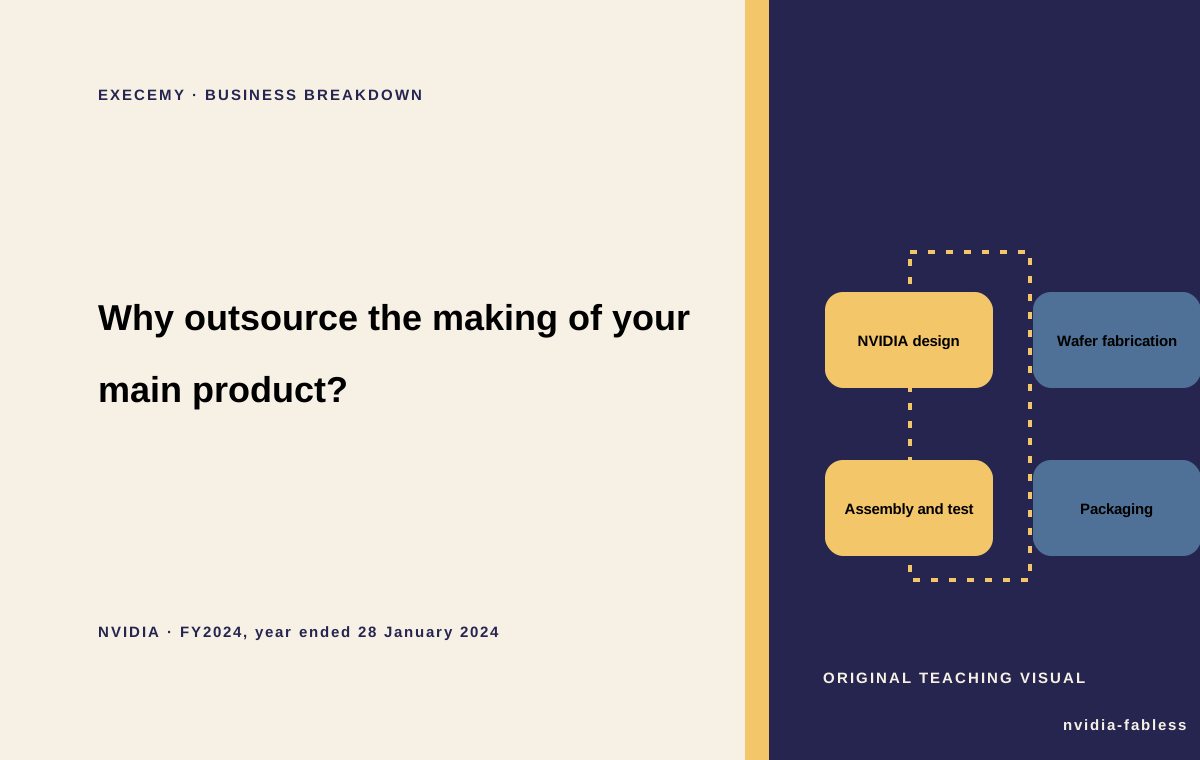
NVIDIA describes a fabless and contracting model. Its suppliers handle wafer fabrication, assembly, testing, and packaging while NVIDIA concentrates resources on product design, quality assurance, marketing, and customer support.
- NVIDIA Corporation FY2024 Form 10-K — Printed pp. 7–8 developer programs and Manufacturing; pp. 15–16 Risks Related to Demand, Supply and Manufacturing, supply not guaranteed and forecasting/commitment risks.
Mechanism 1 · The chip company does not need to own every factory
Avoiding plant ownership changes the capital burden.
NVIDIA says its model avoids many costs and risks of owning manufacturing operations. That leaves the company with different commitments: product investment, supplier coordination, orders, deposits, and the need to secure enough future capacity.
- NVIDIA Corporation FY2024 Form 10-K — Printed pp. 7–8 developer programs and Manufacturing; pp. 15–16 Risks Related to Demand, Supply and Manufacturing, supply not guaranteed and forecasting/commitment risks.
Mechanism 2 · A supplier map is also a concentration map
A supplier map is also a concentration map.
The FY2024 filing names TSMC and Samsung for wafer production, and says the supply chain is concentrated in Asia-Pacific. NVIDIA also names separate memory and packaging partners. Specialization can bring expertise, while concentration creates exposure the company must manage.
- NVIDIA Corporation FY2024 Form 10-K — Printed pp. 7–8 developer programs and Manufacturing; pp. 15–16 Risks Related to Demand, Supply and Manufacturing, supply not guaranteed and forecasting/commitment risks.
Mechanism 2 · A supplier map is also a concentration map
A design decision can arrive after the supply decision was due.
NVIDIA says it has long manufacturing lead times and no guaranteed wafer or capacity supply. In growth periods it may place non-cancellable orders or pay deposits before demand is fully settled. The option to scale later can come with commitments now.
- NVIDIA Corporation FY2024 Form 10-K — Printed pp. 7–8 developer programs and Manufacturing; pp. 15–16 Risks Related to Demand, Supply and Manufacturing, supply not guaranteed and forecasting/commitment risks.
Mechanism 3 · The production chain is one complement in a larger pro
The production chain is one complement in a larger product system.
NVIDIA describes developer programs and engineering support for software built for its platforms. A product promise therefore depends on more than having a wafer: design, production quality, software support, and customer delivery have to connect. The filing does not quantify the ecosystem's effect on demand or switching costs.
- NVIDIA Corporation FY2024 Form 10-K — Printed pp. 7–8 developer programs and Manufacturing; pp. 15–16 Risks Related to Demand, Supply and Manufacturing, supply not guaranteed and forecasting/commitment risks.
Mechanism 3 · The production chain is one complement in a larger pro
Make-or-buy relocates risk; it does not remove it.
An owned plant would bring fixed investment and operating responsibility. A partner model trades that exposure for supplier dependency, long lead times, capacity uncertainty, and coordination work. The filing provides the partner-side risks, not an estimate that outsourcing is always cheaper or safer.
- NVIDIA Corporation FY2024 Form 10-K — Printed pp. 7–8 developer programs and Manufacturing; pp. 15–16 Risks Related to Demand, Supply and Manufacturing, supply not guaranteed and forecasting/commitment risks.
Optional application · unscored
Compare two ways to secure capacity
A fast-growing hardware company can build a specialized factory or reserve supplier capacity with a deposit before demand is fully known.
Reveal: Compare investment, lead time, supplier concentration, flexibility, quality control, and the cost of being wrong. The answer depends on scale, learning, supply alternatives, and the company's ability to manage the network.
Teaching assumption: Original hypothetical hardware company
Teaching assumption: No factory cost, supplier quote, or forecast provided
The answer
Why outsource the making of your main product?
NVIDIA describes a fabless and contracting model. Its suppliers handle wafer fabrication, assembly, testing, and packaging while NVIDIA concentrates resources on product design, quality assurance, marketing, and customer support. Boundary: fabless production can fit businesses that need specialist manufacturing and can coordinate external capacity. It may be a poor fit if control, qualification access, supply resilience, or demand flexibility matters more than avoided factory ownership. The filing does not compare those alternatives quantitatively. The filing supports the manufacturing model and stated supply risks. It does not value an owned-factory alternative, quantify ecosystem contribution or show a particular supplier award decision. A company-wide model should not be presented as a measured make-or-buy result. The case is bounded to NVIDIA's disclosed fabless contracting manufacturing strategy, supplier network, and manufacturing-capacity risks during FY2024, year ended 28 January 2024.
Sources and limitations
- NVIDIA Corporation FY2024 Form 10-K — NVIDIA / U.S. SEC
Printed pp. 7–8 developer programs and Manufacturing; pp. 15–16 Risks Related to Demand, Supply and Manufacturing, supply not guaranteed and forecasting/commitment risks.
Claims and observations identify the precise uses.
The company describes its developer ecosystem, model, and risk exposure; the filing does not quantify ecosystem contribution or provide a comparable owned-factory scenario or supplier bargaining-power estimate.
Original illustrative scenes are not documentary evidence.
New concepts and cases by email