Open visual reader →
Can funding gates make a risky bet more reversible?
Follow NASA’s documented optional funding decisions and later provider contracts, then test whether formal rights produced useful information.
Explore NASA Commercial Crew Program →
The question
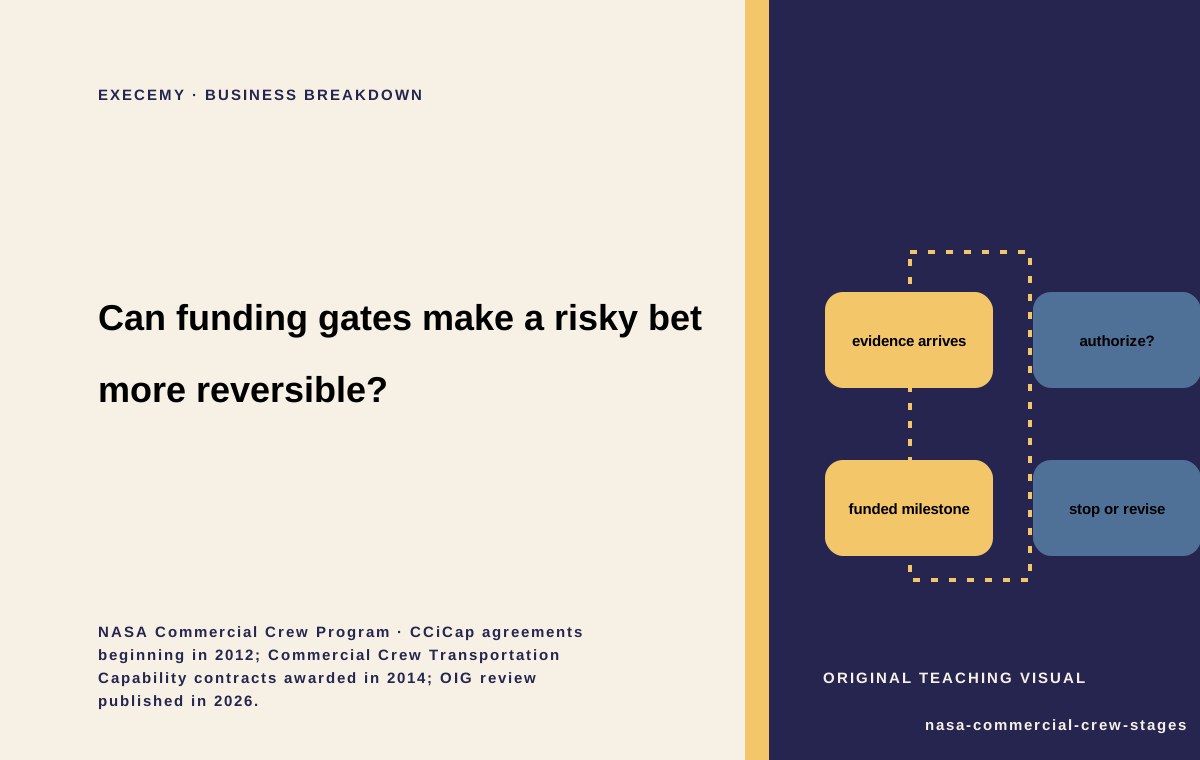
Can funding gates make a risky bet more reversible?
CCiCap optional funding and CCtCap commitments; later oversight boundaries · 2012 capability agreements, 2014 selection and June 2026 oversight release. Staging can make later spending conditional on evidence; the benefit disappears if the evidence does not arrive, is not used, or the organization cannot change course.
Mechanism 1 · NASA exercised optional milestones
NASA exercised optional milestones
NASA did more than label Commercial Crew a phased program. It funded three integrated capability-development agreements in 2012 and later exercised optional, pre-negotiated milestones for Boeing, Sierra Nevada and SpaceX. Those were actual decisions to add commitment at named points in the development structure. NASA’s summary describes the additional work as intended to accelerate development. [Commercial Crew Essentials, CCiCap](https://www.nasa.gov/humans-in-space/commercial-space/commercial-crew-program/commercial-crew-program-essentials/).
- Commercial Crew Program — Essentials — Heading Commercial Crew Integrated Capability (CCiCap): August 2012 three initial funded agreements and paragraph on optional pre-negotiated milestones; heading Supporting NASA’s Mission Needs through Contracts.
Mechanism 1 · NASA exercised optional milestones
A gate needs both a right and evidence
A useful gate joins an action right to evidence. Funding a capability stage can develop hardware and produce information relevant to later certification. Optional milestone funding lets the agency decide whether to add specified work under the existing agreement. The public summary establishes that those milestones were optional and exercised; it does not establish every contractual condition under which NASA could decline them.
Mechanism 2 · Certification contracts changed the boundary
Certification contracts changed the boundary
In September 2014, NASA selected Boeing and SpaceX for FAR-based firm fixed-price CCtCap contracts, with maximum potential values of $4.2 billion and $2.6 billion. The announcement required flight testing and certification before operational missions. This was a new procurement and capability boundary, not merely another installment of the CCiCap amounts in the exhibit. [September 16 announcement](https://www.nasa.gov/news-release/nasa-chooses-american-companies-to-transport-u-s-astronauts-to-international-space-station/).
Mechanism 2 · Certification contracts changed the boundary
Later contract values are not comparable ceilings
The June 2026 OIG release reports amended contract values above $8 billion, excluding substantial additional NASA and company resources. It also reports divergent provider certification status: SpaceX was certified while Boeing was not at that release date. These findings show that milestones and fixed-price contracts did not eliminate schedule, cost or technical uncertainty. They do not establish that a single-stage counterfactual would have cost less. [OIG release](https://oig.nasa.gov/news/nasas-commercial-crew-program-faces-schedule-delays-cost-increases-and-safety-challenges/).
Mechanism 3 · An unused data right weakens learning
An unused data right weakens learning
A more precise challenge concerns information rights. OIG says NASA did not exercise its limited contractual rights to access Boeing simulator training data and did not fully analyze simulation failures. A right can exist without generating the evidence needed to use the next gate. This is not proof that obtaining the data would alone have prevented technical failures, but it is direct contrary evidence to an assumption that contractual discretion automatically produces informed decisions. [OIG oversight finding](https://oig.nasa.gov/news/nasas-commercial-crew-program-faces-schedule-delays-cost-increases-and-safety-challenges/).
Optional application · unscored
Will the pilot answer the scale question?
A fictional manufacturer can fund a prototype before choosing a production line.
Reveal: Check what the prototype reveals about factory-scale uncertainty and whether contracts and decision authority allow redesign or abandonment.
Teaching assumption: Fictional manufacturer; no NASA probability, valuation or causal performance estimate implied.
The answer
Make information rights as usable as funding rights.
Staging can make later spending conditional on evidence; the benefit disappears if the evidence does not arrive, is not used, or the organization cannot change course. NASA’s staged procurement also served capability development, competition and certification needs; optional milestones alone do not establish option value. The 2026 OIG release reports increased contract values, provider certification divergence and unexercised rights to access simulation data; gates did not eliminate uncertainty or ensure useful oversight. The case is bounded to CCiCap optional funding and CCtCap commitments; later oversight boundaries during 2012 capability agreements, 2014 selection and June 2026 oversight release.
Sources and limitations
- Commercial Crew Program — Essentials — NASA
Heading Commercial Crew Integrated Capability (CCiCap): August 2012 three initial funded agreements and paragraph on optional pre-negotiated milestones; heading Supporting NASA’s Mission Needs through Contracts.
Precise uses are bound in the claim ledger.
Retrospective program summary; award ceilings and optional milestone amounts are not audited actual spending or a valuation of flexibility. Space Act Agreements differ from later FAR contracts.
- NASA Chooses American Companies to Transport U.S. Astronauts to International Space Station — NASA
September 16, 2014, Release 14-256; paragraph beginning “The companies selected” and following list of maximum potential firm fixed-price values; next paragraph on crewed flight test and certification.
Precise uses are bound in the claim ledger.
Award-time maximum potential values, with a then-stated 2017 goal. No claim that ceilings were final lifetime program cost.
- NASA’s Commercial Crew Program Faces Schedule Delays, Cost Increases, and Safety Challenges — NASA Office of Inspector General
June 30, 2026 release; paragraphs 2–7 below video: original awards, amended values above $8bn, extra resources, provider certification divergence, unrealistic schedules and simulator-data rights.
Precise uses are bound in the claim ledger.
Checked public release, not full underlying audit. Findings are bounded to release date; >$8bn is a lower bound and excludes extra resources, so no precise overrun percentage or current certification prediction is inferred.
Original illustrative scenes are not documentary evidence.
New concepts and cases by email