Framework · Strategy
Scenario planning
Explore a small set of plausible futures to test strategic choices, expose assumptions, and identify decisions that can wait.

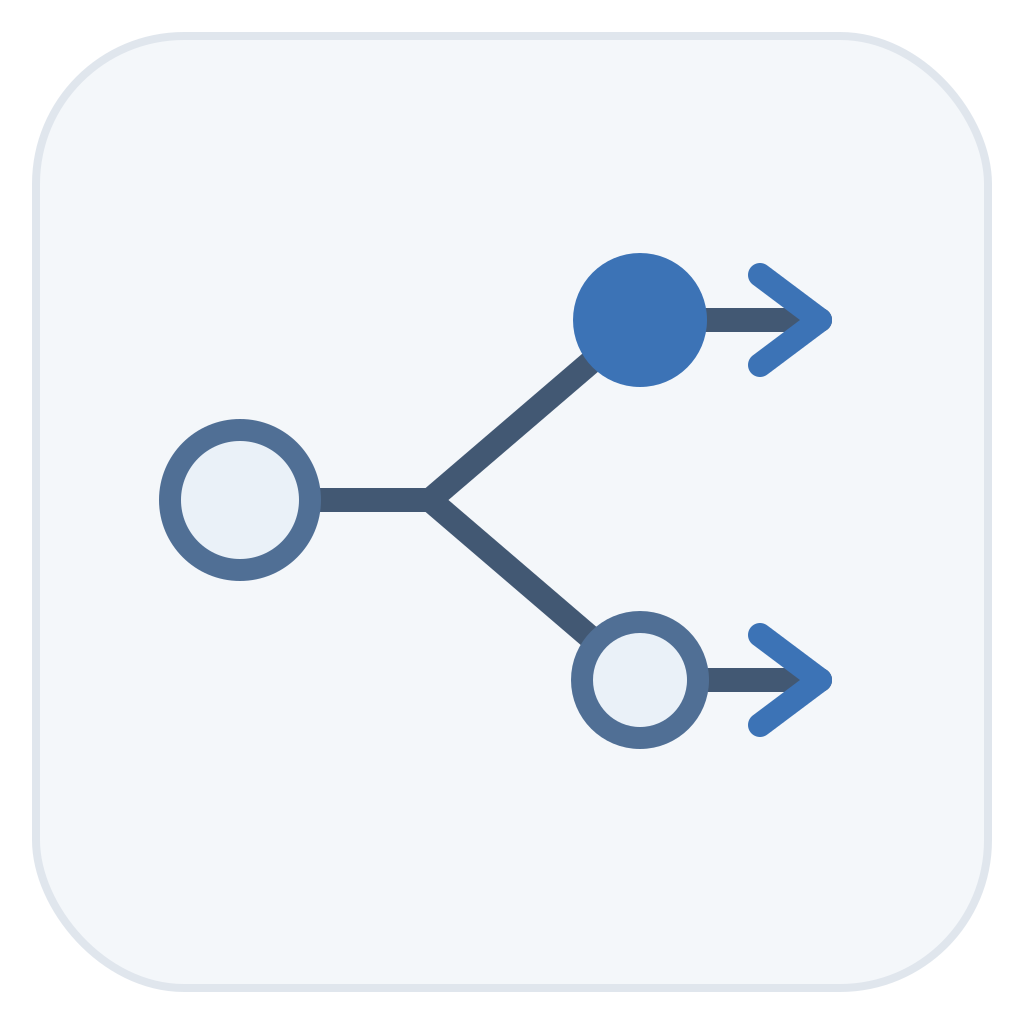
A few plausible futures branch from shared assumptions.
Scenario planning helps leaders think about decisions whose outcomes depend on significant uncertainty. A scenario is a coherent account of how external conditions could evolve, built from explicit assumptions about forces such as technology, regulation, customer behavior, supply, or geopolitics. It is not a forecast with three confidence intervals, and it is not an imaginative story without evidence. Each scenario should be plausible, internally consistent, and different enough to test a choice.
Scenario planning is a structured method for exploring a small set of plausible future conditions and testing decisions against them without presenting any one scenario as a prediction.
A practical process begins with the decision and time horizon. Identify what is already known, then list uncertainties that could materially change the decision. Select a few critical uncertainties, construct distinct combinations, and describe how each would affect customers, operations, economics, and competitors. Test current plans against all scenarios. Robust choices perform acceptably across several futures; contingent choices are staged until evidence resolves an uncertainty.
Finish by naming signposts and actions. A scenario has little operational value if no one watches for the conditions it describes. Define what evidence would make a scenario more relevant, which investments can be delayed, and what action should be triggered if a signpost crosses a threshold. This turns scenario work into a living input to strategy rather than a presentation that is revisited only after events occur.
Scenario uses
Choose the method according to the decision’s uncertainty, commitment, and time horizon.
 Exploratory scenarios
Vary uncertain drivers to examine a plausible range without selecting a desired outcome.
01
Vary uncertain drivers to examine a plausible range without selecting a desired outcome.
Vary uncertain drivers to examine a plausible range without selecting a desired outcome. Normative pathway
Begin with a specified goal and explore conditions or actions that could lead toward it.
02
Begin with a specified goal and explore conditions or actions that could lead toward it.
 Decision stress test
Compare a concrete investment or policy across scenarios and identify robust, staged, or fragile choices.
03
Compare a concrete investment or policy across scenarios and identify robust, staged, or fragile choices.
A continuum, not a switch
Scenario planning explores a set of plausible conditions. It does not assign certainty to one narrative or replace forecasts used for operational planning.
“A scenario is useful when it changes the questions a decision maker asks.”
Why it matters
Long-lived assets, supply chains, infrastructure, and capability investments can be hard to reverse. Scenario planning helps expose hidden single-outcome assumptions before the organization commits. It can also reveal opportunities that one baseline forecast overlooks and encourage leaders to monitor weak signals.
Shell describes its scenarios as explorations of how the world could evolve under different assumptions, not predictions or its business plan. The company says scenario thinking may influence strategy as one input among many. This careful distinction is central: scenarios support judgment, while executives still choose and own the strategy.
Distinguish changed-world assumptions from a sensitivity range. A best/base/worst calculation can be useful while retaining one underlying causal story. A scenario should test how the mechanism itself changes: who can buy, what input is available or which operating rule applies. Do not attach invented probabilities merely to make the comparison look like an expected-value model.
Real-world examples
The same concept shows up in different ways across industries.

When it breaks
Scenario work fails when every future is simply a best, base, and worst version of the same forecast, or when a team smuggles its preferred answer into the assumptions. It also fails when too many scenarios become impossible to compare, or when assumptions and signposts are never revisited. Keep a small set that creates real strategic tension and document the evidence behind it.
A scenario cannot remove uncertainty or tell leaders which outcome will occur. If the decision is reversible and can be tested cheaply, an experiment may be more useful than an elaborate scenario exercise. Conversely, a scenario without a decision, owner, or monitoring plan is merely a speculative narrative. Match the depth of analysis to the size and irreversibility of the commitment.
A signpost is useful only when it can be observed before the relevant commitment becomes irreversible. Identify the source, observation delay, decision owner and feasible response. The signal need not identify one world with certainty; it should be capable of changing the action. A narrative without that connection cannot guide a staged commitment.
Key takeaways
- 01
Start with a decision and a time horizon.
- 02
Build distinct, plausible futures from explicit assumptions.
- 03
Name signposts, contingent actions, and robust choices.
Related concepts
See all → Strategic diagnosis
 Real options
 Decision trees
 Business model innovation
Sources
- What are Shell scenarios? · Shell. Possible futures and what-if questions; distinct assumptions; caution that scenarios are not forecasts, expectations or business plans.