Metric · Economics
Capital intensity
How much investment a business needs to produce, grow, and maintain each unit of output
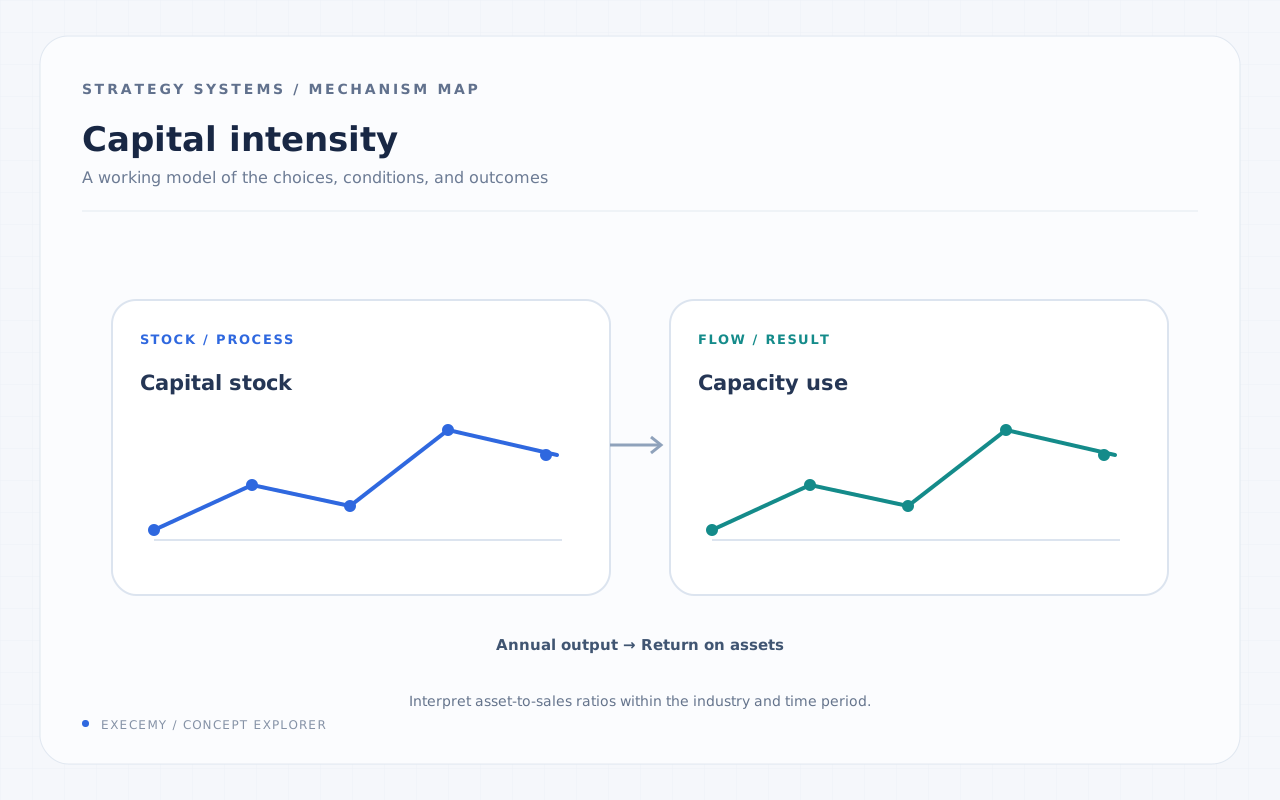
Capital required for each unit of activity.
Capital intensity describes the investment a business needs to create and support activity. The term has several useful measures, not one universal formula. Net property, plant, and equipment divided by annual revenue compares a balance-sheet stock with a yearly flow. Annual capital expenditures divided by annual revenue measures current investment spending relative to sales. Capital per unit of capacity may be more useful when output volume matters more than price.
Capital intensity describes how much fixed or working capital a business needs relative to a stated level of output, capacity, or revenue.
State the measure, currency, balance date and flow period. If K is closing net property, plant and equipment and R annual revenue, K/R compares a stock with a yearly flow; it does not say what share of each sale is spent on new assets. A spending measure uses capex during the year divided by that year’s revenue. Depreciation, acquisitions, leases and assets not yet in use can make the measures move differently.
Capital needs shape how quickly a company can expand and how much demand volatility it can absorb. A factory, airline fleet, data center, or retail footprint requires a different mix of equipment, inventory, leases, and working capital. Outsourcing and leasing can shift ownership or accounting presentation without removing the economic need for capacity. Compare equivalent business boundaries before ranking companies.
Common ways to measure it
Choose the ratio that answers the investment question, and label whether it is a stock or a flow.
 Fixed assets to revenue
Net property and equipment divided by annual revenue; a balance-sheet stock relative to a yearly flow.
01
Net property and equipment divided by annual revenue; a balance-sheet stock relative to a yearly flow.
Net property and equipment divided by annual revenue; a balance-sheet stock relative to a yearly flow. Capital spending to revenue
Capital expenditures divided by sales over the same fiscal period; an investment intensity measure.
02
Capital expenditures divided by sales over the same fiscal period; an investment intensity measure.
 Capital per unit of capacity
Investment required for an aircraft seat, production line, data-center megawatt, or other defined output unit.
03
Investment required for an aircraft seat, production line, data-center megawatt, or other defined output unit.
A continuum, not a switch
Capital intensity varies by asset ownership, operating model, and measure. A useful comparison makes accounting and physical capacity assumptions visible.
“A capital-intensity ratio is only meaningful when its numerator, denominator, and period are named.”
Why it matters
A high-capital model may have significant fixed costs, depreciation, financing needs, and minimum viable scale. Once capacity is installed, incremental output can be attractive until the next investment step, but demand shortfalls can leave assets underused. A lower-capital company may scale with partners or software, yet pay ongoing fees or sacrifice control. The ratio describes a trade-off; it does not rank business quality.
Microsoft’s FY2024 statements report net property and equipment of $135,591 million at June 30 and annual revenue of $245,122 million. Dividing gives approximately 0.553 times annual revenue. The balance sheet also reports operating lease right-of-use assets separately, and Note 1 explains lease classification. A ratio using only net property and equipment therefore has an explicit ownership and accounting boundary.
Real-world examples
The same concept shows up in different ways across industries.

When it breaks
Ratios can mislead when firms lease rather than own assets, use different depreciation lives, outsource production, or operate at different points in an investment cycle. Revenue can rise or fall because of price and mix without any change in physical capacity. Use notes to financial statements and operating metrics to understand what sits outside the numerator.
Low capital intensity does not mean low risk or high returns. A business may rely on scarce talent, expensive customer acquisition, supplier capacity, working capital, or intellectual property. High capital intensity can support a durable position when assets are productive and difficult to replicate, but only if demand earns an adequate return. Compare utilization, maintenance needs, incremental returns, and the cost of capital alongside the ratio.
Key takeaways
- 01
Which capital measure answers the question: net assets, annual capex, working capital, or capital per unit of capacity?
- 02
Are numerator and denominator aligned in period, currency, business boundary, and lease treatment?
- 03
What utilization and incremental return would make the next capacity investment worthwhile, and how would a demand shortfall affect it?
Related concepts
See all → Unit economicsMake the unit and boundary explicit.
 Capital allocationFund the best next use of capital.
 Economies of scaleTest how scale changes average cost.
 Break-even analysisFind the volume that covers the cost base.
 Contribution marginCalculate what the next sale leaves after variable costs.
Related cases
See all →Sources
- Microsoft Annual Report 2024 · Microsoft Corporation. Financial Statements, Balance Sheets June 30 2024 Net property and equipment; Income Statements FY2024 Total revenue; Note 1 Leases. All amounts USD millions.