Concept · Growth
Market development
Find new customers, places, or uses for an offer the business already knows how to provide
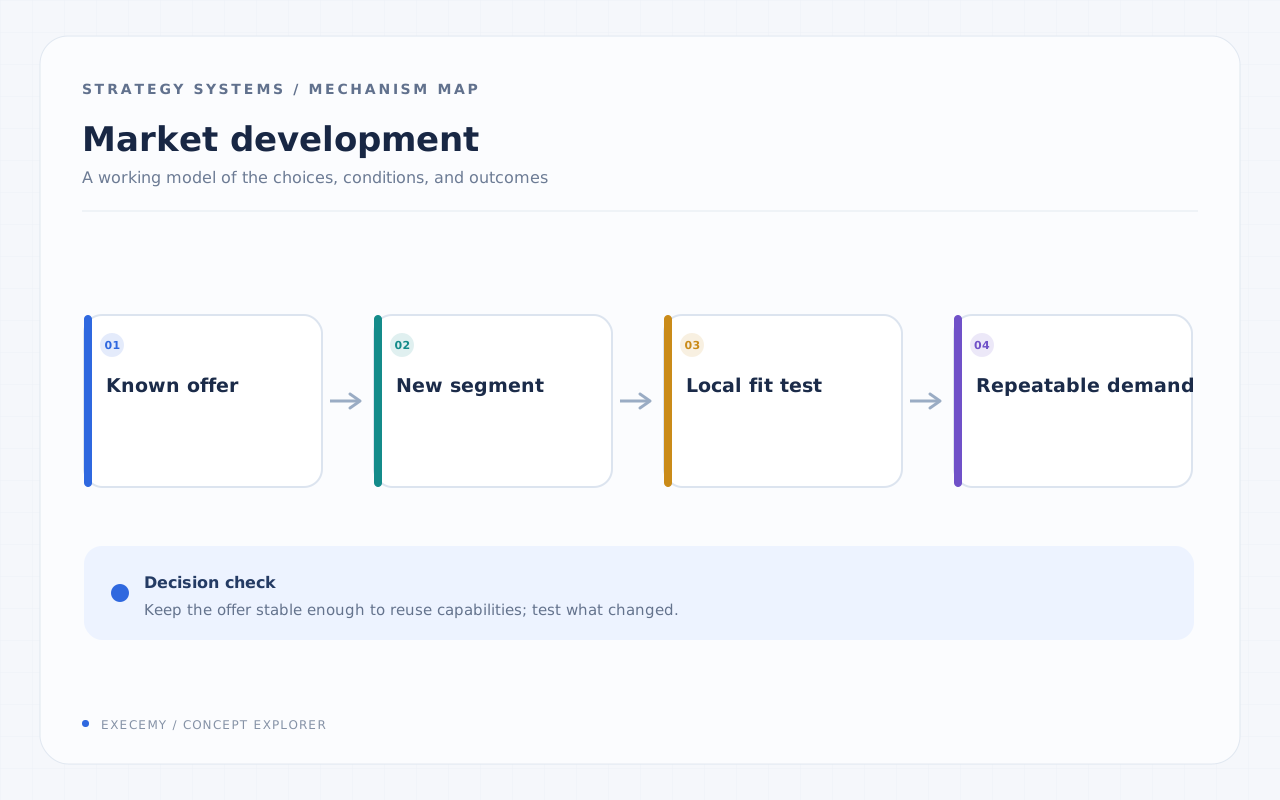
Take a proven offer to a new market.
Market development is one path for growth: keep the core offer substantially the same and seek demand in a new place or among a new group. A company might enter another country, target a new industry, reach smaller businesses through self-service, or adapt distribution to customers who already have the same need. The product can remain stable while its buyer, context, channel, or competitive set changes.
Market development grows an existing product or service by reaching customers, geographies, or use situations that the business does not yet serve well.
The work begins with a boundary. Define the current market and the proposed one by customer, job, geography, and alternative. Then test whether the offer transfers. Regulations, payment behavior, language, buying authority, service expectations, and competitors can change the economics. A market that looks large in population may be inaccessible or unprofitable after channel costs and local adaptation.
Market development differs from selling more to current customers or substantially changing the offer for a current market. In practice these choices overlap: entering a country may require translation, packaging or new partnerships. Ansoff’s separately dated 1958 abstract describes distinguishing diversification from other growth alternatives and comparing choices. The classification organizes the decision; it does not forecast demand.
Ways to open a market
A new market can mean a different buyer, place, channel, or situation.
 New customer group
Take an offer used by large organizations to smaller firms, or serve a new role with the same underlying need.
01
Take an offer used by large organizations to smaller firms, or serve a new role with the same underlying need.
Take an offer used by large organizations to smaller firms, or serve a new role with the same underlying need. New geography
Enter another region or country, accounting for local rules, partners, logistics, and willingness to pay.
02
Enter another region or country, accounting for local rules, partners, logistics, and willingness to pay.
 New use situation
Find a distinct occasion or job for a product whose core capabilities remain relevant.
03
Find a distinct occasion or job for a product whose core capabilities remain relevant.
A continuum, not a switch
Market development moves outward from the current customer boundary while retaining enough of the existing offer to reuse capabilities. The farther the context shifts, the more assumptions need testing.
“A market is new only if the buyer, need, access, or use context changes the commercial problem.”
Why it matters
Market development can extend products, brands, and capabilities that already work. It may be faster than inventing a new product, but it does not remove the need to establish awareness, access, service, and trust in the new segment. The business should test whether the cost to acquire and serve each new cohort leaves enough contribution after any adaptation.
McDonald’s reports separate U.S., International Operated Markets, and International Developmental Licensed Markets segments. Its 2024 filing says ownership structures vary by market with factors such as local entrepreneurial resources and legal conditions. The example shows that taking a recognizable offer abroad can involve a different operating and partner model; the reported segments do not by themselves show that every market is attractive.
IKEA Museum’s first-Japan account describes retaining the common range despite an adaptation warning. Its return account describes home visits and changes to delivery, assembly and range. These choices make customer work visible, but investment and market conditions also changed; the comparison cannot identify a profit effect from adaptation alone.
Real-world examples
The same concept shows up in different ways across industries.

When it breaks
The same product may solve a different problem, or no urgent problem, for the new group. A large addressable market estimate built from total population can hide reachable demand, buying authority, or the cost of support. Interview prospective buyers, observe existing substitutes, and run a limited test before committing a large fixed cost.
Expansion can also distract the core business. New markets may require local inventory, service, compliance, sales capacity, or partners that compete for scarce management attention. Compare contribution after incremental setup and ongoing costs, include a realistic ramp period, and define a stop condition. Growth in geographic revenue is not the same as profitable market development.
A hypothetical furniture entrant could face demand for its design while buyers cannot transport or assemble it. Demand research and a usable fulfillment route answer different questions. Before scaling, ask whether the binding constraint is product fit, a missing service, partner execution or funding; the same remedy does not address them all.
Key takeaways
- 01
What exactly is new: the customer, region, channel, use case, or buying process? Define the boundary before sizing demand.
- 02
Which parts of the current offer transfer unchanged, and which need local adaptation or a new route to market?
- 03
What evidence would prove reachable, repeat demand at a positive contribution after launch and service costs?
Related concepts
See all → Customer segmentationGroup customers where the response changes.
 Go-to-market strategyDesign the path from customer to value.
 Product-market fitLook for sustained demand, not applause.
 International expansionCross borders with a local operating plan.
 Localization strategyKeep the promise. Adapt how it lands.
Related cases
See all →Sources
- McDonald’s 2024 Form 10-K · McDonald’s / SEC. Business Summary, General / Description of the Business, printed p. 1; MD&A Restaurant Development, systemwide restaurants table p. 21
- A Model for Diversification · H. I. Ansoff, Management Science / INFORMS. Publisher abstract, July 1958: distinguishes diversification and other growth alternatives, outlines comparison method
- The first attempt on the Japanese market · IKEA Museum. Size matters; Size creates problems; Gradual adaptations, closing paragraphs
- Story of the second try to make it in Japan · IKEA Museum. Enlightening visits; Home delivery and many returns; Lessons learnt; A customised range