Concept · Strategy
Localization strategy
Adapt the offer and operating choices to local needs without losing a coherent core
Keep the promise. Adapt how it lands.
Localization is the deliberate adaptation of an offer or operating model to the conditions of a local market. Changes may include language, content, product features, package size, payment, pricing, service hours, distribution, sourcing, or compliance. Some are customer-facing; others are invisible operating choices that make delivery reliable and lawful.
Localization strategy adapts selected parts of a product or operating model to the needs and conditions of a specific market while preserving the customer value the company intends to deliver.
A strong localization decision starts with evidence about where the current offer fails or creates unnecessary friction. The company should distinguish a local preference from a difference that changes purchasing behavior, retention, or willingness to pay. Translation alone may not make a service usable; a fully separate product may add complexity without enough demand. The design task is to keep a stable core while adapting the components that matter.
Localization can build local relevance but also fragment product development, supply, support, and brand consistency. Choose a set of decision rights: which elements are global standards, which can vary by country, and who approves exceptions. Track the incremental cost and the customer outcome of each adaptation rather than treating local changes as inherently beneficial.
What can be localized
Adapt the parts shaped by language, regulation, customer behavior, or route to market.
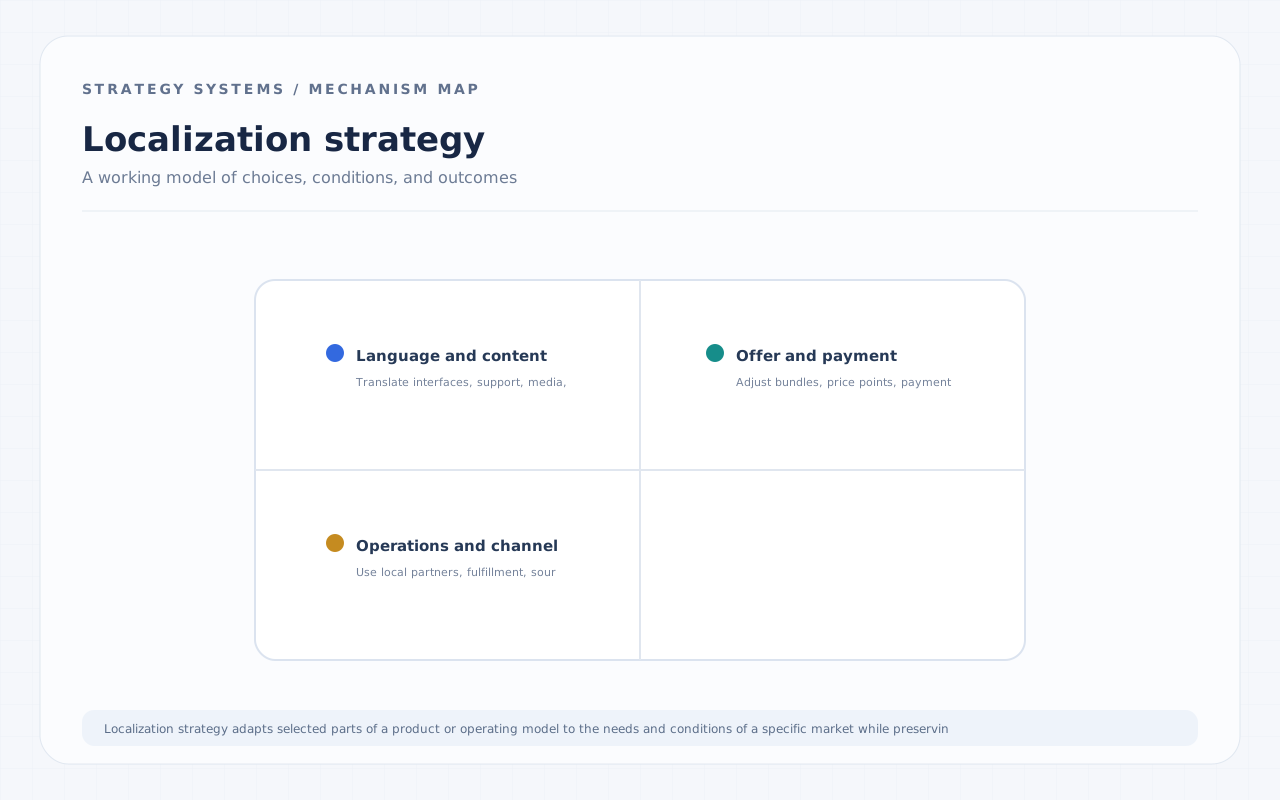
 Language and content
Translate interfaces, support, media, and documentation for local users and cultural context.
01
Translate interfaces, support, media, and documentation for local users and cultural context.
Translate interfaces, support, media, and documentation for local users and cultural context. Offer and payment
Adjust bundles, price points, payment methods, package sizes, or service terms.
02
Adjust bundles, price points, payment methods, package sizes, or service terms.
 Operations and channel
Use local partners, fulfillment, sourcing, or support patterns to meet access and regulatory needs.
03
Use local partners, fulfillment, sourcing, or support patterns to meet access and regulatory needs.
A continuum, not a switch
Localization varies selected parts of the offer or delivery system. The right degree balances local customer fit with product, operating, and governance complexity.
“Local adaptation is a choice about what must change for the value proposition to work.”
Why it matters
Localization can raise relevance and reduce adoption friction, but it should be tied to a measurable constraint. A company may need local-language subtitles, a local payment method, or a compliant data location before customers can use the product. Other adaptations, such as a new flavor or plan, require evidence that enough customers value the change to cover complexity.
Netflix’s Q2 2016 letter said it would add user-interface language, subtitles and dubbing in Poland and Turkey after its broader launch, with further localization as economically prudent. This is an announced next step, not evidence it was already delivered. The letter also describes varied early adoption; neither the planned changes nor the variation isolates an adaptation’s effect.
Separate access requirements from preference experiments. A payment method or understandable interface can be necessary to use the service; a content or package variant may change preference without being necessary. Each choice has a different comparison and maintenance cost. Define who needs the change and what behavior would show the proposed barrier is actually reduced.
Real-world examples
The same concept shows up in different ways across industries.

When it breaks
Too little adaptation can make the product inaccessible or culturally irrelevant. Too much can multiply SKUs, code paths, suppliers, regulatory obligations, and support requirements. Regional teams may optimize a local metric while weakening shared platform economics. Maintain a clear global core and test local variants against both customer outcomes and lifecycle cost.
Localization may be used as a story to justify a change without evidence that customers asked for it. Interviews and local expertise can generate hypotheses, but usage, conversion, retention, and contribution should test them. Also distinguish a localized product from a localized business model: pricing, channel, payment, ownership, and partner economics may need independent decisions.
A local variant can create a continuing global obligation: testing, updates, support and coordination with the shared core. Include those lifecycle resources and the cost of removing the variant later. Local adoption after a launch may reflect distribution, price or competing offers as well as adaptation; keep those explanations in the comparison.
Key takeaways
- 01
Which local condition prevents the current offer from being understood, accessed, trusted, or used?
- 02
What should remain standard globally, what may change locally, and who owns the boundary?
- 03
How will the adaptation change customer behavior and contribution after the cost of maintaining another version?
Related concepts
See all → International expansionCross borders with a local operating plan.
 Market developmentTake a proven offer to a new market.
 Customer segmentationGroup customers where the response changes.
 Product-market fitLook for sustained demand, not applause.
 BrandPerception that compounds.
Related cases
See all →Sources
- Netflix Q2 2016 Shareholder Letter · Netflix / SEC. International discussion, paragraph beginning For Q3..., planned Poland/Turkey user-interface language, subtitles and dubbing; newer-market learning and varied early adoption discussion.