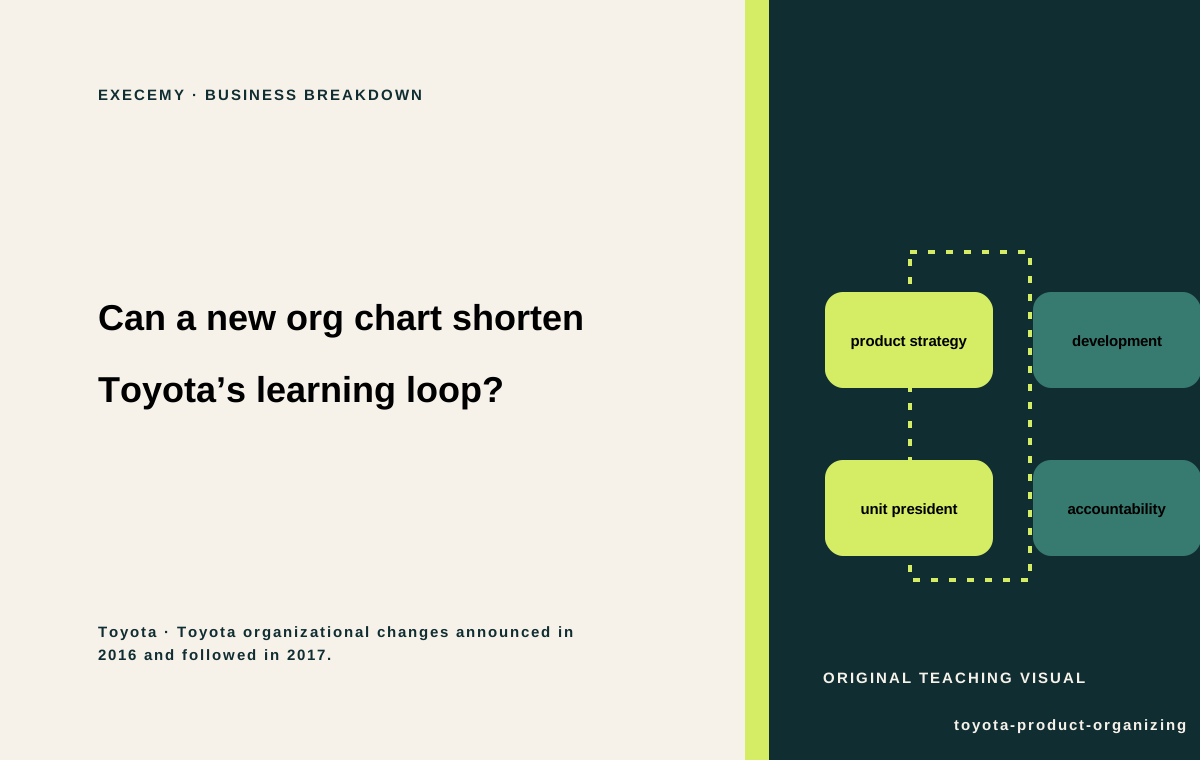
Toyota identified cross-functional coordination as consuming disproportionate time and effort. It separately emphasized on-site learning and announced product-based units intended to speed decisions and develop its workforce. The announcement records intent, not proof that the redesign worked.
The question
Can a new org chart shorten Toyota’s learning loop?
Toyota’s announced shift toward product-based organizations and regional units, with decision authority and coordination responsibilities described at announcement. · Toyota organizational changes announced in 2016 and followed in 2017. The announcement assigned product-based organizations responsibility for short- and medium-term product strategy and development. It named a responsible unit president, making the expected decision owner more legible. Toyota identified cross-functional coordination as consuming disproportionate time and effort. It separately emphasized on-site learning and announced product-based units intended to speed decisions and develop its workforce. The announcement records intent, not proof that the redesign worked. Toyota’s announced shift toward product-based organizations and regional units, with decision authority and coordination responsibilities described at announcement. Toyota organizational changes announced in 2016 and followed in 2017.
- Toyota announces organizational changes — March 2, 2016 announcement: rationale on on-site learning and cross-functional coordination; product-based and regional units; authority and responsibilities for product strategy and development.
Mechanism 1 · Toyota moved short-term product work into product unit
Toyota moved short-term product work into product units.
The announcement assigned product-based organizations responsibility for short- and medium-term product strategy and development. It named a responsible unit president, making the expected decision owner more legible.
- Toyota announces organizational changes — March 2, 2016 announcement: rationale on on-site learning and cross-functional coordination; product-based and regional units; authority and responsibilities for product strategy and development.
Mechanism 2 · Regional discretion was part of the balance
Regional discretion was part of the balance.
Toyota described regional units as a check and balance and said regions could exercise discretion over some R&D. The design attempted to combine product accountability with local market knowledge; the source does not say how well it did so.
- Toyota announces organizational changes — March 2, 2016 announcement: rationale on on-site learning and cross-functional coordination; product-based and regional units; authority and responsibilities for product strategy and development.
Mechanism 3 · An org chart cannot prove a faster feedback loop
An org chart cannot prove a faster feedback loop.
The structure can name who decides, but the operating system also needs regular evidence, clear escalation, and cross-unit learning. Toyota’s president called the reorganization an opportunity and said it might not be the ultimate solution. Toyota’s 2017 annual report later said the framework helped speed decisions, but this remains the company’s assessment, with no before-and-after response-time measurement; the 2017 follow-up shows another revision.
- Toyota announces organizational changes — March 2, 2016 announcement: rationale on on-site learning and cross-functional coordination; product-based and regional units; authority and responsibilities for product strategy and development.
- Toyota announces further organizational changes — March 1 2017 announcement, opening paragraphs and structural updates; announced changes, not independent performance evidence.
- Toyota Annual Report 2017 — Long-term Strategy, organization-change discussion, printed p. 8: 2016 product-based units, 2017 structural updates, and management’s assessment of authority and decision making.
Optional application · unscored
Trace the evidence to its decision owner
A product team hears a recurring customer complaint through service, sales and a regional team, but a separate committee controls changes to the roadmap.
Reveal: Name the decision owner and local authority, specify escalation conditions and return the decision evidence to the teams that raised the issue. Compare time from signal to action and complaint resolution; changing reporting lines alone supplies neither result.
Teaching assumption: Original fictional operating situation.
Teaching assumption: No numerical costs, durations, volumes, probabilities or observed company outcome are assigned.
The answer
Can a new org chart shorten Toyota’s learning loop?
The announcement assigned product-based organizations responsibility for short- and medium-term product strategy and development. It named a responsible unit president, making the expected decision owner more legible. Toyota’s 2016 announcement is useful evidence of an organizational diagnosis and proposed decision rights, not proof of successful cultural change. Learning can improve when authority is clearer, but new unit boundaries can also create fresh coordination costs if they are not paired with shared measures and escalation paths. The 2016 announcement is a diagnosis and design. The 2017 announcement establishes continued revision; the annual report supplies management’s retrospective assessment. No before-and-after response-time measurement or independent attribution is available in these passages. The case is bounded to Toyota’s announced shift toward product-based organizations and regional units, with decision authority and coordination responsibilities described at announcement. during Toyota organizational changes announced in 2016 and followed in 2017..
- Toyota announces organizational changes — Toyota Motor Corporation
March 2, 2016 announcement: rationale on on-site learning and cross-functional coordination; product-based and regional units; authority and responsibilities for product strategy and development.
Claims and observations identify the precise uses.
An announcement describing intended design and management’s diagnosis; it is not a post-implementation evaluation or independent evidence of faster decisions or better products.
- Toyota announces further organizational changes — Toyota Motor Corporation
March 1 2017 announcement, opening paragraphs and structural updates; announced changes, not independent performance evidence.
Claims and observations identify the precise uses.
A later plan confirms continued redesign, not that the original structure failed or that the follow-up achieved faster decisions or innovation.
- Toyota Annual Report 2017 — Toyota Motor Corporation
Long-term Strategy, organization-change discussion, printed p. 8: 2016 product-based units, 2017 structural updates, and management’s assessment of authority and decision making.
Claims and observations identify the precise uses.
This is management’s retrospective assessment; it supplies no baseline or measured response-time comparison and is not independent evidence of the redesign’s effect.
Original illustrative scenes are not documentary evidence.