Open visual reader →
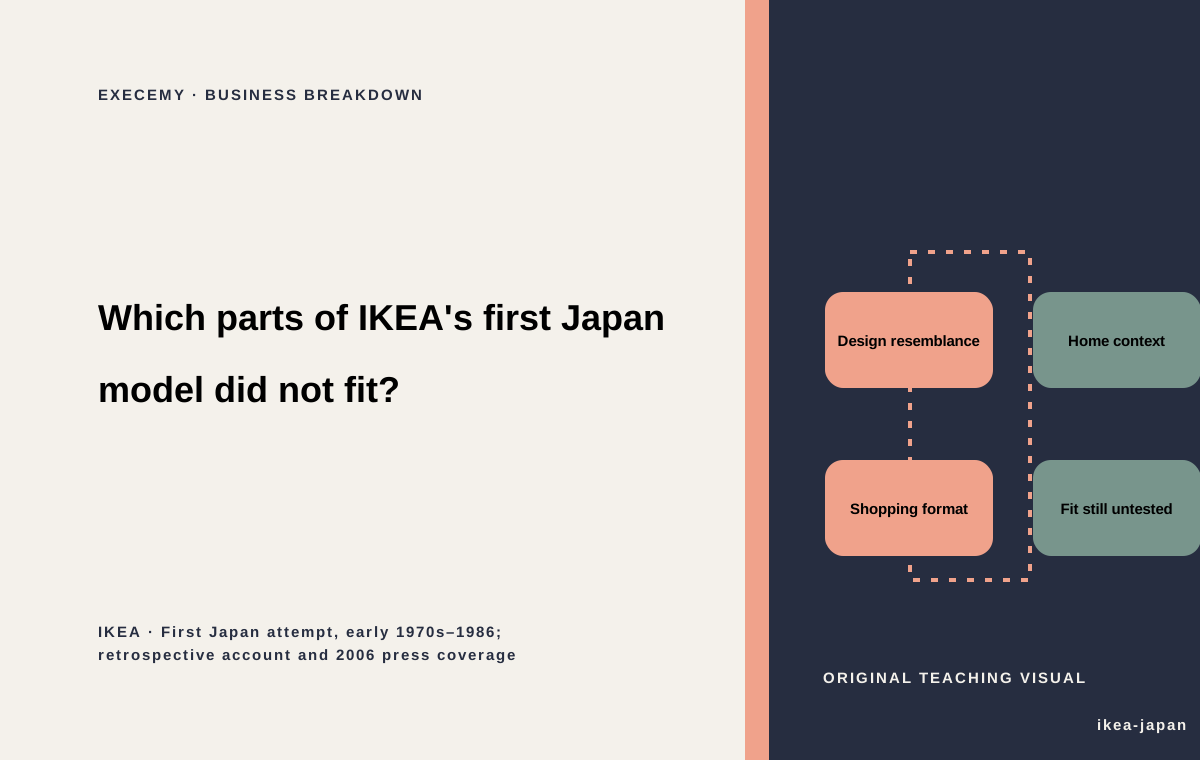
Which parts of IKEA's first Japan model did not fit?
Compare transfer choices without assigning a single cause to exit or a causal return to adaptation.
Explore IKEA →
The question
Which parts of IKEA's first Japan model did not fit?
IKEA’s range-replication choice in its first Japanese venture, contrasted with later selective adaptation · First Japan venture through 1986; separate 2006 return comparison, from dated museum retrospectives. Compare transfer choices without assigning a single cause to exit or a causal return to adaptation.
Mechanism 1 · IKEA declined an adaptation warning
IKEA declined an adaptation warning
IKEA’s first Japanese venture puts a useful limit on the idea of a coherent operating system. Activities that reinforce an offer in one market can impose work that buyers in another market cannot conveniently perform. The decision is not simply whether to preserve consistency. It is which part of the customer outcome requires consistency, and which part requires a different way of delivering it.
IKEA Museum’s retrospective says the local franchise holder warned that the range needed adaptation, while IKEA maintained its established practice of carrying the same assortment. The account dates the first retail corners to 1974 and the closure of the first venture to 1986. These are reported historical choices and dates; the account is not a contemporaneous options memo or a controlled comparison. [IKEA Museum, “Gradual adaptations” and “Size matters”](https://ikeamuseum.com/en/explore/the-story-of-ikea/too-big-in-japan/).
The relevant alternatives are analytical: transfer the existing range and customer work, adapt products or service, or postpone entry until the operating conditions can be supplied. The record supports the chosen replication approach. It does not establish the price or profitability of the alternatives, nor which changes managers seriously considered at a particular meeting.
Consistency has a plausible benefit. A common range can preserve supplier coordination, brand identity and operating familiarity. An adaptation also has a cost: the firm must understand what changes downstream and whether its sourcing, instructions, inventory and partner responsibilities can support them. Neither consideration makes unchanged replication correct by itself.
Mechanism 1 · IKEA declined an adaptation warning
Product fit includes the trip home
The museum describes furniture that was bulky for the homes discussed, difficult transport by public transit, and resistance to self-service and assembly. These are attributed, period-specific accounts. They should not become a permanent statement about Japanese customers or a finding that furniture size alone caused exit. [IKEA Museum, “Size creates problems”](https://ikeamuseum.com/en/explore/the-story-of-ikea/too-big-in-japan/).
The mechanism is a transfer of work. A flat pack may simplify the retailer’s handling while leaving the buyer to carry it, move it through the building and assemble it. A low purchase price is useful only in relation to that full task. If the buyer cannot finish the task, the offer’s internal efficiency does not supply the missing customer capability.
A response should identify the failed handoff rather than infer a preference from nationality. Smaller products, assisted transport and assembly support address different constraints. They can also require different costs, coordination and service promises. The historical record does not let us calculate which option would have produced a viable first venture.
Mechanism 2 · Capital and franchise control compete with the fit exp
Capital and franchise control compete with the fit explanation
The museum reports that the franchise arrangement ended before closure, that IKEA took over the business in 1983, and that non-IKEA products had been sold under the IKEA name. It also attributes a capital-readiness explanation to former export manager Karl Kerker. These events and recollections give some chronology and several possible explanations; they do not assign causal weights. [IKEA Museum, closing passages](https://ikeamuseum.com/en/explore/the-story-of-ikea/too-big-in-japan/).
This matters because an attractive local adjustment can still fail without a reliable partner or sufficient investment. Conversely, more capital cannot make an unusable product useful by itself. A decision-maker should ask which constraint is binding and what evidence would distinguish it. Treating every issue as interchangeable “localization” loses the operating question.
The strongest rival account is therefore broader than product mismatch: execution, franchise control and investment may have limited the venture even if customers liked the design. The available retrospective cannot separate those effects. Its value is to prevent a single-factor explanation, not to establish a definitive postmortem.
Mechanism 2 · Capital and franchise control compete with the fit exp
The later return changed delivery, but does not prove a cure
A separate museum account describes preparation for the 2006 return through home visits, room displays suited to local living conditions, delivery and assembly alternatives, and assortment adjustments. It also describes early returns and changes to measurement and assembly instructions. [IKEA Museum, “Enlightening visits,” “Home delivery and many returns,” “Lessons learnt” and “A customised range”](https://ikeamuseum.com/en/explore/the-story-of-ikea/retail-revival-in-japan/).
This later record supplies a concrete contrast: the retailer changed how parts of the system met the customer’s circumstances. It does not isolate adaptation’s effect on profit. The market, organization, capital commitment and distribution conditions also differed. Opening crowds are not a comparable measure of lasting customer value or investment return.
The useful lesson is narrower. A firm can investigate the customer’s actual setting, alter selected activities and still encounter new problems at the point of use. Adaptation should be treated as an operating hypothesis with feedback, not as a guarantee of transfer success.
Mechanism 3 · Decide what the customer must be able to complete
Decide what the customer must be able to complete
For a hypothetical retailer, begin with the buyer’s full task: evaluate the item, obtain it, get it into the home, assemble it if needed and receive support. Identify which tasks the customer can perform and which require a partner or the retailer. Then ask who can authorize an adjustment and how its cost and service promise will be funded.
The boundary is practical. Do not preserve an activity merely because it belongs to a successful system elsewhere; do not abandon it merely because a new market differs. Specify the missing capability and test a change that could provide it. The IKEA record illustrates the decision and its uncertainty. It does not provide an export formula or a numerical estimate of the benefit of localization.
Optional application · unscored
Separate local constraints from assumptions
Hypothetical: A retailer is entering a city where homes are smaller, shoppers use public transit, and the local distributor wants a different store format.
Reveal: Specify which constraints are observed, who supplied the evidence, and which parts of the offer can change without breaking the system. The setting is invented and is not a claim about Japan today.
Teaching assumption: Original hypothetical retailer
Teaching assumption: No contemporary claim about Japanese customers or IKEA
The answer
Compare transfer choices without assigning a single cause to exit or a causal return to adaptation.
Compare transfer choices without assigning a single cause to exit or a causal return to adaptation. The first venture’s exit and the later return do not isolate a causal profit benefit from localization. The case is bounded to IKEA’s range-replication choice in its first Japanese venture, contrasted with later selective adaptation during First Japan venture through 1986; separate 2006 return comparison, from dated museum retrospectives.
Sources and limitations
- The first attempt on the Japanese market — IKEA Museum
Size matters; Size creates problems; Gradual adaptations, closing paragraphs
1974 retail corners, unchanged-range choice, 1983 takeover, 1986 closure, and attributed fit/capital/franchise explanations.
Institutional retrospective; no causal weights or internal options memo.
- Story of the second try to make it in Japan — IKEA Museum
Enlightening visits; Home delivery and many returns; Lessons learnt; A customised range
2006 return preparation and selective changes to displays, delivery, assembly and assortment.
Later retrospective and changed circumstances; no isolated return-on-adaptation estimate.
Original illustrative scenes are not documentary evidence.
New concepts and cases by email