Concept · Strategy
Build, buy or partner
Choose how to access a capability by comparing control, speed, learning, integration burden, and the value of alternatives.

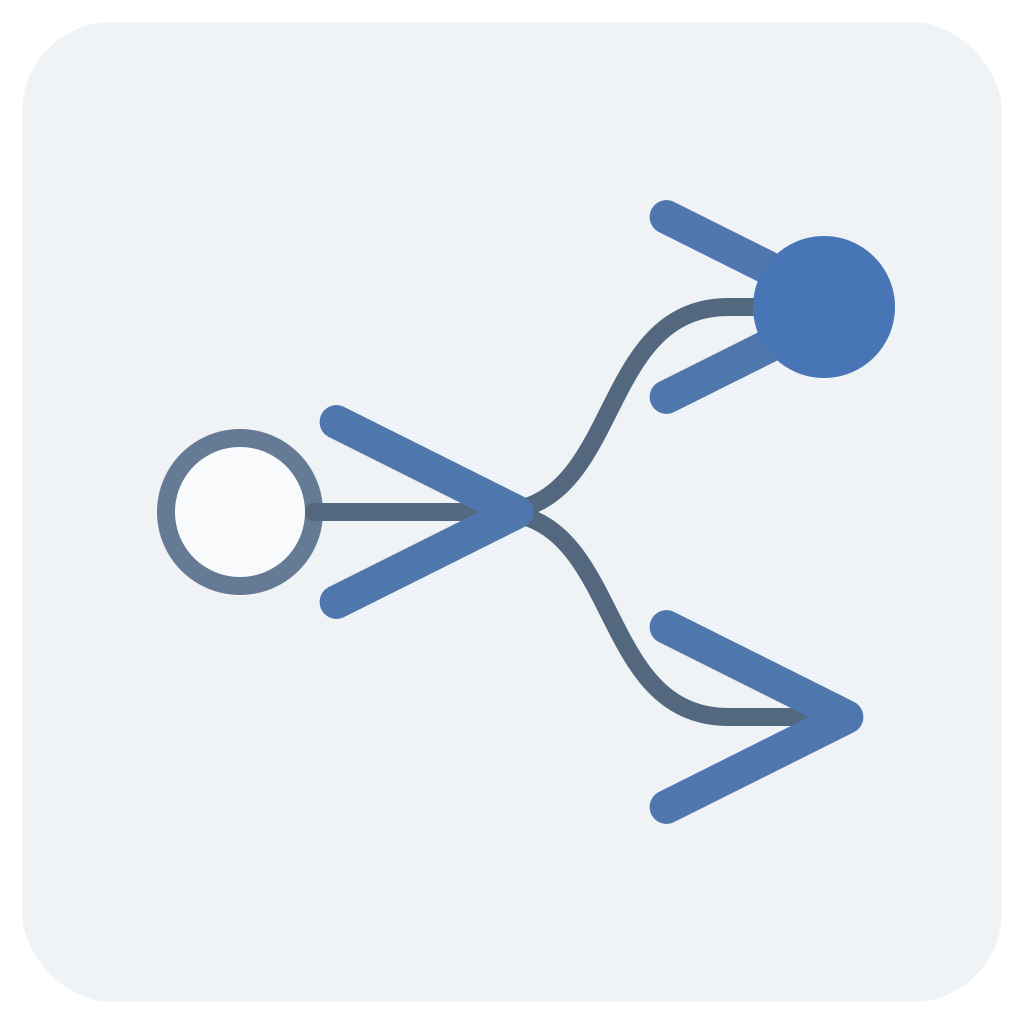
Three routes provide a capability with different commitments and control.
When a strategy depends on a missing capability, leaders can develop it internally, acquire a firm that has it, or form a partnership or contract. Building offers control and learning but can take time and compete for scarce talent. Buying can secure people, technology, customers, or rights more quickly, but purchase price does not include all integration risk. Partnering can provide access and flexibility, while leaving dependence, coordination, and future bargaining in the relationship.
Build, buy, or partner is a strategic choice about whether to develop a capability inside the firm, acquire an organization that has it, or access it through an agreement.
Start by defining the capability and the level of control the strategy requires. A company may need the underlying skill, a specific asset, a route to market, or simply a near-term service. Then compare time to usable capability, total cost, reversibility, learning, intellectual property, quality assurance, regulatory obligations, and the cost of failure. The best option depends on which uncertainty the company can tolerate and which dependency it can manage.
The options can be combined or sequenced. A firm might partner to test demand, build a core capability, and acquire a specialized asset later. Such a sequence can preserve flexibility, but only if the initial arrangement creates a real learning path and does not lock the company into an uneconomic position. Specify decision gates, integration owners, exit rights, and what evidence would change the choice.
Three routes to capability
Compare access, control, timing, and organizational cost—not just the headline price.
 Build
BuildDevelop skills, assets, and operating routines internally; time and execution risk stay with the firm.
01
Develop skills, assets, and operating routines internally; time and execution risk stay with the firm.
Develop skills, assets, and operating routines internally; time and execution risk stay with the firm. Buy
BuyAcquire a company, asset, or team; control increases alongside valuation and integration obligations.
02
Acquire a company, asset, or team; control increases alongside valuation and integration obligations.
 Partner
Use an alliance, license, or contract; access can be faster while governance and dependency remain shared.
03
Use an alliance, license, or contract; access can be faster while governance and dependency remain shared.
A continuum, not a switch
Control, investment, speed, and dependency shift across a partner agreement, internal build, and acquisition. The correct point depends on the capability and the firm’s constraints.
“The fastest route is only useful if it leaves the capability usable.”
Why it matters
Capability choices shape the firm boundary. A purchase can add capabilities that are difficult to hire or reproduce, but acquisition does not guarantee integration. A partner may have complementary expertise and distribution, but strategic priorities can diverge. Internal development can protect sensitive knowledge and build long-term competence, yet the opportunity may pass before the team reaches the required quality.
Microsoft’s Activision Blizzard acquisition brings control over gaming content and capabilities. Toyota and Idemitsu instead announced coordinated electrolyte and battery development with distinct technical contributions and pilot-dependent future study. These are documented boundary choices for different capabilities, not controlled evidence that one route performs better than the other.
Compare time to an accepted capability, rather than time to signing or hiring. A purchased team can need integration; an internal team can need qualification; a partner can need scarce upstream inputs. State the output and control rights needed, then identify the learning each route produces and the later choices it leaves feasible.
Real-world examples
The same concept shows up in different ways across industries.

Microsoft’s FY2024 note records the Activision Blizzard acquisition and describes expected integration benefits. Acquired capability, consolidation and realized economic value remain different claims; the transaction does not value a feasible internal-development alternative.

Toyota and Idemitsu’s October 2023 agreement assigns electrolyte manufacturing and battery/vehicle development roles and makes future full-scale study depend on pilot results. The announcement describes intended collaboration; it does not disclose a completed capability or cancellation right.
When it breaks
The framework breaks when the team treats “build” as free because it avoids a purchase price, or “partner” as risk-free because the partner carries the assets. Internal labor, delay, management attention, integration, governance, and dependency all have economic costs. Include ongoing coordination and exit costs over the expected duration of the relationship.
An acquisition can fail when the target’s value depends on people or routines that leave after closing, or when systems and incentives resist integration. A partnership can fail when rights are vague or each side expects the other to invest first. Internal development can fail when the company underestimates the time to reach reliability. Use milestones and stop conditions instead of assuming the chosen route will work because it has been announced.
A route can appear flexible while its contract commits the buyer to minimum volume or leaves essential rights elsewhere. Read intellectual-property use, change authority, capacity access and termination consequences before crediting an option. Staging has value only when new information can change a feasible later action.
Key takeaways
- 01
Define the capability and required control first.
- 02
Compare total cost, time, learning, dependency, and reversibility.
- 03
Set integration or partnership governance and decision gates before committing.
Related concepts
See all → Business model innovationChange the logic of the business, not only the offer.
 Value chainsTrace the activities behind the customer promise.
 Strategic trade-offsMake the choices competitors cannot copy one by one.
 Strategic alliancesCoordinate the work that neither partner should own alone.
Related cases
See all →Sources
- Microsoft Annual Report 2024 · Microsoft Corporation. Note 8, Business Combinations, Activision Blizzard closing October 13 2023, purchase price allocation, expected goodwill benefits and net post-close revenue/operating-loss impact including content reclassification.
- Idemitsu and Toyota Announce Beginning of Cooperation toward Mass Production of All-Solid-State Batteries for BEVs · Toyota Motor Corporation. October 12 2023, Details of collaboration, Phase 1, Phase 2 and Phase 3 headings; study of future full-scale production based on Phase 2 results.