Concept · Innovation
Sustaining innovation
Improve the offer for the customers and performance measures that define your current market
Make the current offer better for its market.
Sustaining innovation improves an offer along dimensions relevant to established customers and use cases. It can involve a modest change or a major technical advance. The term describes whom the improvement serves and how it competes, not the size of the invention.
Sustaining innovation advances an existing offer for current customers or established performance measures, helping a business compete within its current market trajectory.
The decision is which improvement matters enough to justify development and lifecycle work. A benchmark gain can be impressive while target customers have another constraint. Reliability, service and lower total effort can matter as much as new capability.
An innovation can support established users and open other uses at the same time. Define the customer and task rather than force the entire product into a single label. Classification should help choose the next investment.
Ways to improve an established offer
Choose dimensions current customers value and can recognize or measure.
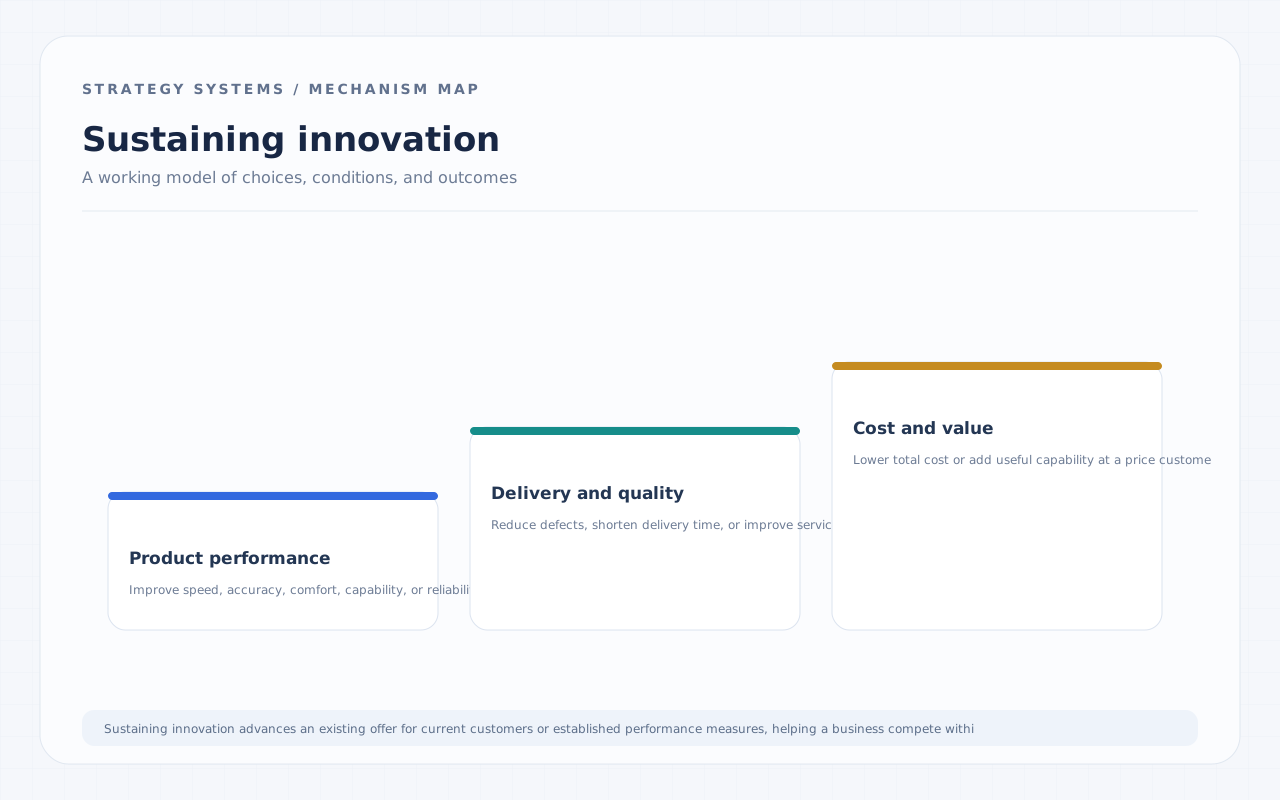
 Product performance
Improve speed, accuracy, comfort, capability, or reliability for current use cases.
01
Improve speed, accuracy, comfort, capability, or reliability for current use cases.
Improve speed, accuracy, comfort, capability, or reliability for current use cases. Delivery and quality
Reduce defects, shorten delivery time, or improve service consistency.
02
Reduce defects, shorten delivery time, or improve service consistency.
 Cost and value
Lower total cost or add useful capability at a price customers will accept.
03
Lower total cost or add useful capability at a price customers will accept.
A continuum, not a switch
Sustaining innovation ranges from small updates to major technical gains when it competes for established customers and market needs.
“Sustaining describes whom an innovation serves and how it competes, not how small the invention is.”
Why it matters
The Christensen Institute distinguishes improvements to established offers from accessible foothold paths. Netflix’s artwork account documents a change to an existing discovery experience. The distinction supplies conceptual context, while the company report remains bounded to that design and comparison.
The mechanism connects a change in performance or delivery to a better usable outcome. Test the full task, including learning, support and compatibility. A new capability can increase complexity or displace another useful activity.
Demand growth, content changes and marketing can contribute to observed performance alongside the innovation. A company-reported rollout does not establish retention or profit improvement. Decide which outcome could overturn the favorable intermediate result.
Real-world examples
The same concept shows up in different ways across industries.

Netflix’s artwork account documents a comparison and rollout of contextual personalization inside an existing viewing service. The actual choice refines how an established offer is delivered. Its quality-engagement target recognizes a conflict: an image can attract a play while leading to disappointing viewing. Improvement therefore needs to be defined through the customer’s task, not the immediate interaction alone. The company reports improvement against an unpersonalized policy, but does not disclose a full numeric experiment report or isolate retention and profit. The relevant alternatives include retaining the old policy and testing a new one; neither outcome should be assumed before the comparison. For a manager, identify which established performance dimension changes, whether customers value it and what delivery cost it introduces. A technically more capable feature can impose complexity without improving the task, while a modest change can remove a meaningful obstacle. The case supports an actual refinement decision. It does not establish disruption, optimal investment or the incremental value of every added capability.

Toyota describes human improvement of work and abnormalities in its production system. The account illustrates continued refinement of delivery. It does not establish the incremental return of a particular improvement or guarantee benefit in another plant.
When it breaks
In a hypothetical application, a sophisticated capability exceeds what occasional users can understand. Technical performance improves while useful task completion falls. The sustaining investment needs a customer outcome, not only a benchmark.
An established customer’s needs can change. Continuing the old performance trajectory may no longer be sustaining useful value. Reassess the task and alternative rather than preserve a roadmap because it has historical momentum.
Key takeaways
- 01
Which established customers and performance dimensions should this improvement serve?
- 02
What behavior or outcome will show that the change matters enough to cover its lifecycle cost?
- 03
Does the innovation improve the mainstream offer, open a previously unserved market, or follow both paths?
Related concepts
See all → Disruptive innovationA market path, not a synonym for breakthrough.
 Product-market fitLook for sustained demand, not applause.
 DifferentiationBe distinct on something buyers value.
 Business model innovationChange the logic of the business, not only the offer.
 Dynamic capabilitiesNotice change, commit, and reorganize to act.
Sources
- Disruptive Innovation Theory · Christensen Institute. Definition; Disruptive vs. Sustaining Innovations
- Artwork Personalization · Netflix TechBlog. Contextual bandit approach, model training and performance evaluation, December 2017
- Toyota Production System · Toyota Motor Corporation. Jidoka; Just-in-Time; synchronized processes and human improvement