Concept · Strategy
Differentiation
Making an offer meaningfully distinct on attributes customers value enough to choose or pay for
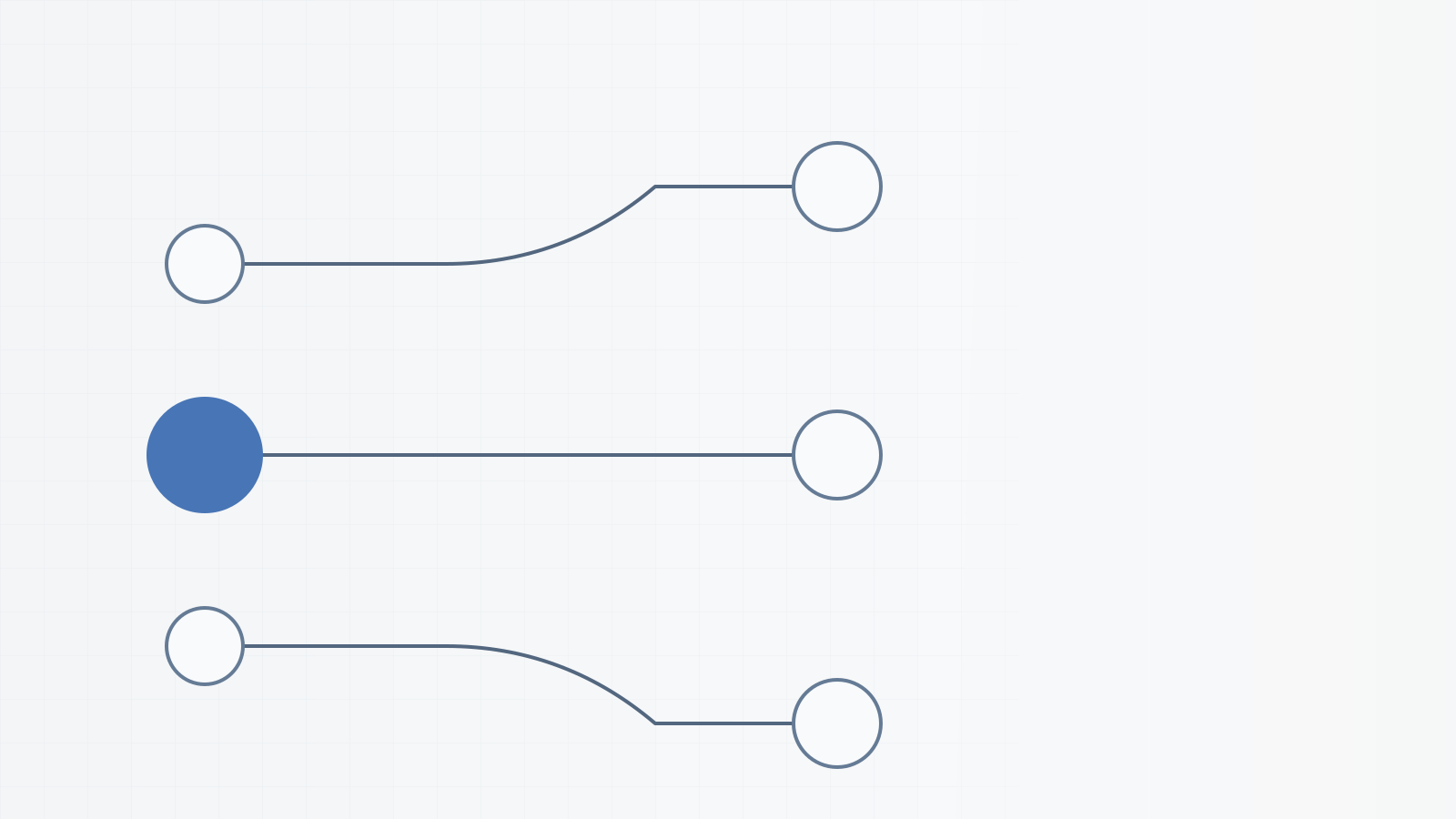
Be distinct on something buyers value.
Differentiation is a customer-relevant difference from available alternatives. It can concern the outcome, the path to using it or the meaning attached to it. Difference alone is insufficient: the target buyer needs to notice it and care enough to choose on terms the business can sustain.
Differentiation is a customer-valued difference in an offer or its delivery; its economic value depends on customer choice and the cost of supplying it. Durability is a separate question.
The decision is which difference to fund and how to supply it reliably. Adding a feature can make the offer harder to understand or more expensive to support. A simpler experience can be distinctive when it removes work that the customer regards as important.
Compare the relevant use case rather than an undifferentiated list of competitors. A feature that matters to an expert may burden an occasional user. The same product can be differentiated for one task and ordinary for another.
Where differentiation can appear
Find the attributes that change the customer’s decision, then connect them to a repeatable way to deliver them.
 Product or outcome
Distinct performance, design, selection, reliability, or result that solves an important problem differently.
01
Distinct performance, design, selection, reliability, or result that solves an important problem differently.
Distinct performance, design, selection, reliability, or result that solves an important problem differently.Experience or accessA more convenient path to discovery, purchase, setup, support, or use in the customer’s circumstances.
02
A more convenient path to discovery, purchase, setup, support, or use in the customer’s circumstances.
 Trust or identity
A credible reputation, service relationship, or shared meaning that reduces uncertainty or makes the choice personally valuable.
03
A credible reputation, service relationship, or shared meaning that reduces uncertainty or makes the choice personally valuable.
A continuum, not a switch
Differentiation matters as customers notice a difference, value it relative to alternatives, and choose or pay for it at a level that supports delivery.
“A difference becomes strategic when a customer notices it and the business can deliver it.”
Why it matters
Harvard Business School’s positioning account connects a distinctive proposition with activities and permits lower cost and differentiation together. The conceptual distinction does not require charging a premium for every useful difference.
The mechanism includes recognition, preference, delivery and exchange. Investigate where it fails before adding more distinction. If a buyer likes a design but cannot assemble it, the necessary change may be a service rather than another aesthetic feature.
Price, access and familiarity can influence choice alongside the proposed distinction. A favorable sales result should not be wholly credited to the feature without evidence. A difference that rivals can reproduce may still create current customer value while failing to provide durable protection.
Real-world examples
The same concept shows up in different ways across industries.

Spotify’s recurring Discover Weekly selection creates an actual difference in how listeners begin searching. Its later Premium genre controls add another choice: the listener can steer the recurring selection toward a desired kind of music. The operating conflict is between relying on personalization and allowing deliberate exploration beyond what previous listening suggests. Those are product choices, not evidence that all listeners prefer the feature. The historical listening total shows use under its cumulative definition, while the control announcement establishes availability. Neither measures time saved or the incremental satisfaction of an unfamiliar genre search. A listener could value the selection because it reduces effort, because the music is appealing or because it is easy to revisit; other product changes may also affect use. For a manager, test the distinction through the intended task and a credible alternative. Copyability affects the durability of an advantage, but a useful difference can create current value before any durable protection is established.

IKEA Museum describes home visits and changes to delivery, assembly and instructions during the Japan return. These choices concern usability as well as assortment. Their occurrence does not supply a causal contribution or show that the same configuration fits every buyer.
When it breaks
In a hypothetical app, a praised capability is expensive to operate and easily copied. It can be useful without supporting a price premium or a moat. Estimate the relevant customer outcome and delivery work separately.
Differences can become distractions when they complicate an otherwise useful task. Remove or redesign the capability when evidence shows that target users are paying attention to it without benefiting from it.
Key takeaways
- 01
Name the target customer, the relevant alternative, and the outcome made meaningfully different.
- 02
Check that customers recognize and value the distinction before scaling its cost.
- 03
Treat imitation risk and service economics as part of differentiation, not as afterthoughts.
Related concepts
See all → PositioningChoose whom to serve—and what to leave out.
 Value propositionChoose a customer, meet a need, earn the price.
 Cost leadershipDesign the system around a lower delivered cost.
 Strategic trade-offsMake the choices competitors cannot copy one by one.
 MoatsDefensible advantages that last.
 BrandPerception that compounds.
Related cases
See all →Sources
- Strategic Positioning · Harvard Business School, Institute for Strategy and Competitiveness. Strategic Positioning; Achieving Superior Performance; The Value Chain
- Discover Weekly usage through June 2020 · Spotify Newsroom. July 9, 2020; opening usage report and Monday refresh description
- Discover Weekly turns 10 · Spotify Newsroom. June 30, 2025; New controls paragraph
- Story of the second try to make it in Japan · IKEA Museum. Enlightening visits; Home delivery and many returns; Lessons learnt; A customised range