Open visual reader →
Can one playlist shrink the search?
A personalized starting set and listener controls can change search work, but listening volume does not measure that change.
Explore Spotify →
The question
Can one playlist shrink the search?
Discover Weekly starting-point design and later listener controls · July 2015–June 2020 usage account; June 2025 genre-control announcement. A personalized starting set and listener controls can change search work, but listening volume does not measure that change.
Mechanism 1 · Spotify supplied a recurring personalized starting poi
Spotify supplied a recurring personalized starting point
A listener deciding what to play faces a search problem before a recommendation problem can be judged. A useful starting set may spare the listener from screening a large catalog. It can also narrow what the listener encounters. The decision is whether the selection helps that person reach a satisfying listening outcome, rather than whether the selected items receive attention.
Spotify’s anniversary account describes Discover Weekly as a playlist refreshed each Monday from personal listening habits. Its later account announced genre controls for Premium listeners. These are actual product choices: supply a personalized set, then allow a listener to steer its direction. They are not a disclosed randomized comparison of alternative search designs. [Spotify’s 2020 account](https://newsroom.spotify.com/2020-07-09/spotify-users-have-spent-over-2-3-billion-hours-streaming-discover-weekly-playlists-since-2015/), [Spotify’s 2025 update](https://newsroom.spotify.com/2025-06-30/discover-weekly-turns-10-celebrating-100-billion-tracks-streamed-and-a-decade-of-personalized-discovery/).
The analytical alternatives are a common editorial list, search initiated by the listener, or a personalized shortlist with controls. The public accounts do not say which alternatives were evaluated internally or what each would have cost. The useful choice concerns who supplies the initial candidates and how a listener can redirect them.
Mechanism 1 · Spotify supplied a recurring personalized starting poi
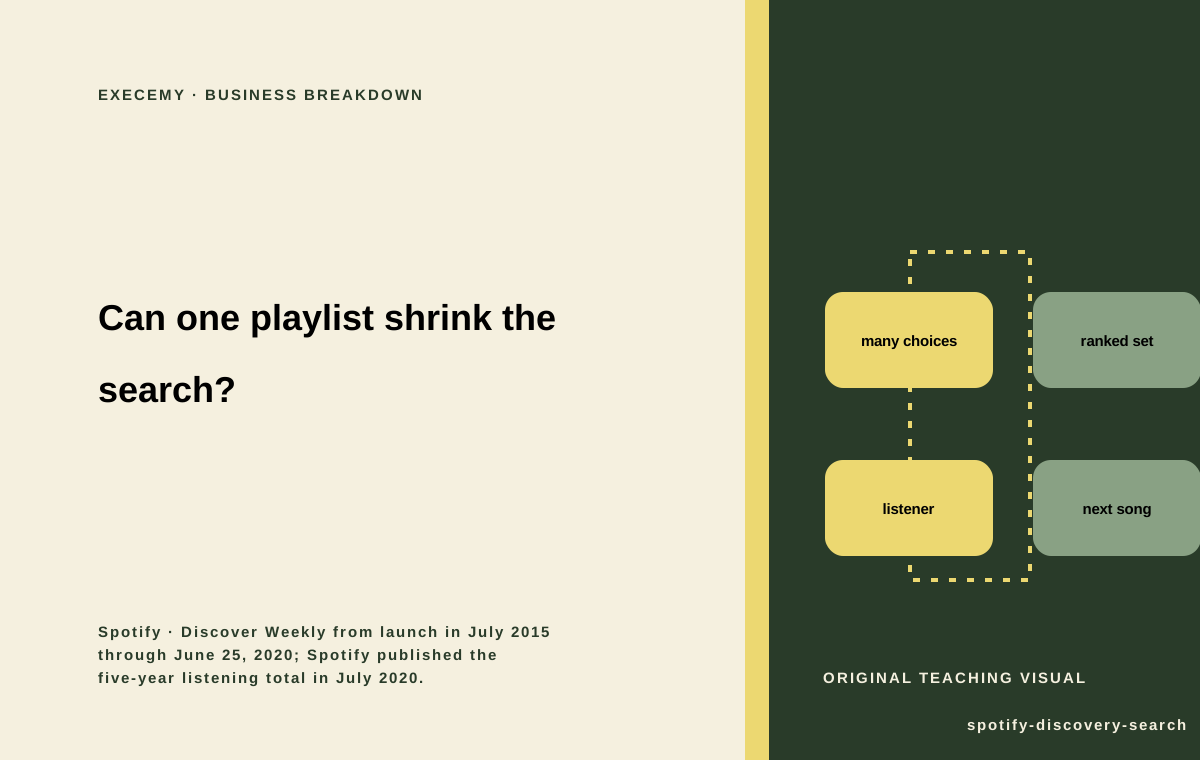
A shortlist changes the work before listening
Personalization can make screening more manageable if the candidates match the listener’s current purpose. That is a mechanism to test, not an observed time saving. A familiar preference is not necessarily the purpose of the current session; someone can want an unfamiliar genre or a different mood.
The added genre control creates an interesting tension. It preserves a supplied starting set while returning some direction to the listener. A control can improve fit or merely add another step. Its presence does not establish how often it was used, whether it reduced search effort or whether the resulting tracks satisfied the listener.
Mechanism 2 · Listening volume does not identify search efficiency
Listening volume does not identify search efficiency
Spotify reported more than 2.3 billion listening hours between July 2015 and June 25, 2020. That is a cumulative company tally with a defined window. It does not report unique listeners, time to choose or incremental listening caused by the playlist. [Spotify’s dated usage report](https://newsroom.spotify.com/2020-07-09/spotify-users-have-spent-over-2-3-billion-hours-streaming-discover-weekly-playlists-since-2015/).
A large usage tally is compatible with useful discovery, familiarity, repeat consumption or simply broad exposure. Those explanations can coexist. Dividing the total by an absent listener count or comparing it with a different type of stream tally would create an unsupported average or growth rate.
Mechanism 2 · Listening volume does not identify search efficiency
Give the competing explanation a chance to change the choice
The strongest alternative to reduced search cost is that a prominent recurring playlist attracted attention without making choice easier. Another is that it favored familiar material rather than useful discovery. The cited accounts do not provide a comparison that separates these possibilities.
The outcome therefore needs to include what the listener wanted to accomplish. Compare time to a satisfying play, subsequent listening, unwanted repetition and ability to redirect the list against a credible starting point. These are proposed measurements; no favorable values are assumed and no algorithm detail is reconstructed from the publicity account.
Mechanism 3 · Match the initial set to an actual customer task
Match the initial set to an actual customer task
For a hypothetical library app, a new reader may lack a search term but know the kind of problem they want a book to address. A shortlist can help them begin while a useful control allows them to reject the inferred purpose. Another reader may already know the title and need direct search. The same starting screen need not serve both tasks.
The case illustrates a concrete product choice and a clear evidence gap. A personalized list can change the work of finding something to use. Its usefulness must be measured separately from the total activity that passes through it.
Optional application · unscored
Choose a useful first shortlist
Hypothetical: a music app offers a recurring personalized set, while a listener sometimes wants an unfamiliar genre. Which change would help distinguish attention from a satisfying choice?
Reveal: Separate a click or stream from the job outcome. Track whether the person finds a satisfying track with less search, returns, or reports a useful discovery; compare with a reasonable baseline.
Teaching assumption: Fictional reader decision with no numerical inputs or measured company outcome.
The answer
A personalized starting set and listener controls can change search work, but listening volume does not measure that change.
A personalized starting set and listener controls can change search work, but listening volume does not measure that change. A personalized starting set and listener controls can change search work, but listening volume does not measure that change. The case is bounded to Discover Weekly starting-point design and later listener controls during July 2015–June 2020 usage account; June 2025 genre-control announcement.
Sources and limitations
- Discover Weekly usage through June 2020 — Spotify Newsroom
July 9, 2020; opening cumulative usage report and weekly refresh description
Personalized weekly playlist and more than 2.3 billion hours, July 2015–June 25, 2020
Company cumulative tally, not unique listeners, search time or incremental listening.
- Discover Weekly turns 10 — Spotify Newsroom
June 30, 2025; New controls section
Genre controls for Premium listeners
Announcement of a control, not its use or effect. No algorithm or numerical control-use measurement imported.
Original illustrative scenes are not documentary evidence.
New concepts and cases by email