Concept · Operations
Standardization
Make repeatable work reliable while leaving room for differences that affect the customer or the risk
Repeat the method. Learn from the variation.
Standardization creates a shared way to perform a task, describe a product, exchange information, or measure quality. A useful standard makes an important result repeatable across operators and settings: the same safety check, compatible data format, or agreed service promise. It can lower training and coordination costs because people do not have to renegotiate basic expectations on every handoff.
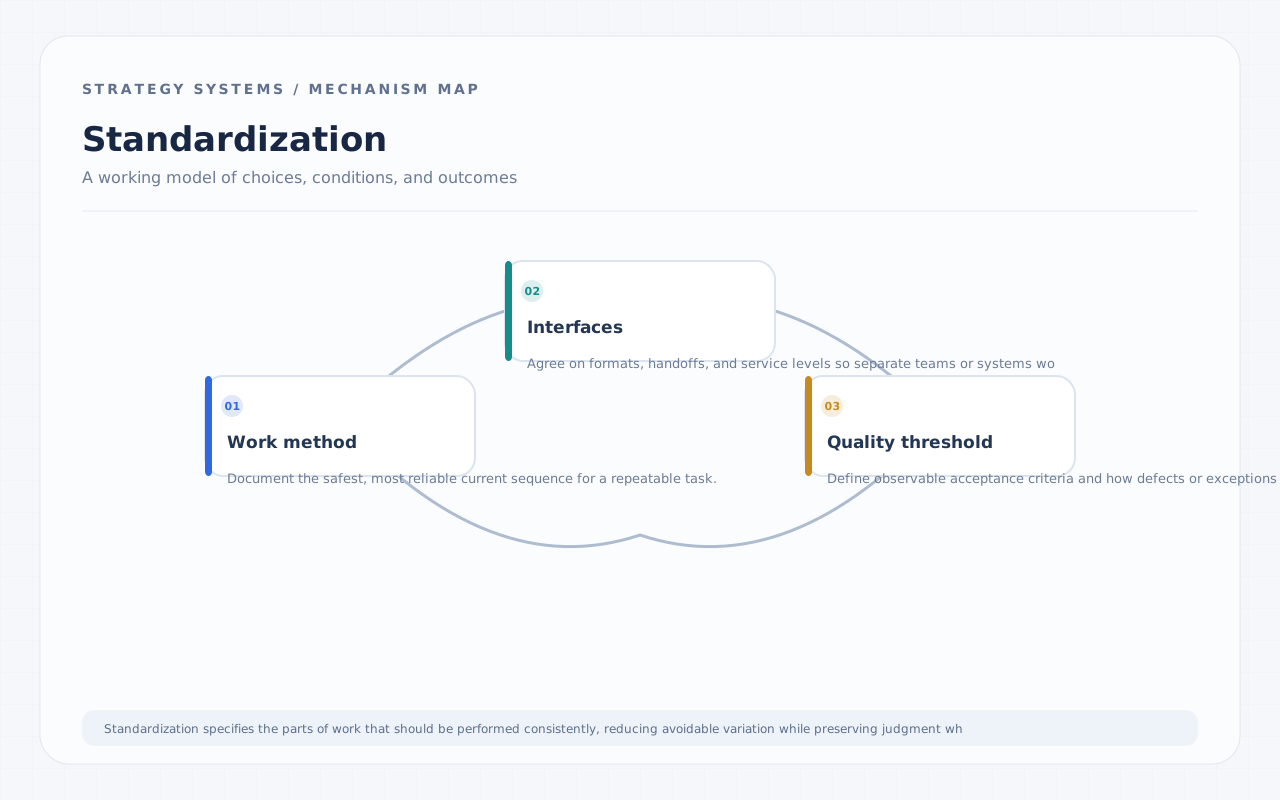
Standardization specifies the parts of work that should be performed consistently, reducing avoidable variation while preserving judgment where context matters.
The mechanism is a cycle. Define the outcome and the few process steps that materially affect it; make the method visible; train people; observe the work; then compare results and revise the standard when evidence changes. In operations, a standard can expose a gap between the expected process and actual conditions. That gap is useful information for improvement, not automatically proof that a worker failed.
Standardization is different from uniformity for its own sake. A stable core can coexist with deliberate local variation in products, routing, or service. The design question is which differences create value or satisfy legal and customer requirements, and which are accidental rework. A standard becomes brittle when it encodes assumptions that no longer hold or makes front-line teams hide exceptions instead of surfacing them.
Where standards create leverage
Set common rules around work that benefits from consistency, comparability, or compatibility.
 Work method
Document the safest, most reliable current sequence for a repeatable task.
01
Document the safest, most reliable current sequence for a repeatable task.
Document the safest, most reliable current sequence for a repeatable task. Interfaces
Agree on formats, handoffs, and service levels so separate teams or systems work together.
02
Agree on formats, handoffs, and service levels so separate teams or systems work together.
 Quality threshold
Define observable acceptance criteria and how defects or exceptions are handled.
03
Define observable acceptance criteria and how defects or exceptions are handled.
A continuum, not a switch
Standardization makes selected tasks, interfaces, or quality thresholds common. The right level preserves useful local judgment and keeps feedback able to change the standard.
“A standard is the current best-known method, not a reason to stop improving it.”
Why it matters
Common methods can make defects easier to spot, reduce avoidable variation, and help a company transfer learning between sites. They also make performance comparisons more meaningful, provided teams are doing comparable work and the measurement accounts for product mix and conditions. Before expanding a standard, confirm that people have the tools, training, time, and authority to follow it.
In May 2018 Toyota described introducing standardized work on the development side to determine necessary time and cost per output and shorten lead times, while preserving specifications and performance for regional needs. This is a dated company account of an effort and its aim, not a measured reduction or a reason to make every task identical.
Write the standard so a deviation can be interpreted. A result can differ because of an outdated assumption, a missing tool, changed mix or a method not followed. Those explanations require different actions. Compare equivalent work and record the conditions rather than rank operators using an unadjusted average.
Real-world examples
The same concept shows up in different ways across industries.

When it breaks
An over-specified process can slow response to unusual needs, local laws, or changing equipment. A standard may also improve the measured step while moving work or defects downstream. Keep exceptions visible, identify who can authorize them, and review the full customer or production outcome rather than optimizing one station in isolation.
Standards are weak when they are written without the people who do the work, when compliance is rewarded over quality, or when the method is not updated after conditions change. Track both adherence and the outcome the standard exists to protect. Use a small pilot, observe variation and rework, and retire requirements that add effort without improving safety, quality, compatibility, or service.
Retain a controlled way to revise the method and authorize necessary exceptions. A standard that prevents correction can preserve a defect more consistently. Observe the full downstream outcome after revision; shifting rework or setup to another team is not a system saving.
Key takeaways
- 01
Which outcome requires consistency, and which differences are valuable responses to customer or operating conditions?
- 02
Can the people doing the work see, understand, and safely improve the standard?
- 03
What customer, safety, quality, or rework measure will show whether the standard helps across the full process?
Related concepts
See all → Lean operationsMake work flow. Surface problems early.
 Economies of scaleUnit costs fall as you grow.
 Throughput and bottlenecksFind the constraint that governs end-to-end output.
 Supply-chain resilienceDesign the network to absorb and recover.
Related cases
See all →Sources
- TMC’s Year-end Financial Results Press Conference, May 9 2018 · Toyota Motor Corporation. Akio Toyoda remarks, paragraph beginning In addition to ascertaining..., applying standardized work to development to determine time/cost per output and shorten lead times.
- Lean Thinking Part II, Lecture 1–3, January 2012 · MIT OpenCourseWare. PDF index 12, Little’s Law, interdependence of average WIP, throughput and cycle time; index 14, standard work and improvement.