Concept · Economics
Lean operations
Improve customer value and flow by removing avoidable work while exposing problems early
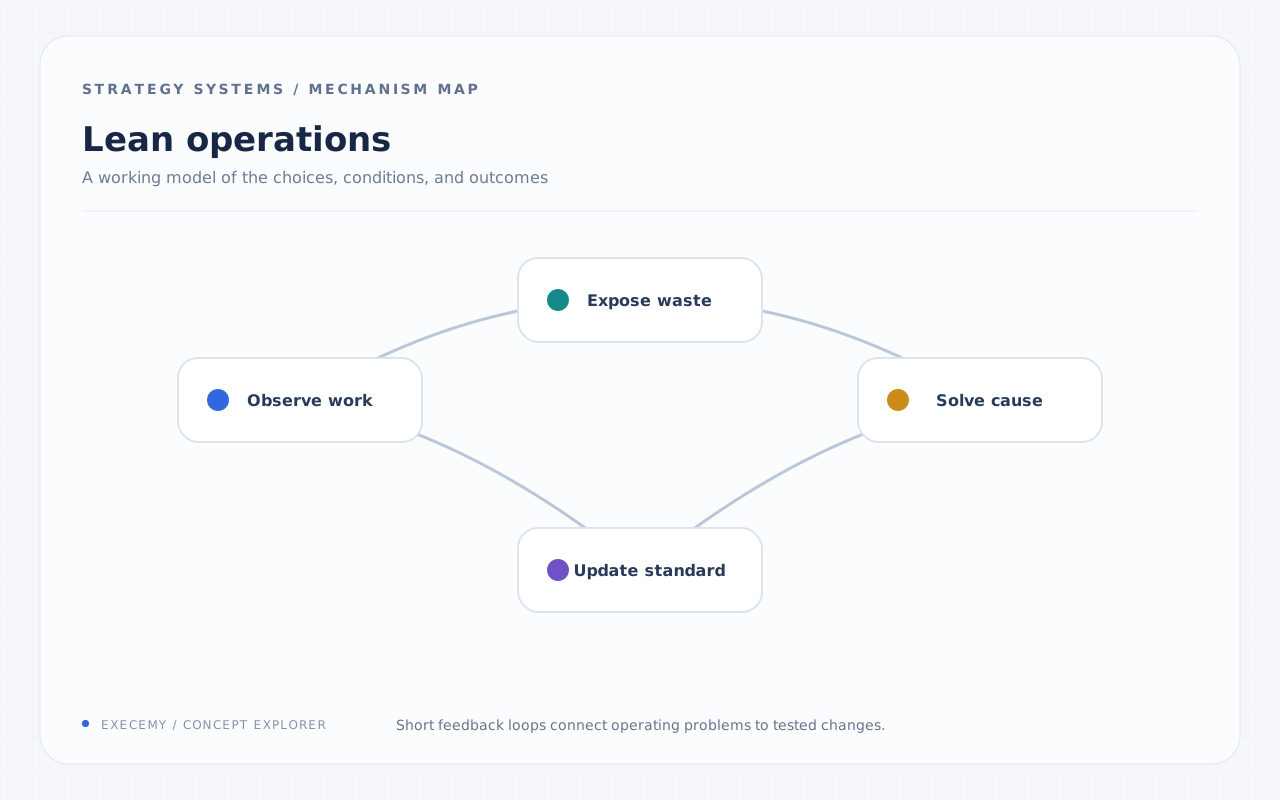
Make work flow. Surface problems early.
Lean operations begin by defining what the customer values and tracing the work needed to deliver it. Teams look for waiting, unnecessary movement, excess production, rework, overprocessing, and other activities that consume resources without improving the outcome. The aim is not to cut every cost indiscriminately. It is to make useful work flow while preserving safety, quality, and the capacity to meet demand.
Lean operations are a management system for delivering customer value with less avoidable work through flow, pull, built-in quality, and continuous improvement.
A pull system replenishes work when the next step needs it instead of pushing large batches forward on a forecast alone. Standard work makes the current best-known method visible, so teams can coordinate and see deviations. Built-in quality, or jidoka in Toyota’s system, stops or flags work when a problem appears. Continuous improvement then tests causes and changes the process rather than hiding defects in inventory.
Lean is a system of operating choices, not a temporary cleanup event or a synonym for layoffs. Lower buffers can reveal problems and reduce waste, but they also make disruptions more visible and can increase the effect of a supplier or equipment failure. Lean systems need reliable replenishment, worker participation, and disciplined problem solving.
Core operating practices
Each practice helps work move predictably and makes defects or delays easier to see.
 Flow and pull
Move work in small, needed quantities and replenish from actual downstream demand.
01
Move work in small, needed quantities and replenish from actual downstream demand.
Move work in small, needed quantities and replenish from actual downstream demand. Built-in quality
Detect an abnormal condition where it occurs, contain it, and correct the underlying process.
02
Detect an abnormal condition where it occurs, contain it, and correct the underlying process.
 Continuous improvement
Use repeatable observation and experiments to improve the current process over time.
03
Use repeatable observation and experiments to improve the current process over time.
A continuum, not a switch
Lean maturity depends on stable processes, clear standards, quality at the source, and continuous improvement—not simply low inventory or high utilization.
“Less inventory is an outcome of reliable flow, not the definition of lean.”
Why it matters
A process can report low unit cost while imposing long lead times, defects, excess inventory, or customer rework. A lean view follows the whole value stream and asks how long a customer waits, where work piles up, and how often it is done correctly. Measure lead time, first-pass yield, defects, changeover time, and safety alongside labor and inventory.
Toyota presents just-in-time and jidoka together, including minimum parts stocks and replenishment as well as stopping to address abnormalities. Its public method connects flow with quality; it does not provide a plant-specific before/after result. Removing stock while omitting response and supply reliability does not reproduce that operating system.
For a stable system, Little’s Law relates average work in process L, throughput λ and average flow time W as L = λW, with compatible boundaries and units. It is an accounting relationship, not proof that removing L causes W to fall while λ stays fixed. A smaller buffer can instead starve the limiting process; measure accepted output and replenishment variation together.
Real-world examples
The same concept shows up in different ways across industries.

When it breaks
Removing inventory without fixing unstable demand, supplier lead times, or process defects can create stockouts and emergency expediting. A system with little slack may look efficient until a machine, shipment, or workforce disruption occurs. Set buffer levels based on variability, recovery time, and the cost of missing demand; do not treat every buffer as waste.
Lean efforts fail when workers are asked to meet higher throughput without authority to raise quality or safety problems. Standard work can become a rigid script if it is never updated. Leaders need to protect stop-and-fix behavior, investigate causes, and reward improvement rather than output alone. A thinner process is valuable only if it remains capable and humane.
Distinguish containing an abnormality from preventing recurrence. A stop can protect downstream work while consuming response capacity, and a quick restart can leave the cause unresolved. Trace detection, authority, correction and learning through the entire customer outcome before declaring that fewer stops or less inventory is improvement.
Key takeaways
- 01
Which steps create value from the customer's perspective, and where do work, waiting, defects, or handoffs accumulate?
- 02
What signal triggers replenishment, and what variation or recovery time should the system's buffers absorb?
- 03
Can employees stop or improve the process when safety or quality deviates, and which measures show that the change helped?
Related concepts
See all → StandardizationRepeat the method. Learn from the variation.
 Economies of scaleUnit costs fall as you grow.
 Supply-chain resilienceDesign the network to absorb and recover.
Related cases
See all →Sources
- Toyota Production System · Toyota Motor Corporation. Jidoka, stopping and improvement; Just-in-Time, continuous flow, minimum parts stock and replenishment.
- Lean Thinking Part II, Lecture 1–3, January 2012 · MIT OpenCourseWare. PDF index 12, Little’s Law, interdependence of average WIP, throughput and cycle time; index 14, standard work and improvement.