Concept · Economics
Outsourcing
Assign an activity to an outside provider while retaining responsibility for the result
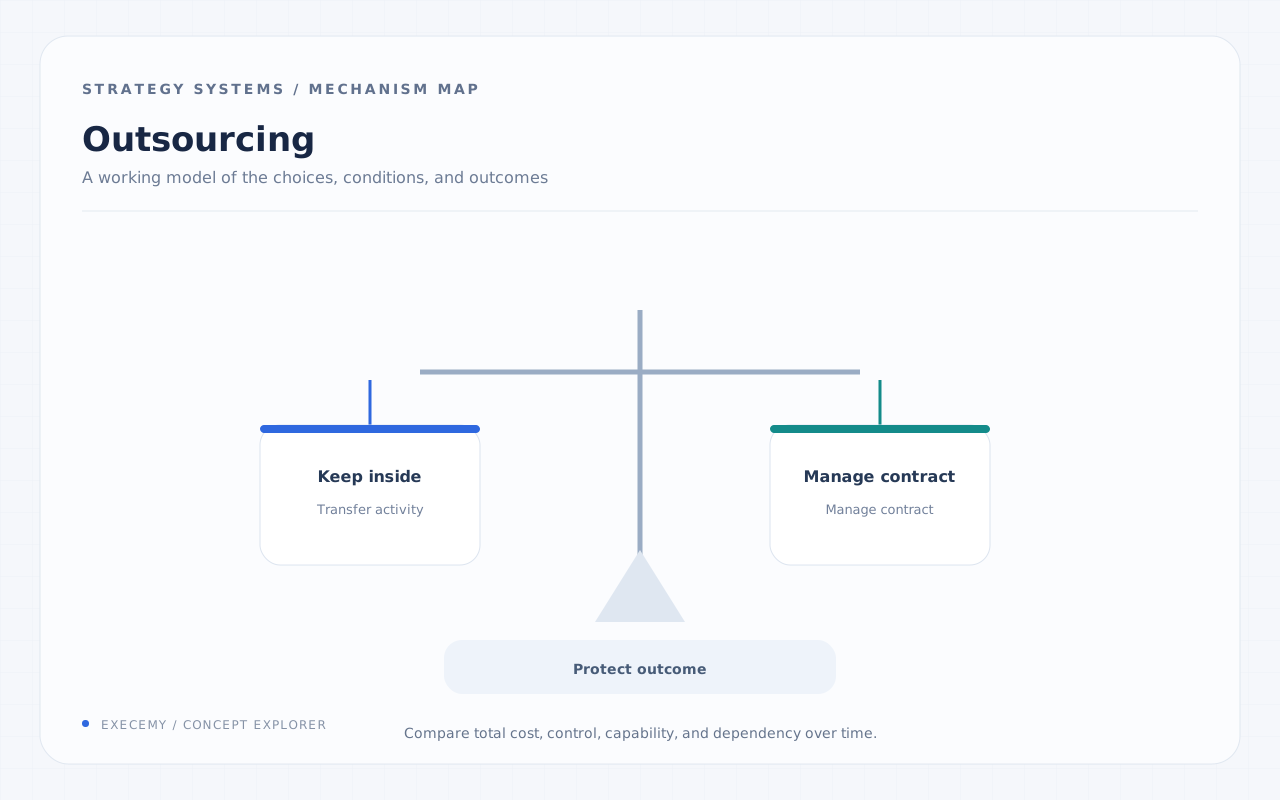
Buy an activity. Govern the dependency.
Outsourcing assigns an activity to an independent provider rather than the company’s own employees or assets. It can apply to manufacturing, logistics, customer support, payroll, software operations, or specialist services. The decision concerns who performs and controls the activity; it does not necessarily mean the work moves overseas. Offshoring describes location, and the two choices can occur together or separately.
Outsourcing is the decision to have an external provider perform work that the organization could otherwise perform itself, under agreed scope, service, and risk terms.
A firm may outsource to access expertise, add capacity, avoid a large fixed investment, or focus internal teams on a different capability. It must compare total cost, not only the supplier’s quoted price. Include transition, integration, contract management, quality checks, data and security controls, switching costs, and the expected cost of failure. Also identify whether the activity is strategically distinctive or tightly linked to customer experience.
The contract cannot specify every future condition. Demand, input availability, technology, and regulation change. Effective outsourcing therefore needs clear service levels, audit and data rights, escalation paths, business-continuity plans, and an exit or transition option. A buyer that loses internal knowledge may find it difficult to evaluate performance or move the work later.
What a firm can outsource
Classify the activity by its role in the customer promise and the risk of losing control.
 Production activity
Contract manufacturing, component supply, assembly, or quality testing.
01
Contract manufacturing, component supply, assembly, or quality testing.
Contract manufacturing, component supply, assembly, or quality testing. Operational service
Use an external specialist for support, processing, data hosting, or recurring administration.
02
Use an external specialist for support, processing, data hosting, or recurring administration.
 Capacity or logistics
Buy transportation, warehousing, or surge capacity while setting controls for delivery and continuity.
03
Buy transportation, warehousing, or surge capacity while setting controls for delivery and continuity.
A continuum, not a switch
Outsourcing moves execution across an organizational boundary. The right choice depends on total cost, access to capability, quality control, and the strategic importance of the activity.
“Contracting out the work does not contract out accountability for the customer result.”
Why it matters
Outsourcing can turn some fixed assets into a variable or contracted cost, but payment commitments may still be long-term and capacity can be constrained. A single-source provider can become a bottleneck. Keep a view of second sources, inventory buffers, supplier health, and what can be brought back in-house if performance changes.
Apple's 2024 Form 10-K says substantially all of its hardware products are manufactured by outsourcing partners, primarily in several Asian countries. The same filing describes trade restrictions, component shortages, and supplier-capacity risks. This shows how a company can design around external manufacturing while remaining exposed to partner capability and geography; it does not mean that outsourcing alone explains Apple's product economics.
Apple’s filing adds a material qualification to the asset-light claim. It owns manufacturing-process equipment held at partners and makes supplier prepayments; it also remains responsible for warranty service. Moving execution outside the firm can leave capital, quality and recovery exposure inside. Include these retained commitments in a make-or-buy comparison.
Real-world examples
The same concept shows up in different ways across industries.

When it breaks
The provider may optimize its own utilization instead of the buyer’s customer outcome. Weak specifications, difficult-to-measure quality, or poorly aligned incentives can make a cheap bid expensive in practice. Start with a measurable service result, inspect failure modes, and check whether the provider has the capacity and permission to meet it.
Outsourcing can also hollow out the capability needed to innovate or supervise. If the activity is difficult to separate from product design, confidential data, or customer trust, the coordination boundary may cost more than the labor saved. Retain enough expertise to challenge the provider, protect critical knowledge, and execute a credible transition.
A fallback must be feasible rather than named. Check qualification, tooling, data, available capacity and the time required to transfer work. A nominal second provider can share the same upstream dependency or lack permission to use the necessary process. The public risk disclosure establishes exposure, not the expected cost of an alternative arrangement.
Key takeaways
- 01
What activity is transferred, and which customer outcome and risks remain the company’s responsibility?
- 02
What is the total cost after transition, oversight, quality, security, failure, and exit expenses?
- 03
Where is the dependency concentrated, and what fallback preserves service if the provider fails or terms change?
Related concepts
See all → Build, buy or partnerChoose the boundary that best fits the capability and time horizon.
 Activity-system fitMake the parts work better together.
 Cost leadershipDesign the system around a lower delivered cost.
 Supply-chain resilienceDesign the network to absorb and recover.
 StandardizationRepeat the method. Learn from the variation.
Related cases
See all →Sources
- Apple Inc. 2024 Form 10-K · Apple / SEC. Printed pp. 7–8, outsourced manufacturing, loss of control, warranty responsibility, company-owned equipment at partners and supplier prepayments.