Framework · Execution
Objectives and key results
Translate a small set of strategic priorities into measurable outcomes that teams can review together
Name the outcome. Measure the change.
An objective states a meaningful outcome or direction; key results describe measurable evidence that the outcome is being achieved. A team can use OKRs to make priorities visible, align work across groups, and review progress on a cadence. They are not a complete strategy, individual task list, or substitute for understanding the customer and market.
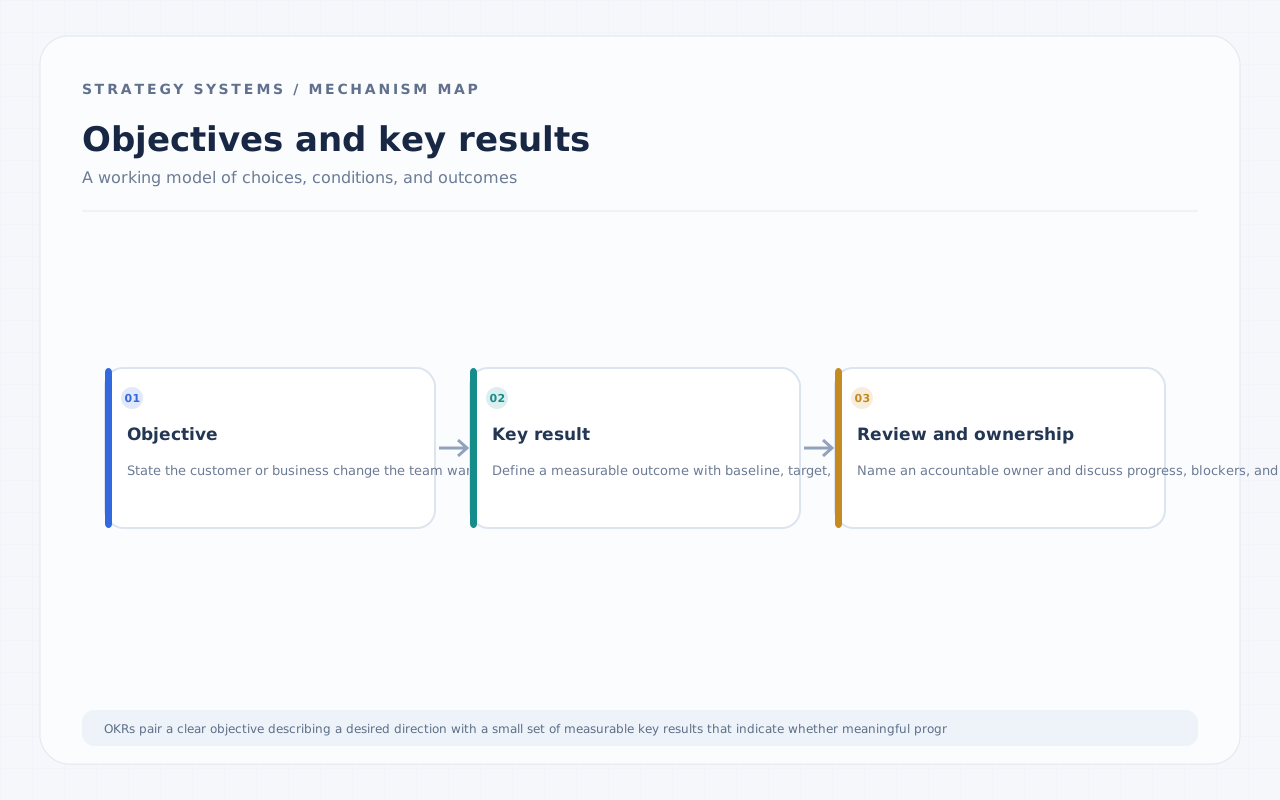
OKRs pair a clear objective describing a desired direction with a small set of measurable key results that indicate whether meaningful progress occurred.
A practical OKR begins with an objective that matters within a chosen period. Key results need a measure, baseline, target, population, owner and source. For onboarding, connect core-workflow completion with later retention for the same cohort using observation windows justified by actual product behavior. A release date can mark a milestone, but alone it does not establish customer impact.
Google's re:Work guide documents its use of OKRs, recommends a limited number of objectives, and distinguishes results from activities. The framework's value depends on the quality of goals, the review process, and organizational context. If OKRs are tied mechanically to compensation or treated as guaranteed forecasts, people may sandbag targets or optimize the measured number at the expense of the real outcome.
A useful OKR has three parts
Keep the result measurable and related to the objective, then connect it to real decisions.
 Objective
State the customer or business change the team wants to make.
01
State the customer or business change the team wants to make.
State the customer or business change the team wants to make. Key result
Define a measurable outcome with baseline, target, time window, and data source.
02
Define a measurable outcome with baseline, target, time window, and data source.
 Review and ownership
Name an accountable owner and discuss progress, blockers, and changed assumptions.
03
Name an accountable owner and discuss progress, blockers, and changed assumptions.
A continuum, not a switch
OKRs work best when a small number of measurable results guide learning and trade-offs while execution choices remain adaptable.
“A task list says what the team will do; a key result states what should change.”
Why it matters
OKRs can reduce the distance between a strategy discussion and weekly trade-offs. A limited set makes it easier to say no to work that does not advance a current priority. At review time, compare the result with its baseline and discuss whether the initiative should change. Separate commitment from learning goals so teams can report uncertainty without hiding failure.
Google's public re:Work guide describes its own OKR practice and provides examples of measurable key results and common writing mistakes. It is a primary source for how Google presented its method, not an independent test that OKRs cause a company's performance. Organizations should adapt the cadence, transparency, and scoring conventions to their size and culture.
Real-world examples
The same concept shows up in different ways across industries.

When it breaks
Too many OKRs fragment attention; vague objectives invite interpretation; activity-based key results reward motion without impact. Measures can be gamed, and quarterly targets can push teams toward short-term wins over long-term health. Set a small number of outcomes, define guardrail measures for quality or trust, and use ranges when the evidence is uncertain.
Company and team OKRs can become a cascade of arbitrary numeric targets that hide dependencies or create conflicting incentives. Involve the people responsible for the work, make shared dependencies visible, and distinguish directly controlled results from external conditions. Review progress as a conversation about decisions and learning, not a scoreboard that removes context.
A key result can improve because the measured population changed. Keep eligibility, measurement windows and instrumentation stable or disclose the change. If a leading measure is intended to predict retention, test the relationship; a well-specified target does not by itself establish that the measure causes the intended outcome.
Key takeaways
- 01
Does each objective name a meaningful customer or business outcome rather than a broad slogan?
- 02
Can every key result be calculated from a clear baseline, target, time window, and trusted data source?
- 03
Which decisions will change if the key results move, and what quality or risk guardrail prevents metric gaming?
Related concepts
See all → Leading and lagging indicatorsAct on the signal. Verify the result.
 Theory of changeShow the path from action to outcome.
 Incentive alignmentReward the outcome without breaking the system.
 Strategic coherenceMake the choices reinforce one another.
 Strategic diagnosisFind the constraint that makes the situation hard.
Sources
- Set goals with OKRs · Google re:Work. Writing effective OKRs, results versus activities; grading and review, annual and quarterly sharing and review.