Concept · Execution
Leading and lagging indicators
Pair early signals you can influence with outcome measures that show what actually happened
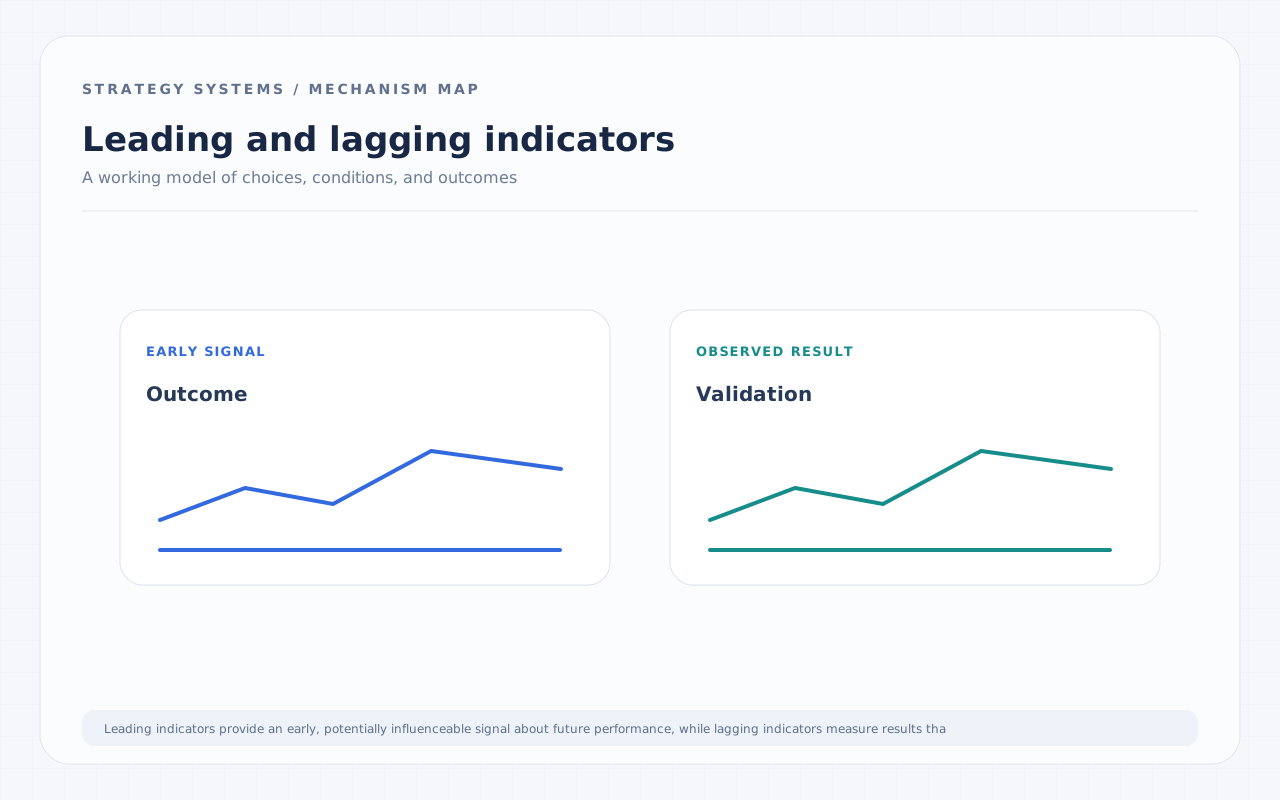
Act on the signal. Verify the result.
A lagging indicator records an outcome after the relevant activity or event has occurred: revenue, churn, defects, or injuries. A leading indicator measures a condition or behavior expected to affect future outcomes, such as qualified trial activation, preventive maintenance completion, or response time before a service failure. The labels depend on the decision and time horizon; the same measure can be leading for one outcome and lagging for another.
Leading indicators provide an early, potentially influenceable signal about future performance, while lagging indicators measure results that have already occurred.
Use both types as a feedback system. Start with the outcome that matters, identify a plausible set of controllable antecedents, and test whether changes in those signals reliably precede the result. For example, an operations team might pair a lagging measure of rework with a leading measure of first-pass checklist completion. The leading measure is useful only if it has a credible link to fewer errors and does not reward superficial compliance.
No indicator is automatically predictive because it is measured early. A leading measure needs a stated causal hypothesis, a time window, a population, and validation against outcomes. Build a balanced dashboard with definitions, owners, and decision thresholds. Avoid relying on a single rate when product mix, seasonality, or reporting delays can change its meaning.
Build a balanced measurement pair
Connect a controllable signal to a result, then test the relationship over time.
 Outcome
Choose the lagging result that reflects customer, financial, quality, or safety performance.
01
Choose the lagging result that reflects customer, financial, quality, or safety performance.
Choose the lagging result that reflects customer, financial, quality, or safety performance. Early signal
Identify a process condition that could influence the outcome and can be acted on.
02
Identify a process condition that could influence the outcome and can be acted on.
 Validation
Check whether movement in the signal consistently precedes a meaningful outcome change.
03
Check whether movement in the signal consistently precedes a meaningful outcome change.
A continuum, not a switch
Leading measures can help teams intervene sooner; lagging measures confirm results. Both need clear definitions and a tested relationship.
“A leading indicator is a hypothesis about the future, not the outcome itself.”
Why it matters
Lagging measures show whether the business achieved a result, but they may arrive too late to intervene. Leading measures can help managers detect risk and respond sooner. Pairing them helps teams connect action to impact while recognizing that multiple factors can influence the outcome. A leading signal should prompt investigation or action, not be treated as proof that the target has been met.
The U.S. Occupational Safety and Health Administration distinguishes proactive, preventive leading indicators from lagging counts of past injuries, illnesses, or fatalities, and recommends using both in safety programs. A manufacturer could pair a leading measure such as corrective-action closure with lagging incident rates, but the company must verify that closing actions corresponds to safer work rather than paperwork completion.
An early signal needs an intervention path. Specify who sees it, what action remains feasible and whether that action changes the outcome before the opportunity closes. A signal can correlate with harm because both follow a hidden condition; changing the count may then change neither the condition nor the result. Evaluate the intervention separately from predictive accuracy.
Real-world examples
The same concept shows up in different ways across industries.

When it breaks
A leading indicator may be weakly related to the outcome, arrive too late to act on, or become a target that people game. For instance, more sales calls may correlate with pipeline but can reduce quality if they reward volume alone. Validate leading measures with historical cohorts or controlled tests where possible, and monitor for unintended effects.
Lagging indicators can be distorted by under-reporting, attribution windows, small denominators, or external events. Define the measure's numerator, denominator, source, and time period. Review disaggregated results and keep a qualitative path for exceptions that a dashboard cannot represent.
Validation can decay when the population, product or reporting method changes. Follow prediction errors and missing observations alongside the measured signal, and preserve a way to surface exceptions. Rewarding a preventive activity count can produce paperwork rather than prevention; compare the completed action with its intended operating consequence.
Key takeaways
- 01
Which outcome has already occurred, and what early condition might plausibly influence it?
- 02
Can the team act on the leading measure before the lagging result arrives?
- 03
What evidence tests the link between signal and outcome, and how will you detect gaming or unintended effects?
Related concepts
See all → Throughput and bottlenecks
 Lean operations
Sources
- Leading Indicators · Occupational Safety and Health Administration. Leading Indicators, proactive/preventive measures, occurred events and joint use in safety programs.
- Toyota Production System · Toyota Motor Corporation. Jidoka, stopping and improvement; Just-in-Time, continuous flow, minimum parts stock and replenishment.