Concept · Organization
Incentive alignment
Reward decisions that advance durable shared outcomes without making one metric the whole strategy
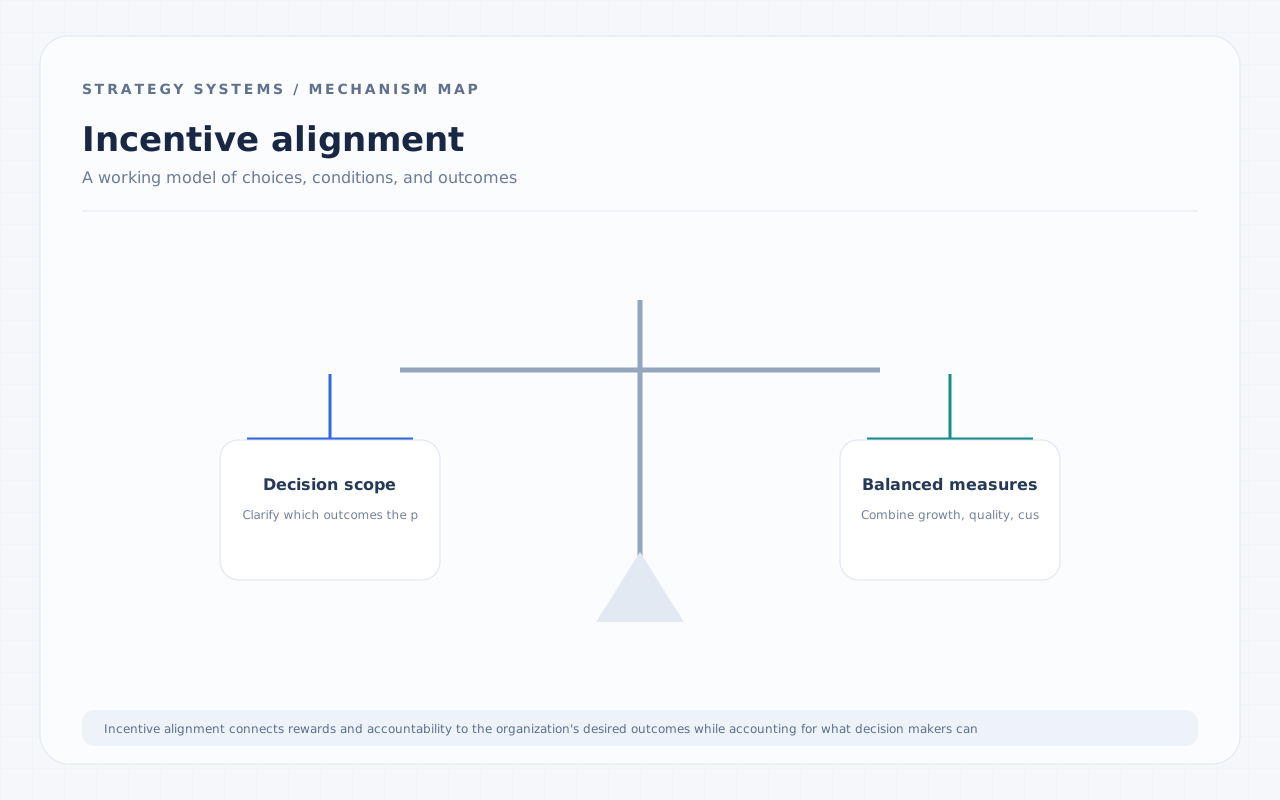
Reward the outcome without breaking the system.
Incentives include more than bonuses. Pay, promotion, status, decision rights, budgets, recognition, and the consequences of failure all influence behavior. Alignment means the system makes it reasonably attractive for a decision maker to consider outcomes that matter to the organization, especially when their own information or short-term interests differ from those of owners, customers, or colleagues.
Incentive alignment connects rewards and accountability to the organization's desired outcomes while accounting for what decision makers can control and the trade-offs a metric may create.
A sound design begins with the decisions the person or team can actually influence. Choose measures that reflect the intended result, combine metrics when any single one would create a distortion, set an appropriate time horizon, and define quality, risk, or customer guardrails. Then examine how the plan behaves under different conditions: uncertainty, low demand, unusual costs, or a sudden opportunity. Rewards tied only to quantity can encourage low-quality growth; rewards tied only to near-term margin can defer useful investment.
Incentives cannot solve every coordination problem. Goals may conflict, effort can be hard to observe, outcomes can depend on luck, and external conditions may dominate an individual's actions. Clear strategy, resources, feedback, and decision authority remain important. Review behavior and unintended consequences after implementation; a compensation formula that appears aligned on paper may still encourage gaming or excessive risk.
Ask whether a person can improve the rewarded measure without improving the intended outcome. For sales, an account-opening count and a verified customer choice are different objects. Test consent, genuine use, downstream loss and complaints independently of the production target. A measure meant to check quality is weak if the same team can manipulate both it and the rewarded count.
Design for the behavior you need
Match rewards to controllable decisions, shared outcomes, and the relevant time horizon.
 Decision scope
Clarify which outcomes the person or team can influence and which depend on others.
01
Clarify which outcomes the person or team can influence and which depend on others.
Clarify which outcomes the person or team can influence and which depend on others. Balanced measures
Combine growth, quality, customer, and risk measures where one metric would distort behavior.
02
Combine growth, quality, customer, and risk measures where one metric would distort behavior.
 Review and safeguards
Set payout boundaries, monitor side effects, and adjust the system when conditions change.
03
Set payout boundaries, monitor side effects, and adjust the system when conditions change.
A continuum, not a switch
Incentives can clarify priorities and encourage cooperation, but design must account for uncertainty, controllability, time horizon, and gaming.
“People respond to what the system rewards, including the side effects of the measure.”
Why it matters
A well-designed incentive can focus attention and support cooperation, but measures also signal what the organization considers valuable. Shared goals can encourage cross-functional results; individual measures may clarify ownership but create local optimization. Use a small number of understandable measures and pair them with qualitative review, especially for decisions with long-term or hard-to-measure consequences.
The CFPB’s September 2016 Wells Fargo consent order describes sales targets and incentive compensation, then employees temporarily funding unauthorized accounts with transfers from authorized accounts to obtain reward credit. The findings connect the rewarded proxy to conduct that could satisfy it while defeating customer consent. Wells agreed to the order without admitting or denying the findings except jurisdiction.
This failure also concerns oversight. In February 2018 the Federal Reserve restricted Wells Fargo’s growth pending governance and risk-control improvements. In June 2025 it removed the asset growth restriction after required third-party and Federal Reserve review; other provisions of that action remained at that date. Those are dated supervisory decisions, not proof that changing a sales bonus alone solved the problem.
Real-world examples
The same concept shows up in different ways across industries.
When it breaks
A narrow target can invite gaming: maximizing booked sales before returns, cutting support that protects retention, or taking risks whose costs arrive after the measurement period. Thresholds and caps can create cliffs, while subjective measures can weaken trust if criteria are unclear. Simulate likely responses before launch and inspect both the metric and downstream outcomes.
Alignment is constrained by information and control. A worker may not be able to affect a company-level result, while external shocks can overwhelm individual contribution. Allocate responsibility at the lowest level with meaningful influence, distinguish controllable process measures from lagging results, and provide a fair review when conditions change. Incentives should complement purpose, capability, and good management rather than compensate for their absence.
Adding metrics is not sufficient if warnings are not escalated or the reviewer cannot challenge the business owner. Inspect who verifies the evidence, who can stop a payout or activity and what happens when a guardrail is breached. A design claim of “balanced incentives” needs behavioral evidence under pressure, not only a formula.
Key takeaways
- 01
Which decisions can the rewarded person or team actually influence, and over what horizon?
- 02
What behavior might the chosen measure encourage at the expense of quality, customer trust, or risk?
- 03
Which guardrails and review process will reveal unintended effects before they become expensive?
- 04
Verify the intended customer outcome separately from the rewarded proxy, and test the escalation authority.
Related concepts
See all → Objectives and key resultsName the outcome. Measure the change.
 Leading and lagging indicatorsAct on the signal. Verify the result.
 Strategic coherenceMake the choices reinforce one another.
 Portfolio strategyChoose businesses and make the links earn their keep.
 Capital allocationFund the best next use of capital.
Related cases
See all →Sources
- Consent Order 2016-CFPB-0015, Wells Fargo Bank · Consumer Financial Protection Bureau. PDF index 1, §II Stipulation ¶2; indexes 3–4, ¶7–13 sales targets, incentives and simulated funding.
- Federal Reserve restricts Wells Fargo growth until governance and controls improve, February 2 2018 · Federal Reserve Board. Opening substantive paragraphs, asset-size cap, firmwide compliance/risk escalation and board oversight.
- Federal Reserve removes Wells Fargo asset growth restriction, June 3 2025 · Federal Reserve Board. Substantive paragraphs 1–4, conditions met, third-party/Fed review and other provisions remaining.