Concept · Platforms
Disintermediation
Remove a middle layer when direct access creates enough value to cover the work that layer performed
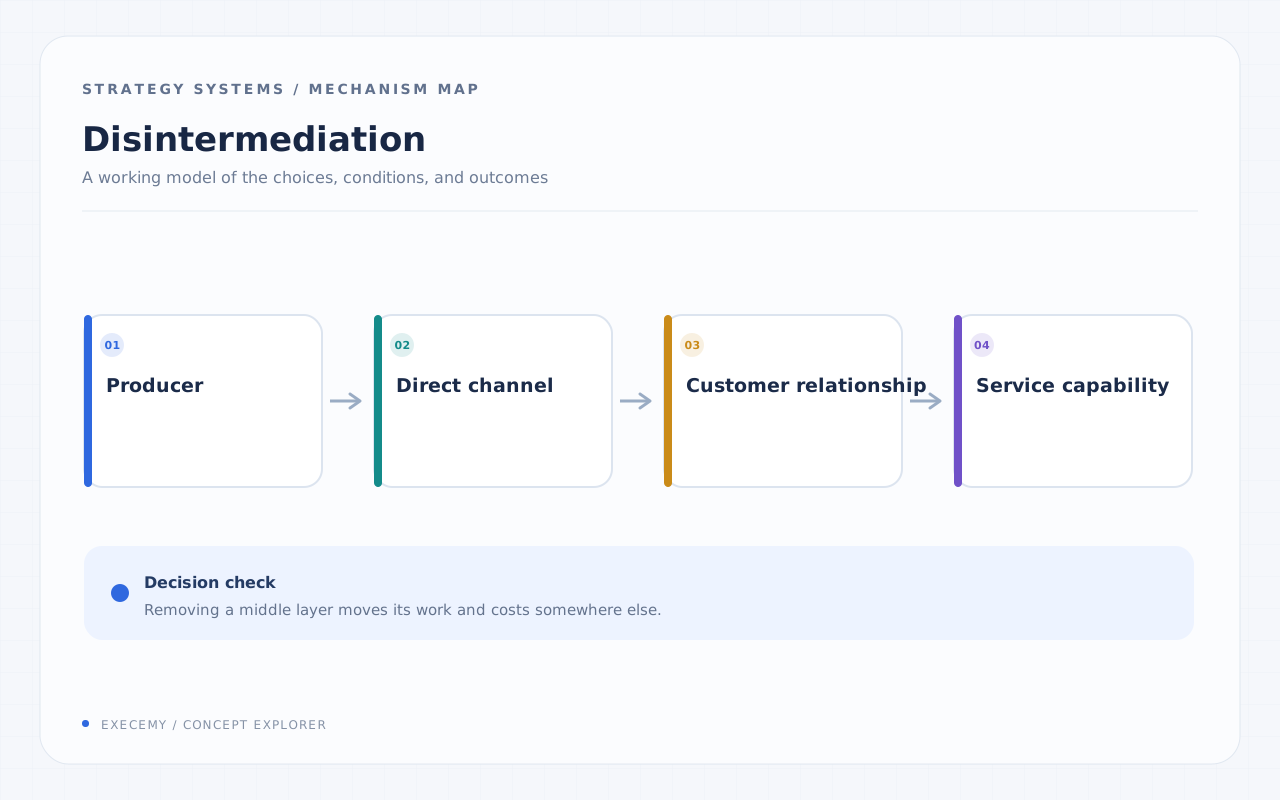
Remove a layer. Rebuild its useful work.
Disintermediation removes or bypasses a layer between a producer and a customer. It changes who performs discovery, matching, payment, delivery, trust and support. Useful work does not disappear merely because a commission or distributor is removed.
Disintermediation occurs when a producer and customer transact with fewer intermediaries, usually because technology or a new operating model makes direct access practical.
The decision is which function to take over and whether the complete direct route improves the customer outcome and economics. A producer can own checkout while depending on another platform for discovery or installation. A route can become more direct in one layer while gaining a new intermediary elsewhere.
Compare the full work under each arrangement, including transitions, returns and failures. The fee avoided is only part of the calculation. Missing capabilities and lost access can outweigh it without making the original arrangement universally preferable.
What changes in the chain
Map the function being removed before deciding whether the route is truly direct.
 Direct sales
A producer owns pricing, customer data, and service through its own channel.
01
A producer owns pricing, customer data, and service through its own channel.
A producer owns pricing, customer data, and service through its own channel. Self-service marketplace
Customers reach producers through a platform that handles discovery, payment, or reputation.
02
Customers reach producers through a platform that handles discovery, payment, or reputation.
 Peer exchange
Participants transact with one another, while a network provides rules, matching, or dispute support.
03
Participants transact with one another, while a network provides rules, matching, or dispute support.
A continuum, not a switch
A route becomes more direct as fewer independent layers control discovery and exchange, but value depends on how well the remaining parties replace those functions.
“When a middle layer disappears, its useful work still has to be done by someone.”
Why it matters
NIKE describes digital and wholesale roles during marketplace repositioning. Apple documents alternative app routes with authorization and operating conditions. The examples show changes in route and responsibility, without establishing a general profit gain from bypassing a layer.
The mechanism can improve control or information, yet require new infrastructure and customer service. A partner may supply expertise and local access that a direct route must replace. Evaluate where those capabilities matter for the intended buyer.
Demand, assortment and inventory can explain revenue changes alongside the route. A platform can also become a new gatekeeper for an apparently direct exchange. Identify who controls the next-best route and the relevant terms.
Real-world examples
The same concept shows up in different ways across industries.

NIKE’s FY2025 filing describes digital repositioning and wholesale reinvestment during inventory and demand pressure, alongside markdowns and returns. The actual response adjusts both direct and partner routes rather than treating the intermediary as a disposable checkout layer. A partner can perform discovery, advice, access, inventory and service work that does not disappear when the sale moves to the producer’s website. The decision is which of those activities the producer can perform reliably and at what cost. Direct selling can change customer access and margin allocation; it can also require acquiring traffic and managing fulfillment or returns. Partner selling can surrender some control while providing useful capabilities. The filing’s channel revenue and consolidated margin do not identify full channel contribution or prove which adjustment caused a result. Inventory management and changing demand are rival explanations. Trace the work and the complete customer outcome before removing the intermediary, then compare contribution under the applicable route. Ownership of checkout is not the same observation as the economics of the whole sale.

Apple’s authorized web-distribution route changes how an app reaches the user while retaining technical and operational requirements. It does not eliminate every platform dependence or supply a measured saving for an individual developer.
When it breaks
In a hypothetical producer, avoiding a distributor’s fee adds costly fulfillment and complaint work that the distributor handled well. The direct route may still be worthwhile for some customers, but fee removal alone cannot decide.
A producer can become dependent on a search, payment or device platform after bypassing a reseller. Map the resulting route and alternatives rather than equate fewer visible layers with complete control.
Key takeaways
- 01
Which intermediary function are you removing, and who will perform matching, trust, payment, delivery, and support afterward?
- 02
What is the fully loaded direct-channel cost per completed, retained transaction compared with the current route?
- 03
Does a platform or service become the new gatekeeper, and what terms or data does it control?
Related concepts
See all → Distribution advantageBeing where others can't be easily.
 Platform lock-inControl the ecosystem.
 Two-sided marketsCoordinate distinct related participant groups.
 Value chainsTrace the activities behind the customer promise.
 Build, buy or partnerChoose the boundary that best fits the capability and time horizon.
Sources
- NIKE 2025 Form 10-K · NIKE / SEC. MD&A pp. 28–29 financial highlights and actions; pp. 34–35 NIKE Brand revenue and gross margin
- Changes for apps in the European Union · Apple Developer. What’s new; Alternative distribution; Business terms; Transition to unified EU terms
- Web Distribution in the EU · Apple Developer. Opening; Eligibility and requirements; Transition to unified EU terms