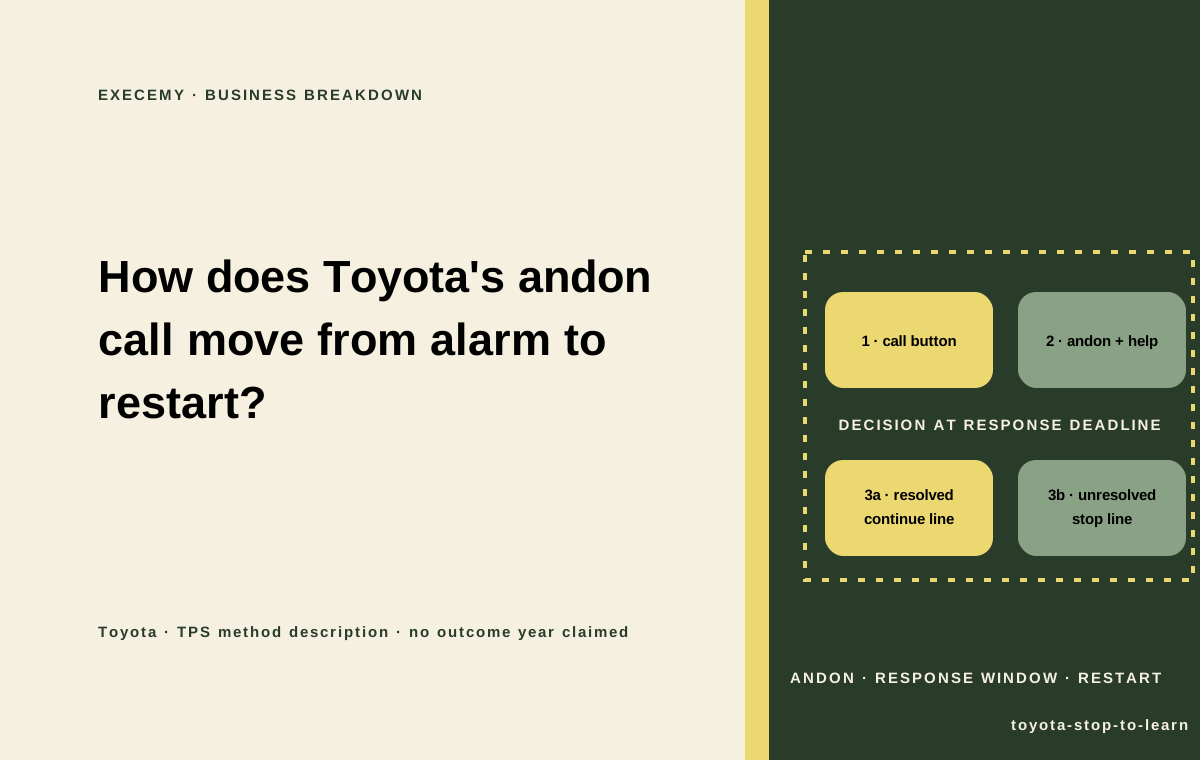
Toyota’s retrospective history records stop-button-linked andon adoption on the Crown assembly line at Honsha Plant in 1955 to identify the process responsible for a stoppage. The subsequent operating analysis distinguishes intended mechanism from observed improvement.
The question
How does Toyota's andon call move from alarm to restart?
Toyota’s recorded adoption of stop-button-linked andon on the Crown assembly line at Honsha Plant. · 1955 Honsha Plant Crown-line andon adoption; present-day response description. Toyota says the stop helps keep a defective product from flowing onward and supports addressing the abnormality at its source. The source states the purpose of the method, not a measured defect reduction for a particular factory. Toyota’s retrospective history records stop-button-linked andon adoption on the Crown assembly line at Honsha Plant in 1955 to identify the process responsible for a stoppage. The question is how the recorded design changes the work and which evidence would establish its benefit.
- Toyota Production System — Sections ‘Jidoka’ and ‘Just-in-Time’: abnormality detection, automatic or operator line stop, andon signal, and stated defect-prevention purpose.
- Toyota virtual plant tour · Production System — Production system tour, andon and stop-cord demonstration: leader response and restart after issue resolution.
- What happens when installation is delayed or incorrect? — Toyota Global Kids FAQ on production: call button, andon alert, helper response, timed recovery window, automatic conveyor stop, and restart after work is corrected.
- Toyota 75-year history: production-system development — PDF index 0, block Adoption of andons linked to a stop button (1955), Crown assembly line at Honsha Plant.
Mechanism 1 · A dated design choice, with an unmeasured outcome
A dated design choice, with an unmeasured outcome.
The recorded design choice joined a stop with location information. A halt without a usable location can consume time while the team searches; a location signal without someone able to respond can leave the problem untouched. The alternative of leaving those functions separate is an analytical comparison. The record does not disclose management’s option ranking, response times or a particular defect episode. Toyota’s current tour and FAQ illuminate response and restart responsibilities, but cannot prove that the same protocol or timing operated on the 1955 line.
Mechanism 1 · A dated design choice, with an unmeasured outcome
The earlier the signal, the less hidden work can travel.
Toyota says the stop helps keep a defective product from flowing onward and supports addressing the abnormality at its source. The source states the purpose of the method, not a measured defect reduction for a particular factory.
- Toyota Production System — Sections ‘Jidoka’ and ‘Just-in-Time’: abnormality detection, automatic or operator line stop, andon signal, and stated defect-prevention purpose.
Mechanism 2 · A slow response can turn the stop into a queue
A slow response can turn the stop into a queue.
In a generic process, a blocked station can create a queue upstream and starve downstream work. That is an operating inference, not Toyota queue data. The signal therefore needs a named responder and a practical escalation window.
Mechanism 3 · A stop rule needs a restart rule
A stop rule needs a restart rule.
Stopping is not a performance target. A useful operating system gives people authority to flag abnormalities, assigns an accountable responder, and learns whether the cause recurs. Toyota’s page describes the first two parts of its own method; recurrence rates are not disclosed here.
Optional application · unscored
Make the recurring error visible
A customer-support team recognizes a recurring application error only after the ticket has moved between teams.
Reveal: Place a signal where the error is recognizable, assign a responder and define what must be corrected before the ticket moves on. Compare downstream rework, customer delay and recurrence; a stop count alone does not measure improvement.
Teaching assumption: Original fictional operating situation.
Teaching assumption: No numerical costs, durations, volumes, probabilities or observed company outcome are assigned.
The answer
How does Toyota's andon call move from alarm to restart?
Toyota says the stop helps keep a defective product from flowing onward and supports addressing the abnormality at its source. The source states the purpose of the method, not a measured defect reduction for a particular factory. Jidoka is a stop-and-surface method, not a claim that stopping always increases throughput. It pays only when early visibility prevents larger downstream loss and the team can restore the process; the cited Toyota pages do not quantify that balance. Toyota’s FAQ describes a response window before an automatic conveyor stop, but supplies no duration or response-time distribution. Whether the blocked step limits system output also remains an operating question; a local stop cannot settle it. The dated intervention comes from a retrospective company history; modern method pages explain the mechanism but do not establish the original response protocol or causal performance. Contemporaneous option records and comparable outcome measurements remain unavailable. The case is bounded to Toyota’s recorded adoption of stop-button-linked andon on the Crown assembly line at Honsha Plant. during 1955 Honsha Plant Crown-line andon adoption; present-day response description.
- Toyota Production System — Toyota Motor Corporation
Sections ‘Jidoka’ and ‘Just-in-Time’: abnormality detection, automatic or operator line stop, andon signal, and stated defect-prevention purpose.
Exact factual uses and inference limits are bound in the evidence claim ledger.
An official description of the method, not a plant-level dataset showing stop frequency, queue length, defect rate, or net productivity effect.
- Toyota virtual plant tour · Production System — Toyota Motor Corporation
Production system tour, andon and stop-cord demonstration: leader response and restart after issue resolution.
Exact factual uses and inference limits are bound in the evidence claim ledger.
A company-produced illustration of standard practice; it does not measure how consistently or quickly the response occurs across plants.
- What happens when installation is delayed or incorrect? — Toyota Motor Corporation
Toyota Global Kids FAQ on production: call button, andon alert, helper response, timed recovery window, automatic conveyor stop, and restart after work is corrected.
Exact factual uses and inference limits are bound in the evidence claim ledger.
This is Toyota’s Japanese-language educational explanation of the procedure; the English claim is a translation and not a report of average stop or response performance.
- Toyota 75-year history: production-system development — Toyota Motor Corporation
PDF index 0, block Adoption of andons linked to a stop button (1955), Crown assembly line at Honsha Plant.
Exact factual uses and inference limits are bound in the evidence claim ledger.
Retrospective company history, not a contemporaneous experiment. Adoption dates and equipment/configuration are reported; no measured causal improvement or internal option-ranking record is supplied. Current method explanations are not projected backward as historical operating protocols.
Original illustrative scenes are not documentary evidence.