Open visual reader →
When should a brand sell direct and when should it use partners?
Reported channel contraction and consolidated margin pressure do not identify a winning channel.
Explore NIKE →
The question
When should a brand sell direct and when should it use partners?
NIKE Brand Direct and wholesale roles during FY2025 marketplace repositioning · Fiscal years ended May 31, 2024 and May 31, 2025; FY2025 disclosed marketplace actions. Reported channel contraction and consolidated margin pressure do not identify a winning channel.
Mechanism 1 · NIKE reported a choice across the marketplace
NIKE reported a choice across the marketplace
A brand choosing between owned and wholesale routes is assigning work, risk and control. Owned channels may give it direct contact with buyers and responsibility for the transaction. A retail partner may supply customer access, presentation and service while sharing the economics. The right comparison depends on the customer task and the resources needed to complete it.
NIKE’s fiscal 2025 disclosure records a difficult adjustment across both routes. It supports a decision about marketplace management. It does not tell us that wholesale won, that direct selling failed as a general model, or that a new channel mix would restore profit.
The company said it was repositioning NIKE Brand Digital toward full-price selling and reinvesting in wholesale distribution. Its inventory actions included markdowns in NIKE Direct and discounts and returns with wholesale partners. [NIKE 2025 Form 10-K, MD&A, marketplace-management action](https://www.sec.gov/Archives/edgar/data/320187/000032018725000047/nke-20250531.htm).
Those are disclosed management actions. The analytical alternatives include continuing the existing channel emphasis, changing the inventory position without altering channel roles, or adjusting the roles and the product portfolio together. The filing does not supply a ranked internal options paper. We should distinguish the reported choice from alternatives reconstructed for teaching.
The mechanism to investigate is coordination. An owned site seeking full-price demand cannot be evaluated independently of clearance, available products, customer traffic and what partners are being asked to carry. Moving inventory through another route does not remove its discount or return cost; it changes who handles the work and where the effect appears.
- NIKE 2025 Form 10-K — MD&A pp. 28–29 financial highlights and actions; pp. 34–35 NIKE Brand revenue and gross margin
Mechanism 1 · NIKE reported a choice across the marketplace
Revenue movement is not channel contribution
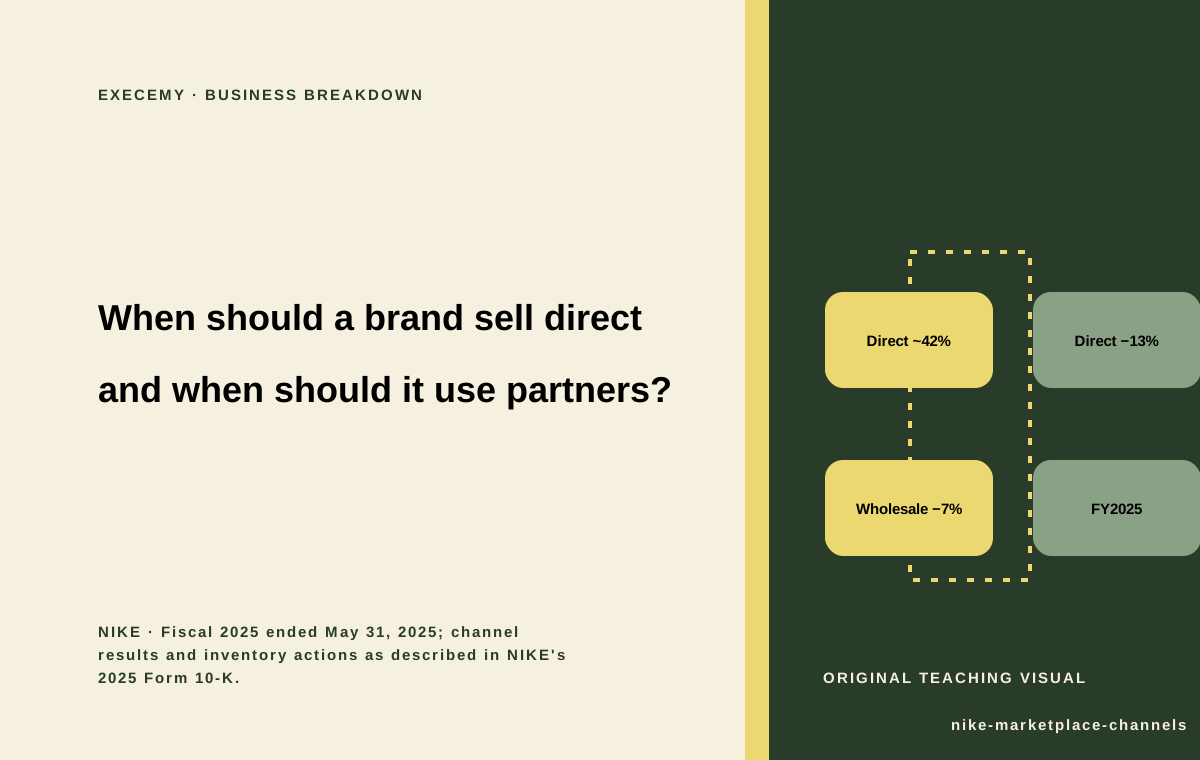
NIKE reported Direct revenue of $18.8 billion in fiscal 2025 versus $21.5 billion in fiscal 2024, a reported decline of 13%. Direct represented approximately 42% of NIKE Brand revenue. Wholesale revenue declined 7% on a reported basis. These are the company’s rounded results, not a comparison of channel profit. [Form 10-K, fiscal 2025 financial highlights and NIKE Brand revenue discussion](https://www.sec.gov/Archives/edgar/data/320187/000032018725000047/nke-20250531.htm).
The denominator matters. A share of NIKE Brand revenue is different from a share of consolidated company revenue. A reported revenue decline is also different from a currency-neutral change. Keeping those definitions intact is necessary before making any comparison; additional decimals calculated from rounded headline values would not create more measurement precision.
Both routes contracted. That observation weakens a simple story in which one distribution method clearly displaced the other successfully. It does not establish that the routes had equal problems or that the same intervention would suit them. A useful analysis needs the offer, buyer and operating conditions within each route.
- NIKE 2025 Form 10-K — MD&A pp. 28–29 financial highlights and actions; pp. 34–35 NIKE Brand revenue and gross margin
Mechanism 2 · Inventory and product choices are competing explanatio
Inventory and product choices are competing explanations
NIKE’s consolidated gross margin moved from 44.6% to 42.7%, a decline of 190 basis points. Management named discounts, channel mix and inventory obsolescence among the factors. Its discussion also described lower Direct traffic and changes to product supply. [Form 10-K, gross margin and fiscal 2025 operating discussion](https://www.sec.gov/Archives/edgar/data/320187/000032018725000047/nke-20250531.htm).
This is a management explanation with multiple factors, not an experiment identifying the effect of the channel strategy. Demand, product selection and the inventory transition can change results together. A diagram should show those possible connections qualitatively and attribute management’s account; it should not display a fabricated causal contribution for each factor.
The strongest alternative to a channel-only explanation is that the product and demand position constrained both routes. Another is that clearance deliberately reduced near-term results to create capacity. The filing does not tell us how much of the year’s decline each explanation accounts for, nor whether the later benefits justified the costs.
- NIKE 2025 Form 10-K — MD&A pp. 28–29 financial highlights and actions; pp. 34–35 NIKE Brand revenue and gross margin
Mechanism 2 · Inventory and product choices are competing explanatio
Compare the work and risk retained after the sale
The missing channel contribution comparison is consequential. A brand needs revenue net of discounts and returns, along with fulfillment, acquisition, service, inventory and capital costs assigned consistently. It also needs to understand what a partner contributes: access to a buyer, local merchandising, fit assistance, stock availability or recovery after a problem.
Some costs are shared, and assigning them mechanically can produce an apparently precise but misleading ranking. Some channel benefits also appear later or in another route. A buyer might discover a product through a retailer and purchase elsewhere. The appropriate question is how the marketplace completes that buyer’s task, not which route receives all the credit from an incomplete attribution rule.
For a hypothetical footwear label, the practical alternatives could be owned digital access, specialist retailers, or a coordinated mix. Try-on, discovery, returns and stock risk should inform that choice. No margin or conversion parameter is assumed here; unavailable economics must be measured rather than supplied for the exercise.
Mechanism 3 · Treat the adjustment as a choice whose outcome remains
Treat the adjustment as a choice whose outcome remains open
The case’s portable lesson is to assign a useful role to each channel and account for the transition between roles. Reported revenue and consolidated margin can show pressure without identifying a winner. A full-price ambition and partner reinvestment can be reasonable hypotheses while their payoff remains unresolved.
NIKE’s disclosure establishes the actions and the contemporary reported results. It does not establish recovery, prove channel superiority or supply the contribution economics another brand should use. The reader should leave with a clearer decision and a precise measurement gap, rather than a rule to imitate the latest channel direction.
Optional application · unscored
Choose channels by customer and operating fit
Hypothetical: A new footwear label can sell from its own site or through specialist retailers. Choose which buyer need and operating capability should decide the first channel mix.
Reveal: Map discovery, fit/try-on, service, inventory risk, and customer data for each path. Pilot a mix that tests the customer job while tracking discount, return, and contribution costs.
Teaching assumption: The footwear label is fictional.
Teaching assumption: No channel margin or sales result is supplied.
The answer
Reported channel contraction and consolidated margin pressure do not identify a winning channel.
Reported channel contraction and consolidated margin pressure do not identify a winning channel. Neither the larger Direct decline nor the wholesale reinvestment establishes channel contribution or future recovery. The case is bounded to NIKE Brand Direct and wholesale roles during FY2025 marketplace repositioning during Fiscal years ended May 31, 2024 and May 31, 2025; FY2025 disclosed marketplace actions.
Sources and limitations
- NIKE 2025 Form 10-K — NIKE / SEC
MD&A pp. 28–29 financial highlights and actions; pp. 34–35 NIKE Brand revenue and gross margin
Reported Direct and wholesale changes, consolidated margin and management marketplace actions.
Rounded reported versus currency-neutral measures differ; no channel contribution comparison or recovery proof.
Original illustrative scenes are not documentary evidence.
New concepts and cases by email