Concept · Pricing
Two-part tariffs
A pricing structure that pairs an access fee with a charge for each unit used

Price access and usage as separate decisions.
A two-part tariff has two pieces: an access fee F and a usage price p for each unit q. The total bill is F + p × q. Membership with per-item purchases, an installation fee plus usage over a specified contract horizon, and a club entry charge plus rides can all have this shape. A charge is not automatically a two-part tariff just because an invoice contains two line items; the components should represent access or participation and units consumed.
A two-part tariff charges each customer a fixed access fee plus a per-unit price for subsequent use.
The classic benchmark assumes identical customers, known demand, no resale, and a seller able to set terms. In that model, setting the usage price near marginal cost can encourage efficient consumption, while an access fee captures some or all of the buyer’s surplus. Real buyers differ. A fee high enough for a heavy user may exclude light users; a lower usage price can expand volume but a high fixed fee can deter participation. The joint design determines who joins, how much they use, and how value is shared.
To analyze the offer, write the bill equation, estimate demand at each usage price, and identify which customers still participate after paying F. Include marginal delivery cost, customer heterogeneity, capacity, and churn. A company should compare the two-part structure with a single price, subscription, bundle, or tier rather than assume separating the charge always raises profit.
Common two-part structures
The same mathematical form appears in different markets; the purpose and cost drivers vary.
 Membership plus purchases
Pay to enter or retain access, then pay a posted price for each selected item.
01
Pay to enter or retain access, then pay a posted price for each selected item.
Pay to enter or retain access, then pay a posted price for each selected item. Connection plus usage
Pay a recurring connection charge and a variable amount for units, time, or transactions.
02
Pay a recurring connection charge and a variable amount for units, time, or transactions.
 Setup plus service
Pay an upfront installation or activation fee followed by recurring usage charges.
03
Pay an upfront installation or activation fee followed by recurring usage charges.
A continuum, not a switch
A two-part tariff separates participation from consumption and is useful only when customer demand, costs, and choices support both charges.
“The fixed fee earns access; the usage price shapes how much a customer consumes.”
Why it matters
Separating access from use can support a lower marginal price and recover fixed costs from customers who value participation. It can also screen customers by expected use: frequent users may accept a larger access fee in exchange for lower unit costs, while occasional users prefer a different plan. That screening outcome depends on differences in demand and customer ability to choose.
Costco’s annual report describes an annual membership fee, access to its warehouses and e-commerce sites, and purchases of merchandise. The structure illustrates a fixed participation payment alongside product prices. It does not establish that Costco is maximizing a theoretical two-part tariff or capturing each member’s surplus.
Participation and use are separate decisions. If a buyer’s surplus from use at price p is CS(p), participation requires CS(p) to cover access fee F and any adoption burden. Conditional on joining, use responds to p. The identical-buyer benchmark can align p with marginal cost under its assumptions, but heterogeneous buyers, capacity and information can change the preferred pair.
Real-world examples
The same concept shows up in different ways across industries.

When it breaks
A two-part tariff may exclude customers with low or uncertain demand, create bill shock, or invite avoidance when access rights can be shared. Usage can exceed capacity, and marginal cost may rise at peak times rather than stay constant. A fixed charge can also shift risk onto customers even when they receive little value during a period.
The textbook result relies on strong assumptions. With different customer types, the seller may need menus of plans, and an access fee can cause efficient users to opt out. In some industries, pricing structures are regulated or subject to consumer-protection rules. Model participation and distribution effects; do not import the identical-buyer solution as a universal prescription.
For an unchanged usage quantity q, compare bills F_A + p_Aq and F_B + p_Bq on the same service and horizon. That comparison is only a first step: q can change with the usage price, and an upfront setup payment cannot be compared directly with a recurring access fee without aligning time and renewal rights. No numerical crossover is supplied without those inputs.
Key takeaways
- 01
Write the tariff as access fee plus unit price times usage.
- 02
Model both customer participation and consumption at each price.
- 03
Check heterogeneity, capacity, fairness, sharing, and regulation.
Related concepts
See all →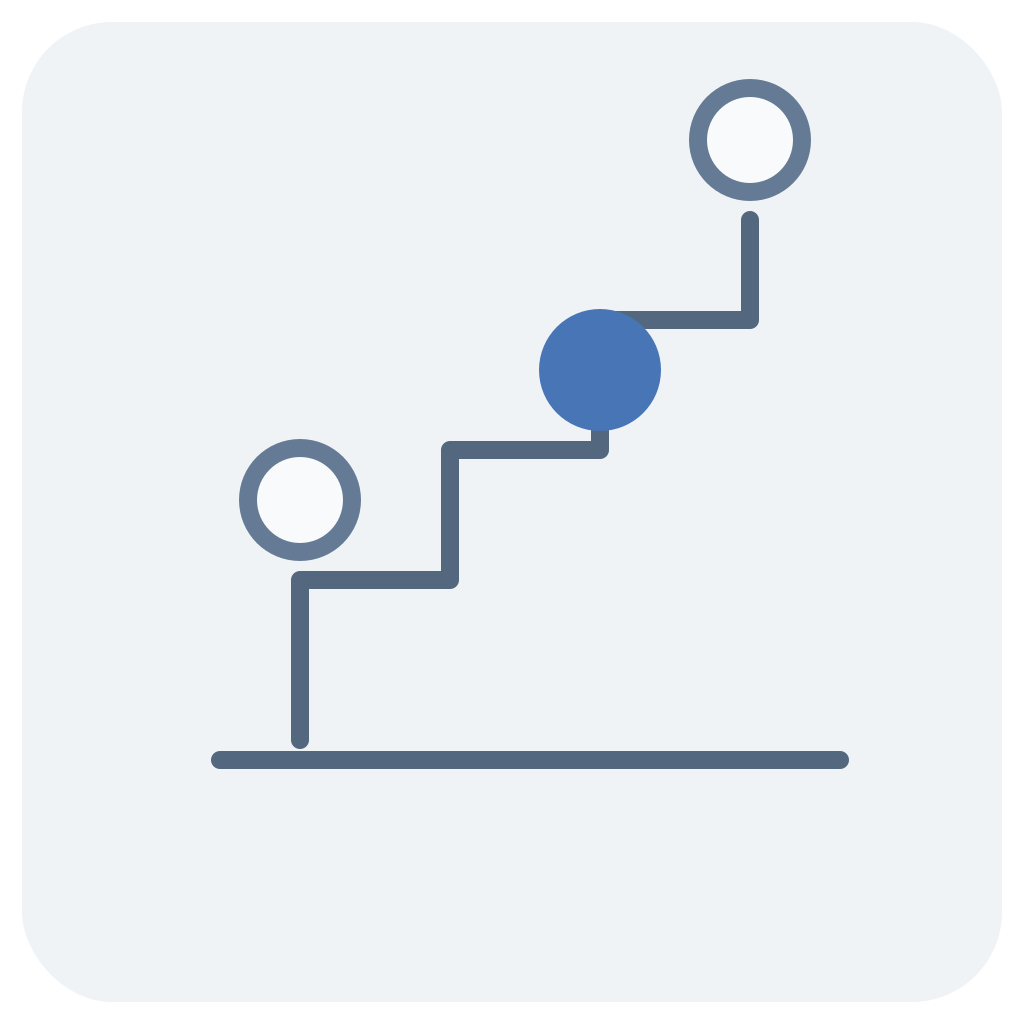 Price discriminationMatch the offer to willingness to pay.
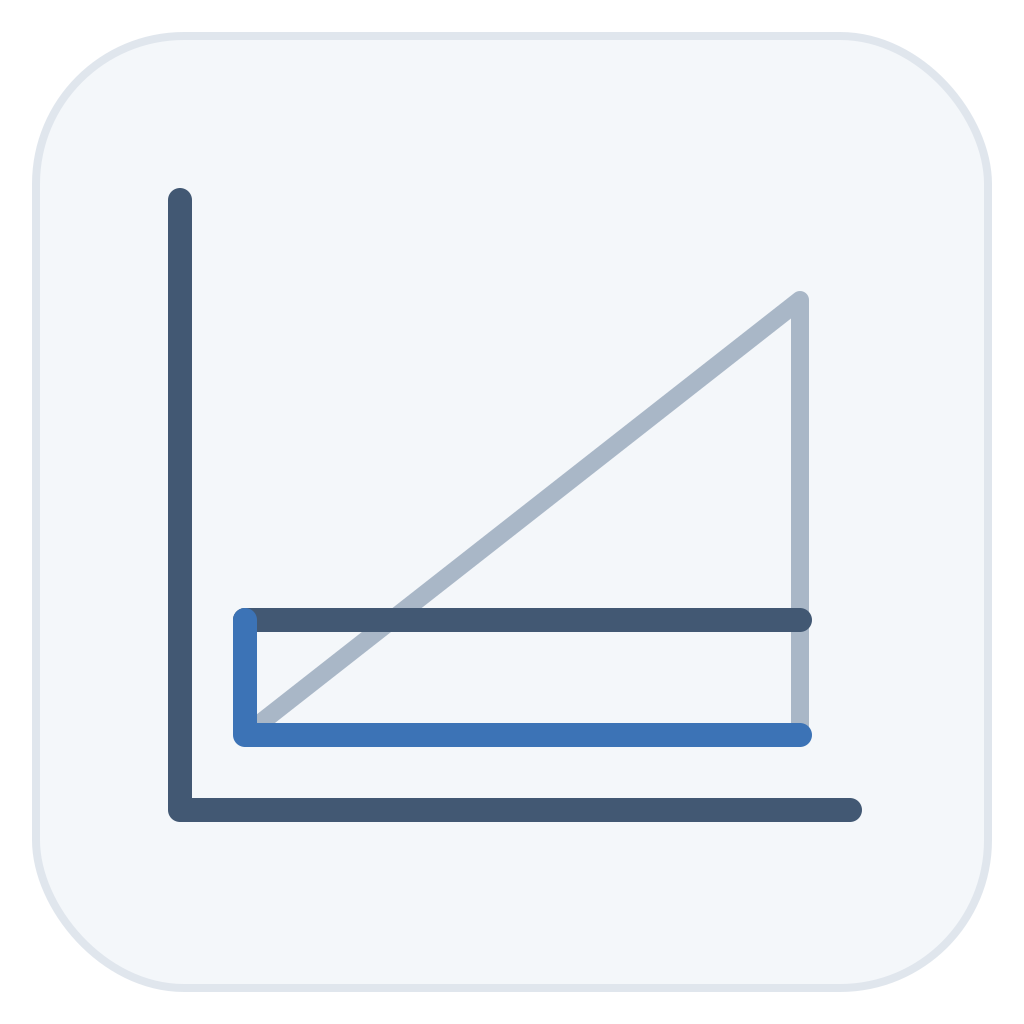 Customer surplusEstimate the buyer’s gain from the complete offer.
 Subscription economicsRecurring revenue still has to earn back its costs.
 BundlingCompare the package with every available menu choice.
Related cases
See all →Sources
- Economic Analysis for Business Decisions: Pricing Power II, Fall 2004 · MIT OpenCourseWare. PDF index 1, price-discrimination classifications and conditions; indexes 2–6, two-part pricing with identical consumers; indexes 7–14, heterogeneous consumers.
- Costco Wholesale Corporation 2024 Form 10-K · Costco Wholesale Corporation / SEC. Item 1 Business: warehouse operating model, membership and fees; Note 1 Revenue Recognition: membership-fee recognition.