Concept · Growth
Retention
How to measure continued relationships and investigate why customers remain
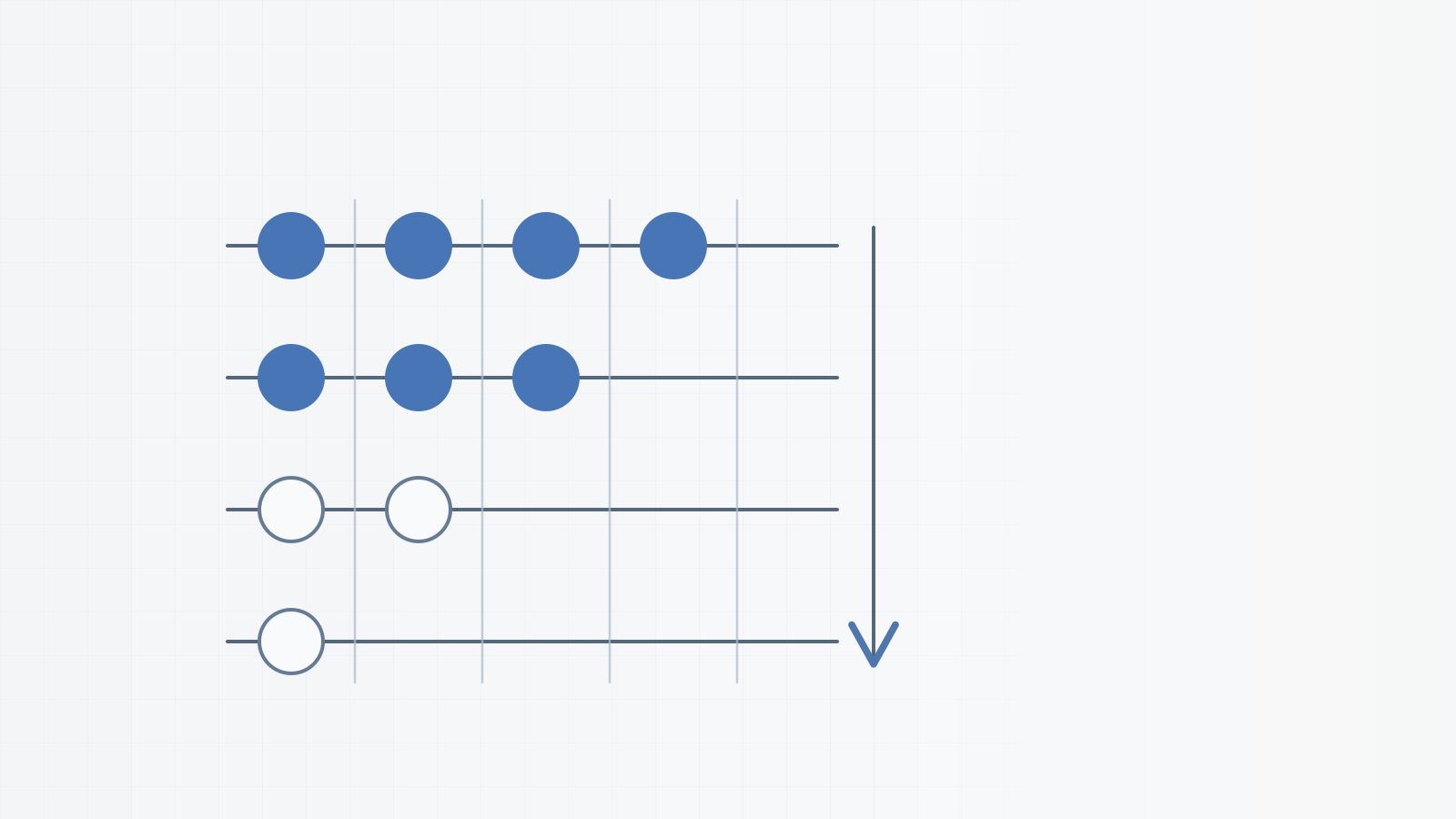
Measure who stays, when, and why.
Retention measures continued participation or revenue for a defined starting population over a defined interval. State the cohort, event, denominator and time before interpreting a rate. A current stock of active people is not a cohort merely because it is large.
Retention is the continued use, renewal, or revenue contribution of a defined customer cohort over a specified period.
The decision is what kind of continuation matters for the product’s task and economics. Activity, customer renewal, gross recurring revenue and net recurring revenue answer different questions. Expansion can offset cancellations in a net measure while the customer population contracts.
A natural use cycle matters. An occasional-use product should not be judged by daily return, and a daily activity event should not automatically establish useful progress. The retained event must correspond to the intended customer outcome.
Retention measures
Choose the measure that matches the decision, and state its cohort and time period beside the result.
 Customer retention
The share of customers in a starting cohort who remain active or renew by a defined date.
01
The share of customers in a starting cohort who remain active or renew by a defined date.
The share of customers in a starting cohort who remain active or renew by a defined date. Gross revenue retention
Recurring revenue kept from the starting cohort after churn and contraction, excluding expansion.
02
Recurring revenue kept from the starting cohort after churn and contraction, excluding expansion.
 Net revenue retention
Revenue from the same starting customer cohort after churn, contraction, and expansion are included.
03
Revenue from the same starting customer cohort after churn, contraction, and expansion are included.
A continuum, not a switch
Retention measures continuation in a defined cohort and period. Evidence about useful work and alternatives is needed to distinguish value from inertia, contract terms or measurement artifacts.
“Retention gives acquisition a time horizon.”
Why it matters
Slack’s filing defines net dollar retention through a starting paid monthly-revenue cohort and includes expansion, contraction and attrition while excluding new customers. Duolingo’s streak counts instead describe nested active-user thresholds at a date. They cannot substitute for one another.
The mechanism of continuing use can involve value, habit, contract terms or migration work. Pair the metric with evidence about the task and available alternatives. A rising net-revenue measure does not identify why people stay or establish improved customer-count retention.
Changes in cohort composition, pricing or expansion among large accounts can explain aggregate movement. Inspect the distribution and cancellation pattern before crediting an intervention. A positive average can conceal an important group whose experience worsened.
Real-world examples
The same concept shows up in different ways across industries.
Slack’s rolling twelve-month paid-revenue cohort definition makes the denominator and included movements explicit. Its reported expansion measure is not a unique-person count or a causal seller effect. New customers do not belong to the retained starting cohort.
Duolingo’s FY2024 filing defines a streak through consecutive days with a completed lesson and reports nested long-streak groups among daily active users at a date. The actual design makes continued daily activity visible. It does not follow every learner who started in a common period or estimate the chance that a new learner will return. The operating conflict is between rewarding recurrence and improving learning. A hypothetical learner may preserve the recorded streak with an easy action while avoiding difficult practice; another may practice elsewhere while losing the app’s streak. Those possibilities do not establish harm at Duolingo, but they show why the chosen event needs an outcome check. The filing’s activity and engagement measures cannot identify the streak feature’s causal effect, and selection among committed learners remains a rival explanation. For a manager, choose the cohort, return event and period first, then investigate useful work and available alternatives. Continued activity can support a retention hypothesis without proving that value or mastery caused it.
When it breaks
In a hypothetical subscription cohort, a small group expands enough to offset many canceled accounts. Net revenue looks durable while customer-count retention weakens. Both can be true; the decision needs the relevant distribution.
A learner can preserve a streak with an easy action while avoiding useful practice. A recurring event can be accurately measured and still be an insufficient outcome. Examine the task and comparison before assigning a retention benefit to the feature.
Key takeaways
- 01
Specify the starting cohort, retained event, denominator, and time period.
- 02
Separate customer counts, gross revenue retention, and net revenue retention.
- 03
Pair the metric with reasons for staying or leaving and the value customers receive.
Related concepts
See all → Growth loopsMake product use create the next opportunity.
 Product-market fitLook for sustained demand, not applause.
 Switching costsWhy leaving is hard.
 Network effectsRelevant participation can change another participant’s value.
 Customer lifetime valueModel future contribution, then test it against cohorts.
Related cases
See all →Sources
- Slack 2019 S-1: key business metrics · Slack / SEC. Key Business Metrics, printed pp. 68–70: January 31, 2017–2019 table; Paid Customers definition; Paid Customers >$100,000 definition; Net Dollar Retention Rate definition
- Duolingo 2024 Form 10-K · Duolingo / SEC. Business, The Duolingo Learning Experience, It’s Fun: streak definition and December 31 counts; MD&A Operating Metrics, Daily Active Users: Q4 DAU/MAU comparisons