Concept · Pricing
Price skimming
Launch at a high price for buyers who value early access, then widen reach as price changes
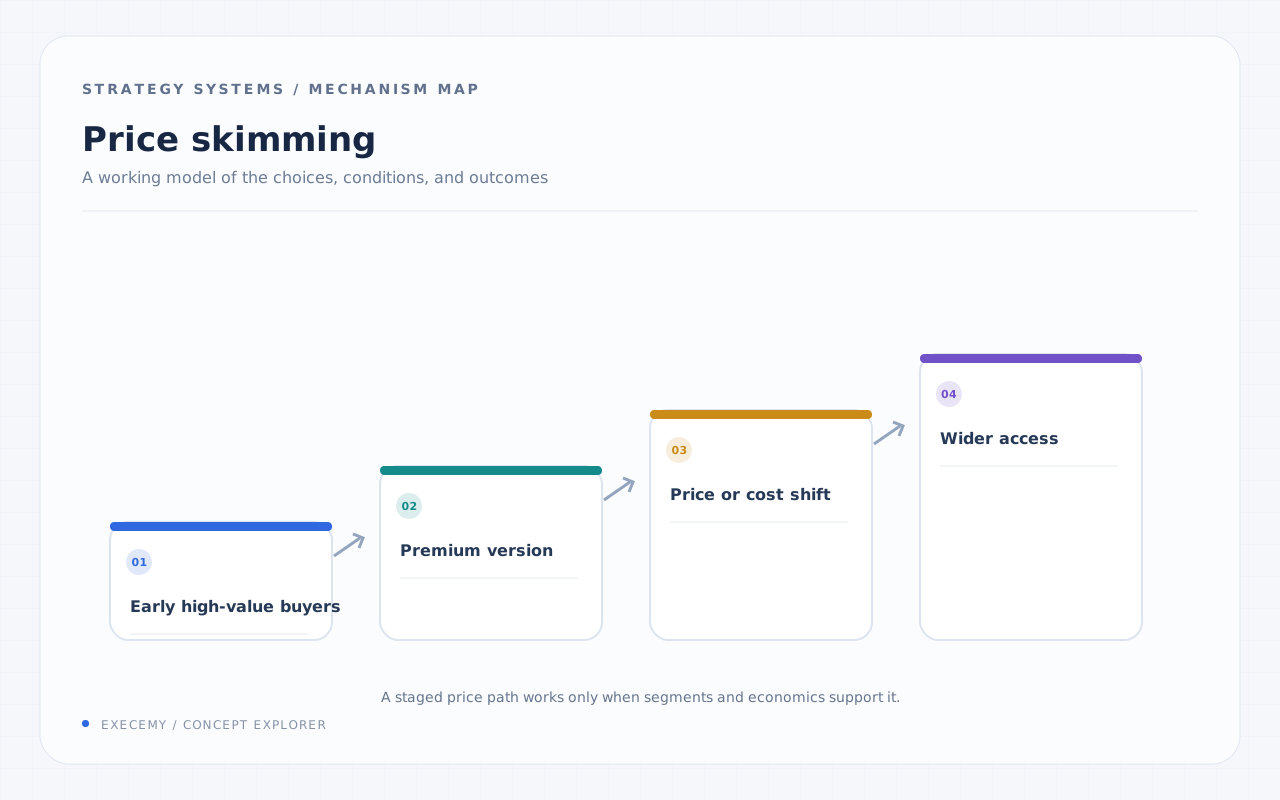
Price early demand before broadening access.
Price skimming sets an initial price high relative to later expected prices. It can make sense when a product is scarce, differentiated, costly to develop, or most valuable to early buyers who care about access, novelty, or performance. The company may later lower price, add a lower-priced model, or let costs fall so other customers can enter. A “skim” is a sequence, not simply a high price.
Price skimming is a launch sequence that captures willingness to pay among early buyers before lowering price or introducing lower-priced versions to reach more demand.
The sequence depends on segment differences. Early buyers must be willing to pay more and less sensitive to price; later groups must value the offer at a lower price but remain profitable to serve. The business should estimate willingness to pay, contribution per unit, capacity, competitive response, and the pace at which the product loses distinctiveness. A high price can protect limited capacity or fund investment, but it can also slow adoption and attract substitutes.
Skimming differs from penetration pricing, which starts low to accelerate adoption. Price discrimination can separate buyers at the same time or across time. A skimming sequence can implement intertemporal self-selection: buyers who value early access pay more, while buyers more willing to wait choose a later lower price. Anticipated reductions can also induce early buyers to delay. Simultaneous segment prices, versions and promotions may coexist with that sequence. A price decrease after launch alone does not prove that management deliberately followed a skimming strategy.
How a launch sequence can work
The initial price, product line, and later access need to fit the demand curve.
 Early-access price
Charge buyers who place high value on immediacy, novelty, or scarce capacity.
01
Charge buyers who place high value on immediacy, novelty, or scarce capacity.
Charge buyers who place high value on immediacy, novelty, or scarce capacity. Version ladder
Keep a premium model while adding lower-cost versions with clearly chosen trade-offs.
02
Keep a premium model while adding lower-cost versions with clearly chosen trade-offs.
Planned reductionLower the price when the early segment is served, costs fall, or broader reach becomes more valuable.
03
Lower the price when the early segment is served, costs fall, or broader reach becomes more valuable.
A continuum, not a switch
Skimming is a managed price path across time or versions. It is useful only when demand segments and costs support the sequence without undermining future trust or adoption.
“The high launch price is a hypothesis about a segment, not proof of durable pricing power.”
Why it matters
The approach can help a firm recover launch investment from customers with high willingness to pay while capacity or component costs are tight. But revenue per unit is not enough: calculate contribution after discounts, channel margin, returns, support, and any cost of serving early buyers. If a price cut teaches customers to wait, it can damage future launches and stock value.
Apple’s January 9 2007 announcement listed a planned U.S. June release with an 8GB price of $599. Its September 5 announcement made the 8GB model immediately available in the United States at $399 and stated an affordability rationale. This verifies announcements at two dates; the January notice is not evidence of a January sale or an independently checked June transaction.
A planned sequence needs a trigger tied to the actual segment and operating conditions. Early demand, available capacity, customer waiting and competitor response can change the comparison. Evaluate the option to hold the price, alter the offer or lower it using future contribution; a high initial price followed by a cut does not by itself identify the reason for either action.
Real-world examples
The same concept shows up in different ways across industries.

When it breaks
A high launch price can exclude the very customers who would make a product more useful, create a reputation for poor value, or invite competitors to serve the market first. It is harder to skim when products are easy to compare, buyers can delay, resale is strong, or switching is easy. Premium pricing also cannot compensate for weak product-market fit.
A price path can be confounded by new versions, bundles, component-cost changes, channel promotions, and different customer mixes. Compare like-for-like products and cohorts. State the price, unit, market, and time period; measure contribution and repeat purchases, not just launch revenue. If early buyers feel punished by a quick cut, plan a protection or upgrade policy and include its cost.
Key takeaways
- 01
Which early customers value access enough to pay the launch price, and what evidence supports that willingness?
- 02
How much contribution does each price produce after channel, service, discount, and return costs?
- 03
What event would trigger a lower price or version, and how will you avoid teaching all buyers to wait?
Related concepts
See all → Pricing powerMeasure the contribution after customers respond.
 Price discriminationMatch the offer to willingness to pay.
 Customer segmentationGroup customers where the response changes.
 Contribution marginCalculate what the next sale leaves after variable costs.
 Value propositionChoose a customer, meet a need, earn the price.
Sources
- Apple Reinvents the Phone with iPhone, January 9 2007 · Apple. Pricing & Availability, planned U.S. June availability and announced 8GB price.
- Apple Sets iPhone Price at $399 for this Holiday Season, September 5 2007 · Apple. Opening 8GB price reduction and affordability rationale; Pricing & Availability, immediate U.S. availability at the new price.
- Optimal Price Skimming by a Monopolist Facing Rational Consumers (1990), accessible abstract · INFORMS / Management Science. Official accessible abstract, intertemporal pricing and intertemporal price discrimination