Concept · Platforms
Ecosystem orchestration
Coordinate independent contributors so their offers work together around a customer outcome
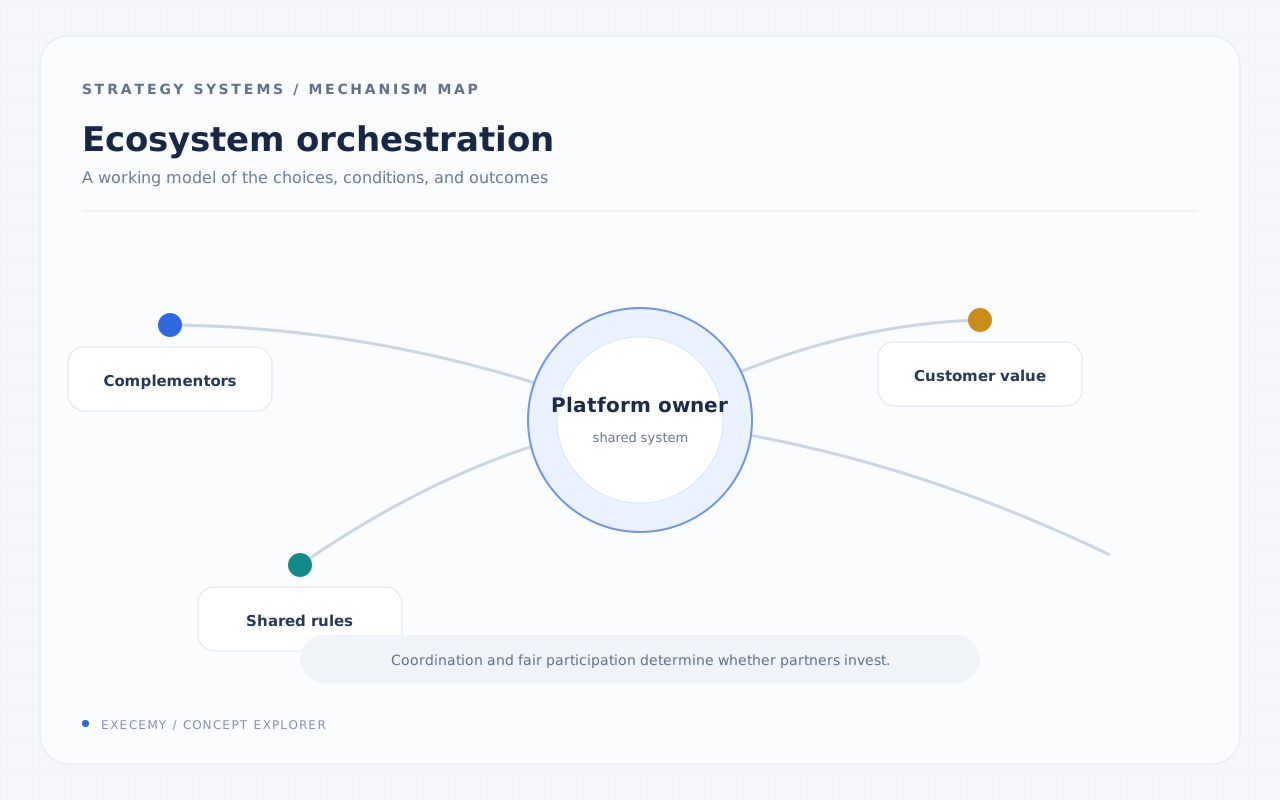
Coordinate the parts no single firm owns.
An ecosystem is a set of organizations whose offerings depend on one another to deliver value. A device may need applications, payment systems, repair, content, and network access; an industrial product may need installers, financing, software, and maintenance. Orchestration is the ongoing work of coordinating those contributions: defining technical interfaces, access conditions, quality standards, commercial incentives, and how participants resolve disputes.
Ecosystem orchestration is the work of setting interfaces, incentives, governance, and shared priorities so independent participants can create a coherent customer outcome.
The orchestrator does not necessarily own the participants. It may control a key interface, customer relationship, standard, or marketplace and persuade others to invest around it. Contributors participate when expected benefits—reach, revenue, access to complementors, or lower development cost—exceed their fees, restrictions, and dependence. Orchestration therefore combines product design with governance and bargaining.
A partner list is not an ecosystem. Participants must contribute complementary assets that customers actually use, and the system must be coordinated well enough for the pieces to work together. Network effects can strengthen an ecosystem when additional participants increase value for other participants, but participation alone does not prove that mechanism.
A hypothetical app transaction crosses discovery, installation, payment, update and support handoffs. The orchestrator’s decision is who supplies each necessary capability and who responds when it fails. A rule can allocate that responsibility without guaranteeing the participant has the resources or incentive to fulfill it.
Orchestration mechanisms
The coordinator can shape participation through technical, commercial, and institutional choices.
 Interfaces and standards
Publish tools and stable rules that let complements connect to the core offer.
01
Publish tools and stable rules that let complements connect to the core offer.
Publish tools and stable rules that let complements connect to the core offer. Incentives and access
Set revenue shares, fees, eligibility, and investment terms that make participation worthwhile.
02
Set revenue shares, fees, eligibility, and investment terms that make participation worthwhile.
 Governance and trust
Define safety, privacy, quality, dispute, and enforcement processes across participants.
03
Define safety, privacy, quality, dispute, and enforcement processes across participants.
A continuum, not a switch
Orchestration grows stronger as participants can coordinate reliably around a customer outcome while retaining viable incentives and clear governance.
“An ecosystem is coordinated through choices and rules, not by drawing a circle around suppliers.”
Why it matters
Good orchestration lowers coordination cost and makes complementary offers dependable. The orchestrator must balance openness with control: too little control may expose users to poor quality or fraud, while too much can deter contributors or turn the platform into a bottleneck. Rules should be legible, applied consistently, and reviewed when the ecosystem changes.
Apple published an estimate of $406 billion in U.S. App Store ecosystem billings and sales in 2024, reporting no commission on more than 90% of that activity. The estimate combines monetization routes. Facilitated activity is not Apple’s revenue or profit, and the announced aggregate does not identify what a particular contributor gained.
The report discloses support from Apple and attributes its conclusions to the authors. This provenance calls for scrutiny of method and scope; funding alone does not establish that the estimate is wrong. [Study support statement](https://www.apple.com/newsroom/pdfs/2024-US-Apple-Ecosystem-Report.pdf)
Real-world examples
The same concept shows up in different ways across industries.

When it breaks
Participants may leave if the orchestrator changes fees, access, data rights, or technical requirements after they invest. A central actor can also optimize for its own product and weaken the complementors that made the ecosystem valuable. Watch participant entry and exit, quality failures, multi-homing, and the share of ecosystem value each party captures.
An ecosystem may be too complex to coordinate or may lack a customer outcome that justifies the extra participants. Overlapping standards, poor integrations, and uncertain accountability create costs that no individual partner owns. Map dependencies and define a fallback for critical functions; orchestration cannot replace product-market fit or sound unit economics.
A coordinator may mistake total activity around its product for activity it caused. The useful counterfactual is the customer outcome under a credible alternative arrangement, including contributor work and costs. Until that comparison is available, report facilitated volume separately from capture and causal contribution.
Key takeaways
- 01
Which independent contributions are necessary to complete the customer job, and who is accountable for each handoff?
- 02
Do access rules, technical interfaces, and economics give participants a reason to invest and remain?
- 03
How much value is facilitated across the ecosystem, how much does the orchestrator capture, and what evidence supports both figures?
Related concepts
See all → Network effectsRelevant participation can change another participant’s value.
 Cross-side network effectsOne side’s participation changes another side’s value.
 ComplementorsA stronger ecosystem can strengthen the core offer.
 Multi-homingThe same participant can belong to several networks.
 Two-sided marketsCoordinate distinct related participant groups.
Related cases
See all →Sources
- App Store US billings and sales in 2024 · Apple Newsroom. May 29, 2025 opening paragraph; linked report Summary printed pp. 1–3 and Methodology pp. 16 onward
- Changes for apps in the European Union · Apple Developer. What’s new; Alternative distribution; Business terms; Transition to unified EU terms
- Web Distribution in the EU · Apple Developer. Opening; Eligibility and requirements; Transition to unified EU terms
- App distribution · European Commission. What are the DMA rules for Apple’s and Google’s respective app stores?
- The Apple Ecosystem in the US: study support statement · Jessica Burley and Andrey Fradkin. PDF cover, page index 0: support and author-independence statements