Open visual reader →
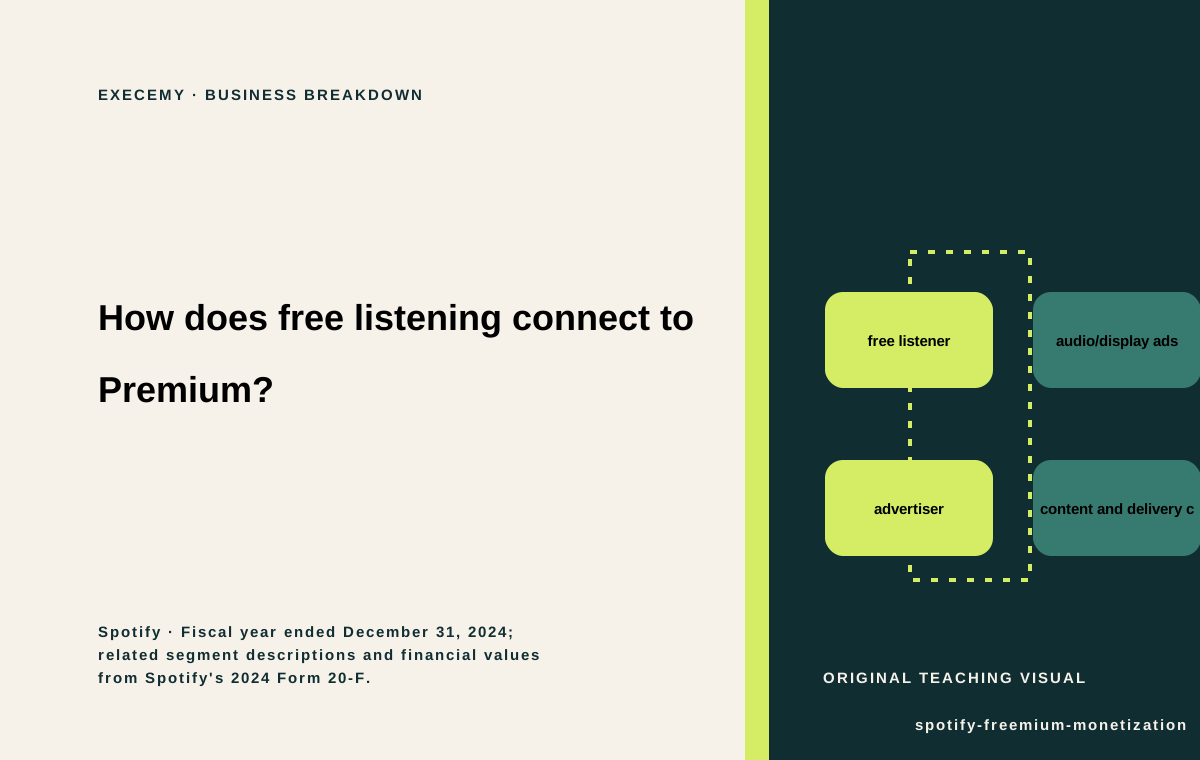
How does free listening connect to Premium?
The free offer has an independent product and attributed funnel role; segment averages do not identify an induced upgrade’s marginal return.
Explore Spotify →
The question
How does free listening connect to Premium?
Ad-Supported and Premium architecture, revenue mix and segment gross economics · Fiscal year ended December 31, 2024. The free offer has an independent product and attributed funnel role; segment averages do not identify an induced upgrade’s marginal return.
Mechanism 1 · Spotify retained distinct free and paid services
Spotify retained distinct free and paid services
A free offer can be a product in its own right and a route to a paid product. Those roles need different evidence. A listener who remains free can create advertising revenue; a listener who later subscribes changes the commercial path. Neither event establishes the incremental value of the free offer without its associated costs and a counterfactual.
Spotify’s 2024 filing describes Ad-Supported and Premium services and says Ad-Supported supplies a significant portion of gross additions to Premium. The same description treats the services as independent offerings. These are management’s account of the chosen architecture and funnel, not a reported cohort conversion probability. [Spotify 2024 Form 20-F, business model](https://www.sec.gov/Archives/edgar/data/1639920/000163992025000003/ck0001639920-20241231.htm).
The analytical alternatives include a subscription-only route, an advertising offer without an upgrade role, or differentiated offers that coexist. The filing does not disclose a controlled comparison of those architectures. Calling the free product a funnel should not erase customers who prefer to remain on that product.
- Spotify 2024 Form 20-F — Business, Our Business Model; MD&A Revenue and Gross Profit and Gross Margin, printed p. 45; Ad-Supported margin discussion
Mechanism 1 · Spotify retained distinct free and paid services
Revenue share and gross margin answer different questions
For 2024, the filing reported Premium at 88% of revenue and Ad-Supported at 12%. It also reported segment gross margins of 33% and 12%, respectively. The latter Ad-Supported percentage is a gross-margin measure; its equality to the revenue-share percentage is coincidental and does not make the two definitions interchangeable. [Form 20-F, revenue and gross-margin tables](https://www.sec.gov/Archives/edgar/data/1639920/000163992025000003/ck0001639920-20241231.htm).
The gross-margin disclosure improves the evidence beyond a revenue-only comparison. It still does not supply a free listener’s marginal contribution, acquisition payback or the value of an induced upgrade. Segment averages combine listeners, content and arrangements that can differ. They cannot be assigned to an imagined individual as if that person had average economics.
- Spotify 2024 Form 20-F — Business, Our Business Model; MD&A Revenue and Gross Profit and Gross Margin, printed p. 45; Ad-Supported margin discussion
Mechanism 2 · Costs and selection change the interpretation of the f
Costs and selection change the interpretation of the funnel
A listener who upgrades may differ from one who remains free in engagement, affordability, preferred features and likely retention. These are plausible selection mechanisms, not identified listener groups in the filing. Attributing all later subscriber value to the prior free account would skip whether that person would have subscribed through another route.
A more useful comparison follows a defined exposure and upgrade path and includes the incremental work needed to serve it. Content, delivery, selling and support costs can occur at different stages. Some costs are shared, so an accounting allocation may answer a segment-reporting question without answering whether adding a listener improves contribution.
Mechanism 2 · Costs and selection change the interpretation of the f
A disclosed margin is not a permanent property of the offer
The filing’s explanation of Ad-Supported margin improvement names prior-year reorganization charges, lower podcast production and personnel costs, marketplace-program benefits and delivery costs. That is an attributed multi-factor account. It weakens a simple claim that a more effective upgrade funnel caused the margin change. [Form 20-F, Ad-Supported gross margin discussion](https://www.sec.gov/Archives/edgar/data/1639920/000163992025000003/ck0001639920-20241231.htm).
Advertising demand, content economics and operating changes can affect the value of remaining free independently of conversion. A design can improve access while a weak advertising environment reduces its business contribution. No universally favorable ad yield or upgrade rate follows from the existence of both offers.
- Spotify 2024 Form 20-F — Business, Our Business Model; MD&A Revenue and Gross Profit and Gross Margin, printed p. 45; Ad-Supported margin discussion
Mechanism 3 · Decide which outcome the free path must support
Decide which outcome the free path must support
For a hypothetical language app, free practice might be useful access, an advertising product or an introduction to paid capabilities. Define which role matters for a particular learner and why the paid offer would provide additional value. A prompt to upgrade is not itself evidence that useful free practice has occurred.
Track the customer outcome and the commercial path separately. Spotify’s filing documents the architecture, revenue mix and segment gross economics. It leaves the marginal and causal questions open. The reader should use the disclosed averages for context and measure the next decision at the appropriate listener, cohort and cost scope.
Optional application · unscored
Measure one free-to-paid path
Hypothetical: A language app offers free lessons with ads and a paid ad-free plan. Identify why a learner might stay free, what might prompt an upgrade, and the cost to serve each path.
Reveal: Track free-user ad revenue, incremental content and delivery cost, conversion by cohort, and paid-plan contribution. Do not infer upgrade performance from total registrations or total paid subscribers alone.
Teaching assumption: Fictional reader decision with no numerical inputs or measured company outcome.
The answer
The free offer has an independent product and attributed funnel role; segment averages do not identify an induced upgrade’s marginal return.
The free offer has an independent product and attributed funnel role; segment averages do not identify an induced upgrade’s marginal return. The free offer has an independent product and attributed funnel role; segment averages do not identify an induced upgrade’s marginal return. The case is bounded to Ad-Supported and Premium architecture, revenue mix and segment gross economics during Fiscal year ended December 31, 2024.
Sources and limitations
- Spotify 2024 Form 20-F — Spotify / SEC
Business, Our Business Model; MD&A Revenue and Gross Profit and Gross Margin, printed p. 45; Ad-Supported margin discussion
Independent free and paid offers, attributed funnel role, 88% / 12% revenue share and 33% / 12% segment margins
Segment averages do not identify marginal listener economics, cohort conversion or causal free-offer returns.
Original illustrative scenes are not documentary evidence.
New concepts and cases by email