Open visual reader →
Where does a systemwide dollar go?
Examine McDonald’s 2015 refranchising targets and rejected REIT alternative, then use later accounting evidence to test what a parent margin can establish.
Explore McDonald’s →
The question
Where does a systemwide dollar go?
McDonald’s documented refranchising policy and the parent/operator cost boundary · May–November 2015 ownership-policy decisions; 2017 follow-up and FY2024 accounting illustration. Changing restaurant ownership changes the parent’s revenue and cost perimeter; a high franchise-margin percentage cannot identify the incremental value of a conversion.
Mechanism 1 · The 2015 policy changes cost ownership
The 2015 policy changes cost ownership
Management proposed selecting ownership structures market by market, tightening financial screens for company-operated markets and using conventional franchises and developmental licences. It expected steadier parent revenue and cash flow with a lighter support structure. These were stated expectations, not a demonstrated conversion effect. [May 2015 release, ownership-mix paragraph](https://www.sec.gov/Archives/edgar/data/63908/000006390815000034/form8k.pdf).
Mechanism 1 · The 2015 policy changes cost ownership
Savings cover several actions
By November 10, the conversion target was 4,000 by 2018, with about 93% franchised by then and a longer-term 95% goal without a deadline. The G&A target became $500 million annually, mostly by the end of 2017. Savings were attributed to refranchising, organisational changes and service efficiencies together; currency effects were excluded. [November 2015 release, revised targets](https://www.sec.gov/Archives/edgar/data/63908/000006390815000084/exhibit991.htm).
Mechanism 2 · A REIT was considered and rejected
A REIT was considered and rejected
McDonald’s also considered a real-estate investment trust spin-off. In November it rejected that route, saying potential tax and valuation advantages were outweighed by financial and operational risk to the business and turnaround. This is the company’s stated assessment of an actual alternative. [November 2015 release, REIT Decision Announced](https://www.sec.gov/Archives/edgar/data/63908/000006390815000084/exhibit991.htm).
Mechanism 2 · A REIT was considered and rejected
Conversion and savings use different clocks
The 2017 filing reported reaching the 4,000-conversion target that year and being 92% franchised. Its long-term outlook nevertheless expected full realisation of the annual G&A savings target in 2019. Conversion progress and savings timing were distinct outcomes. [2017 10-K, pp. 15 and 18](https://www.sec.gov/Archives/edgar/data/63908/000006390818000010/mcd-12312017x10k.htm).
- McDonald’s Corporation 2017 Form 10-K — Printed p. 15: paragraph on achieving the 4,000-restaurant target in 2017 and 92% franchised; printed p. 18: Long-Term Outlook, net annual G&A savings target expected fully in 2019.
Mechanism 3 · The 2024 figures have different boundaries
The 2024 figures have different boundaries
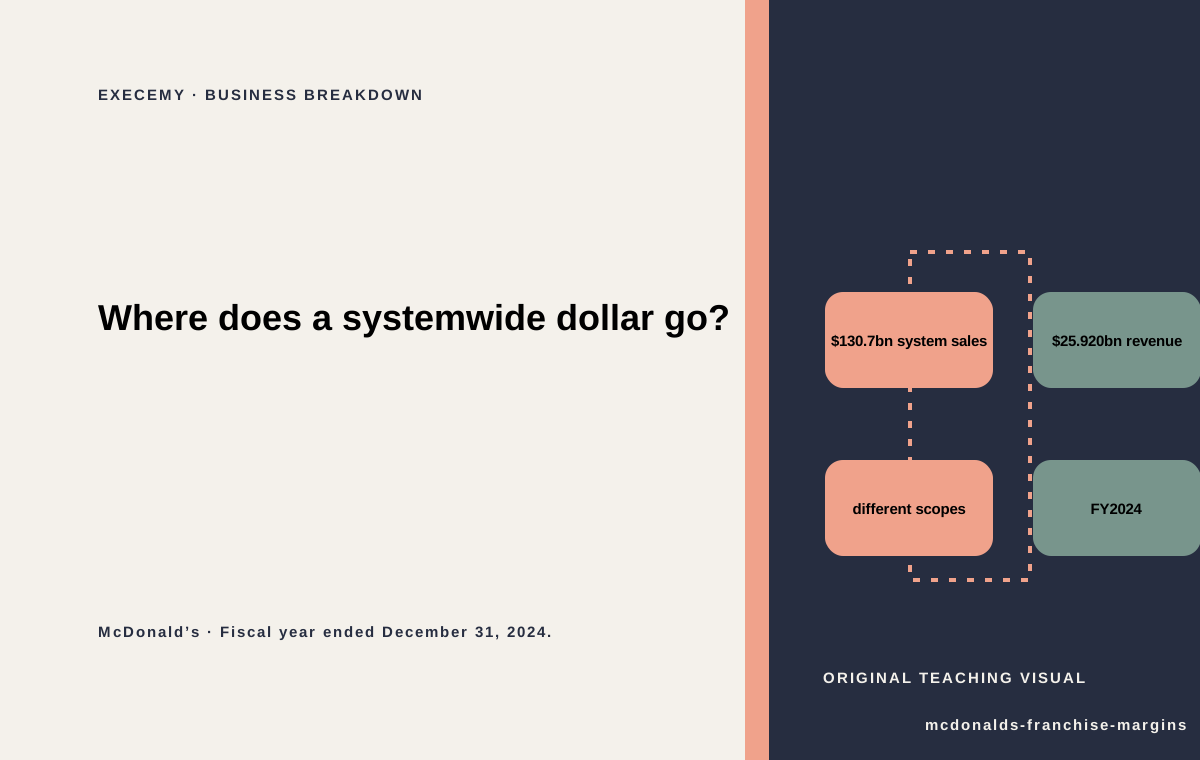
The 2024 figures are a later illustration of the accounting boundaries, not information available in 2015 or a causal test of that policy. McDonald’s reported $130.7 billion in systemwide sales and $25.920 billion in consolidated revenue. Franchisee sales are included in the first measure but excluded from parent revenue, which records fees, rent and royalties. [2024 10-K, pp. 7–8](https://www.sec.gov/Archives/edgar/data/63908/000006390825000012/mcd-20241231.htm).
- McDonald’s Corporation 2024 Form 10-K — Printed pp. 7–8 (systemwide sales definition and 2024 results); p. 16 Restaurant Margins, definitions and table; p. 40 Consolidated Statement of Income, 2024 column. HTML headings and row labels are exact locators.
Mechanism 3 · The 2024 figures have different boundaries
Trace what the conversion changes
For a proposed conversion, identify the parent revenue surrendered, fees gained and costs removed or added over the decision horizon. Include retained property commitments and support that changes only after multiple conversions. Evaluate the operator’s capacity to earn a sustainable return while maintaining the restaurant. These are analytical requirements; the filings do not disclose a counterfactual for an individual conversion.
Optional application · unscored
Choose the missing schedule
A fictional chain considers either an idle-capacity discount or a franchise conversion.
Reveal: For the discount, request variable cost and displacement data; for conversion, request capital, fees and obligations on both sides. A parent margin percentage cannot answer either alone.
Teaching assumption: Fictional chain and decision; no McDonald’s internal deliberation is asserted.
The answer
An ownership target needs an incremental cost and capital model.
Changing restaurant ownership changes the parent’s revenue and cost perimeter; a high franchise-margin percentage cannot identify the incremental value of a conversion. A high restaurant margin percentage may reflect the parent recording fee revenue while operators record food and labor costs; it does not alone prove superior store economics. McDonald’s restaurant margins include occupancy costs and exclude support and other expenses. They therefore cannot be relabeled as contribution margin. The case is bounded to McDonald’s documented refranchising policy and the parent/operator cost boundary during May–November 2015 ownership-policy decisions; 2017 follow-up and FY2024 accounting illustration.
Sources and limitations
- McDonald’s Corporation 2024 Form 10-K — McDonald’s Corporation / SEC
Printed pp. 7–8 (systemwide sales definition and 2024 results); p. 16 Restaurant Margins, definitions and table; p. 40 Consolidated Statement of Income, 2024 column. HTML headings and row labels are exact locators.
Precise uses are bound in the claim ledger.
Annual parent-company reporting; no operator contribution costs or store-level counterfactual. Restaurant margin is company-defined. Income-statement rows are rounded independently.
- Initial steps in McDonald’s turnaround plan, May 4, 2015, Form 8-K Exhibit 99.1 — McDonald’s Corporation / SEC
PDF index 5: New Refranchising Target and Financial Updates Announced, target bullets and following market-by-market financial-screen paragraph.
Precise uses are bound in the claim ledger.
Contemporary targets and management expectations; not realized savings or an independently established benefit.
- Executing the turnaround plan, November 10, 2015, Exhibit 99.1 — McDonald’s Corporation / SEC
Printed p. 2: New Refranchising and G&A Targets Announced; printed p. 3: REIT Decision Announced.
Precise uses are bound in the claim ledger.
Contemporary targets and stated reasons for rejecting a REIT; no internal deliberations or causal estimate.
- McDonald’s Corporation 2017 Form 10-K — McDonald’s Corporation / SEC
Printed p. 15: paragraph on achieving the 4,000-restaurant target in 2017 and 92% franchised; printed p. 18: Long-Term Outlook, net annual G&A savings target expected fully in 2019.
Precise uses are bound in the claim ledger.
Later management report, not information available in 2015. Completion of conversions does not establish economic benefit or completion of savings.
Original illustrative scenes are not documentary evidence.
New concepts and cases by email