Open visual reader →
How far can customers do the selling?
An invitation can originate in useful shared work without establishing durable adoption, payment or the referral route’s incremental return.
Explore Dropbox →
The question
How far can customers do the selling?
Product-mediated acquisition and the subsequent paid path · 2018 registration account and December 31, 2017 stocks. An invitation can originate in useful shared work without establishing durable adoption, payment or the referral route’s incremental return.
Mechanism 1 · Dropbox used sharing as an acquisition route
Dropbox used sharing as an acquisition route
A collaboration tool can reach another person during useful work. That invitation has a different purpose from an advertisement: it can be part of completing a shared task. It still does not establish that the recipient becomes active, pays or remains. The growth decision must separate the customer interaction from the commercial steps that follow.
Dropbox’s 2018 registration described free signup, sharing with nonregistered collaborators and in-product referrals. It also described paid marketing and distribution partnerships. These were actual routes in the company’s model, while its claim of efficient acquisition remains a management assertion. [Dropbox S-1, Our Business Model](https://www.sec.gov/Archives/edgar/data/1467623/000119312518055809/d451946ds1.htm).
The analytical alternatives include product-mediated invitations, paid distribution and sales assistance. They need not be mutually exclusive. The filing does not identify a controlled comparison that assigns incremental signups or profit to each route.
- Dropbox registration statement on Form S-1 — Our Business Model: signup, acquisition and paid conversion paragraphs; paying-user definition printed p. 13; registration/conversion risk p. 15; referral and enterprise selling risk; Sales and Marketing
Mechanism 1 · Dropbox used sharing as an acquisition route
Account scale does not supply a referral cohort
The filing reported over 500 million registered accounts and 11 million paying users at December 31, 2017. Its paying-user definition counts active paid licenses; a person can count more than once. Registrations also can be duplicated and many may never pay. These populations cannot produce a valid conversion rate by division. [S-1, user definition and conversion risk](https://www.sec.gov/Archives/edgar/data/1467623/000119312518055809/d451946ds1.htm).
A recipient can open a shared file without becoming a durable user. Another can register for a purpose unrelated to the invitation. A referral cohort needs the originating exposure, a defined recipient and an outcome window. Those observations are not supplied by the aggregate totals.
- Dropbox registration statement on Form S-1 — Our Business Model: signup, acquisition and paid conversion paragraphs; paying-user definition printed p. 13; registration/conversion risk p. 15; referral and enterprise selling risk; Sales and Marketing
Mechanism 2 · Revenue attribution is a separate measurement
Revenue attribution is a separate measurement
Dropbox reported more than 90% of revenue from self-service channels and described prompts, trials and lifecycle marketing for paid conversion. A revenue route is not the share of referral signups, the cost of acquiring them or the cause of their decision to pay. [S-1, bottom-up adoption and conversion methods](https://www.sec.gov/Archives/edgar/data/1467623/000119312518055809/d451946ds1.htm).
Payment can follow successful shared work, a need for administrative features or another product benefit. The exposure mechanism and the paid proposition should therefore be inspected separately. A commercially useful loop needs a reason to use, a reason to invite and a reason to pay where payment is required.
- Dropbox registration statement on Form S-1 — Our Business Model: signup, acquisition and paid conversion paragraphs; paying-user definition printed p. 13; registration/conversion risk p. 15; referral and enterprise selling risk; Sales and Marketing
Mechanism 2 · Revenue attribution is a separate measurement
Let the outside route remain a competing explanation
Brand familiarity, alternative distribution and the offer’s usefulness can affect growth alongside sharing. The filing warned that referral-led acquisition might not continue as expected and described limited large-account sales experience. The risk is a disclosed possibility, not proof that referrals had already failed. [S-1, referral and enterprise-sales risks](https://www.sec.gov/Archives/edgar/data/1467623/000119312518055809/d451946ds1.htm).
An invitation may also impose work on a recipient who did not choose the tool. If the shared task is inconvenient or does not require continued use, exposure can end without another invitation. That mechanism is a boundary to investigate, not a measured Dropbox complaint or attrition result.
- Dropbox registration statement on Form S-1 — Our Business Model: signup, acquisition and paid conversion paragraphs; paying-user definition printed p. 13; registration/conversion risk p. 15; referral and enterprise selling risk; Sales and Marketing
Mechanism 3 · Follow the customer task through the commercial path
Follow the customer task through the commercial path
For a hypothetical workspace, an invited colleague may only need to read a file. Successful exposure does not imply a recurring collaboration need. Another recipient may need ongoing shared access but lack authority to purchase. Define first useful work, payment, expansion and retention separately before changing an invitation incentive.
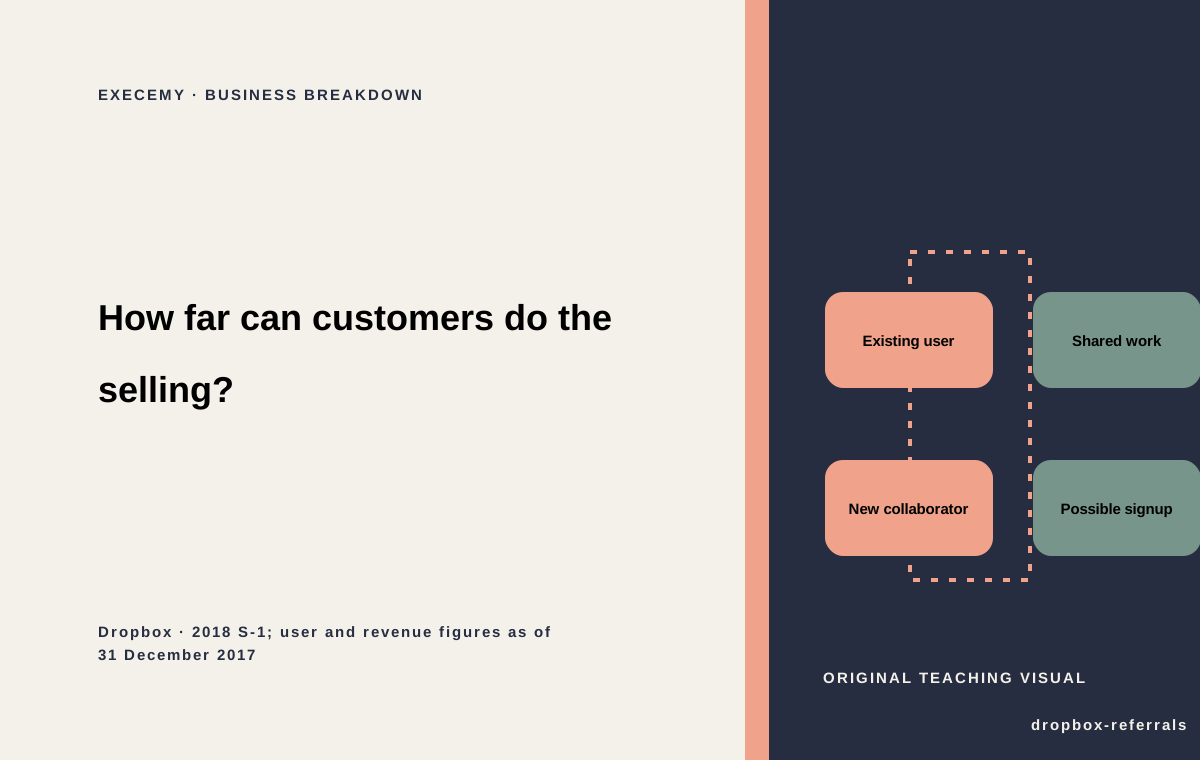
The case documents product-mediated acquisition and several later commercial methods. It does not supply a viral coefficient or cohort return. A growth loop is useful when its observable steps and failure points can change the investment decision; a diagram alone cannot demonstrate that the loop sustains itself.
Optional application · unscored
Find the missing step after the invite
Hypothetical: A team workspace sends invitations to coworkers, but invited users do not return after opening one file.
Reveal: The invitation only creates exposure. The product still has to deliver a first useful result, support collaboration, and make the paid or team value clear. This is an original scenario.
Teaching assumption: Fictional reader decision with no numerical inputs or measured company outcome.
The answer
An invitation can originate in useful shared work without establishing durable adoption, payment or the referral route’s incremental return.
An invitation can originate in useful shared work without establishing durable adoption, payment or the referral route’s incremental return. An invitation can originate in useful shared work without establishing durable adoption, payment or the referral route’s incremental return. The case is bounded to Product-mediated acquisition and the subsequent paid path during 2018 registration account and December 31, 2017 stocks.
Sources and limitations
- Dropbox registration statement on Form S-1 — Dropbox / SEC
Our Business Model: signup, acquisition and paid conversion paragraphs; paying-user definition printed p. 13; registration/conversion risk p. 15; referral and enterprise selling risk; Sales and Marketing
Free entry, sharing/referrals and other routes; >500 million registrations, 11 million active paid licenses at December 31, 2017; >90% self-service revenue
Company design claims and aggregate stocks/route share do not identify activation time, unique people, referral conversion or viral coefficient.
Original illustrative scenes are not documentary evidence.
New concepts and cases by email