Open visual reader →
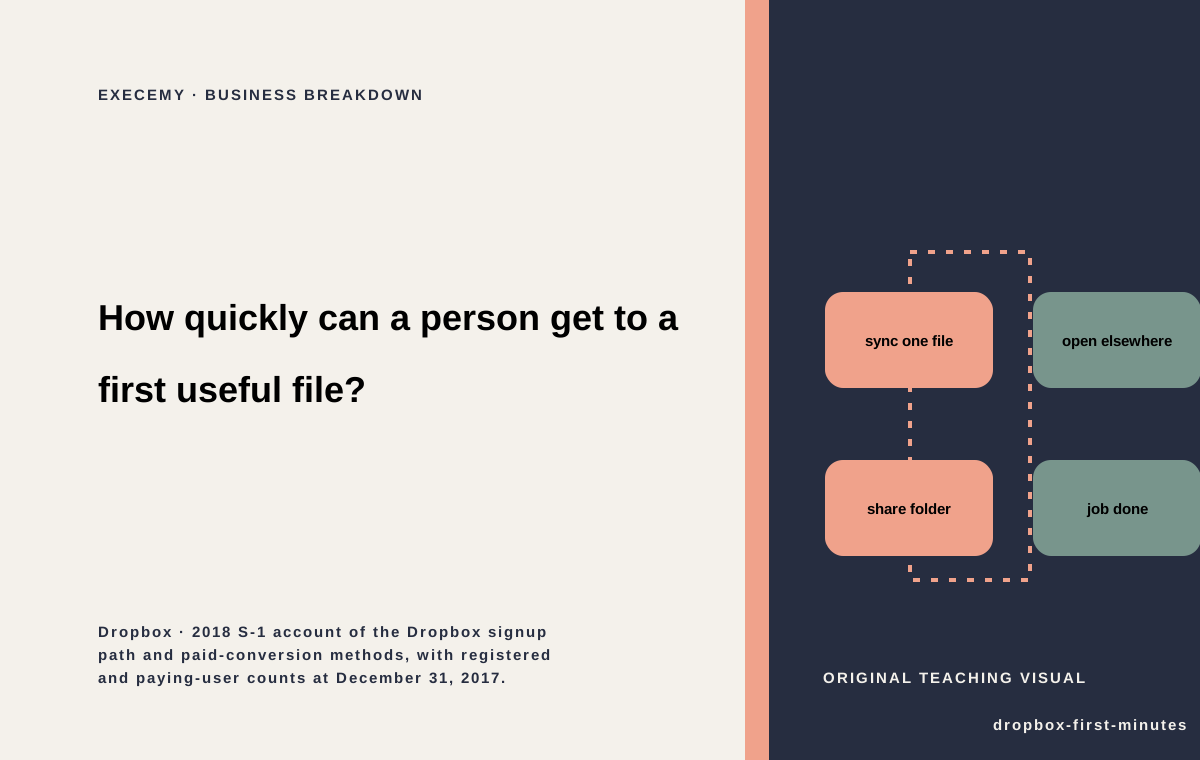
How quickly can a person get to a first useful file?
Define an activation event by the customer’s completed task; a company claim of quick entry supplies no activation distribution.
Explore Dropbox →
The question
How quickly can a person get to a first useful file?
Free entry and a proposed distinction between signup and first useful work · 2018 registration account. Define an activation event by the customer’s completed task; a company claim of quick entry supplies no activation distribution.
Mechanism 1 · Dropbox designed a free entry route
Dropbox designed a free entry route
A user can finish creating an account before accomplishing the task that brought them to the product. The design decision is which work to make easy at entry and when to explain the next capability. An account-completion event is observable, but its value depends on what the customer can do afterwards.
Dropbox’s 2018 registration said anyone could create a free account and be running in minutes. This is the company’s design claim, not a published distribution of setup or activation times. It establishes the entry choice without identifying how often people completed a useful file task. [Dropbox S-1, signup and business model](https://www.sec.gov/Archives/edgar/data/1467623/000119312518055809/d451946ds1.htm).
The analytical alternatives include explaining more capabilities before use, allowing a narrow first task or supplying assistance. The public account does not identify which onboarding variants were compared. A reader can examine those choices without inventing an activation benchmark.
- Dropbox registration statement on Form S-1 — Our Business Model: signup, acquisition and paid conversion paragraphs; paying-user definition printed p. 13; registration/conversion risk p. 15; referral and enterprise selling risk; Sales and Marketing
Mechanism 1 · Dropbox designed a free entry route
Define useful work for the particular job
For a hypothetical file tool, a customer may need access on another device or a completed handoff to a collaborator. These are different proposed activation events. The user can succeed at registration while neither outcome occurs.
A common event should not be selected merely because it is easy to count. A file uploaded but unavailable where it is needed would meet an upload metric without completing the task. The relevant event needs a reason to predict continuing use for the customer group being served.
Mechanism 2 · A paid prompt introduces another choice
A paid prompt introduces another choice
The filing described in-product prompts, trials, email campaigns and lifecycle marketing for paid conversion. It did not disclose the event timing or comparative effect needed to prove a particular first-value-before-prompt sequence. [S-1, conversion methods](https://www.sec.gov/Archives/edgar/data/1467623/000119312518055809/d451946ds1.htm).
A relevant prompt may explain a capability needed for the next task. A premature prompt may interrupt work; an excessively late one may hide a useful option. Those are competing design hypotheses. The appropriate timing should depend on the actual task and be tested rather than inferred from the existence of lifecycle marketing.
- Dropbox registration statement on Form S-1 — Our Business Model: signup, acquisition and paid conversion paragraphs; paying-user definition printed p. 13; registration/conversion risk p. 15; referral and enterprise selling risk; Sales and Marketing
Mechanism 2 · A paid prompt introduces another choice
Registration totals cannot settle the timing question
The source’s registered-account and active-paid-license totals have different definitions and can count a person repeatedly. They do not measure setup success or first-task completion. The aggregate denominator cannot be reused for an activation estimate just because the populations are large. [S-1, paying-user definition and registration caveat](https://www.sec.gov/Archives/edgar/data/1467623/000119312518055809/d451946ds1.htm).
The strongest rival explanation for an unsuccessful first session is weak fit rather than interface friction. Another is a technical or permission constraint outside the signup screen. A faster form would not solve either by itself. Observe where the customer task stops before assigning the problem to onboarding.
- Dropbox registration statement on Form S-1 — Our Business Model: signup, acquisition and paid conversion paragraphs; paying-user definition printed p. 13; registration/conversion risk p. 15; referral and enterprise selling risk; Sales and Marketing
Mechanism 3 · Make the next change answer the uncertain cause
Make the next change answer the uncertain cause
In a hypothetical team workflow, an evaluator may create an account but be unable to access the file they need. Determine whether the obstacle is permissions, device setup, collaboration or an irrelevant offer. Then choose a change that could distinguish the causes and track the completed task.
The actual Dropbox choice was an accessible free entry and a set of later conversion methods. The public evidence does not establish measured first-value latency or an optimal prompt sequence. The case’s reader application makes those gaps explicit so that a design claim cannot quietly become a performance benchmark.
Optional application · unscored
Choose a first-value event
Hypothetical: A new customer has signed into a project-management app but has not completed a useful task. Decide whether a task-help prompt or a plan-upgrade prompt belongs at this point, and what evidence would distinguish their effects.
Reveal: A prompt that helps the customer complete the task may be needed before the result. A promotion serves a different purpose. Test whether showing an upgrade after a useful result improves completion and later paid use; compare it with another timing that fits the task. Signup alone does not settle the choice.
Teaching assumption: Fictional reader decision with no numerical inputs or measured company outcome.
The answer
Define an activation event by the customer’s completed task; a company claim of quick entry supplies no activation distribution.
Define an activation event by the customer’s completed task; a company claim of quick entry supplies no activation distribution. Define an activation event by the customer’s completed task; a company claim of quick entry supplies no activation distribution. The case is bounded to Free entry and a proposed distinction between signup and first useful work during 2018 registration account.
Sources and limitations
- Dropbox registration statement on Form S-1 — Dropbox / SEC
Our Business Model: signup, acquisition and paid conversion paragraphs; paying-user definition printed p. 13; registration/conversion risk p. 15; referral and enterprise selling risk; Sales and Marketing
Free entry, sharing/referrals and other routes; >500 million registrations, 11 million active paid licenses at December 31, 2017; >90% self-service revenue
Company design claims and aggregate stocks/route share do not identify activation time, unique people, referral conversion or viral coefficient.
Original illustrative scenes are not documentary evidence.
New concepts and cases by email