Open visual reader →
Can self-service get more valuable as it scales?
Self-service changes transaction work while support and a durable customer outcome remain necessary; activity totals and interval spend use different populations and clocks.
Explore Atlassian →
The question
Can self-service get more valuable as it scales?
Online evaluation and purchase route with later support and expansion work · September 2015 acquisition snapshot; fiscal 2009–2011 cohorts’ subsequent five-year spend. Self-service changes transaction work while support and a durable customer outcome remain necessary; activity totals and interval spend use different populations and clocks.
Mechanism 1 · Atlassian chose an online evaluation and purchase rout
Atlassian chose an online evaluation and purchase route
A web purchase can remove a salesperson from a transaction without removing the buyer’s work. The product must remain understandable, usable and worth renewing; a larger deployment can add administrative and organizational requirements. The decision is which offer a buyer can evaluate independently and which support must remain available as the relationship grows.
Atlassian’s late-2015 registration account described affordable products that teams could evaluate and purchase online without a traditional salesforce. It also described technical and product support for enterprise customers and channel partners. The model changed the work of selling; it did not eliminate all selling or support work. [Atlassian 2015 amended registration, acquisition model and sales expense discussion](https://d1lge852tjjqow.cloudfront.net/CIK-0001650372/5a33e51e-347d-450a-9b16-942ef3aa60eb.pdf).
The analytical alternatives are online evaluation, a sales-led explanation or a combination tied to buyer needs. The filing does not publish an internal comparison of their return. A low-friction purchase route is a design choice; stating that it caused the customer volume would require evidence the public account does not supply.
Mechanism 1 · Atlassian chose an online evaluation and purchase rout
The activity snapshot preserves a particular counting rule
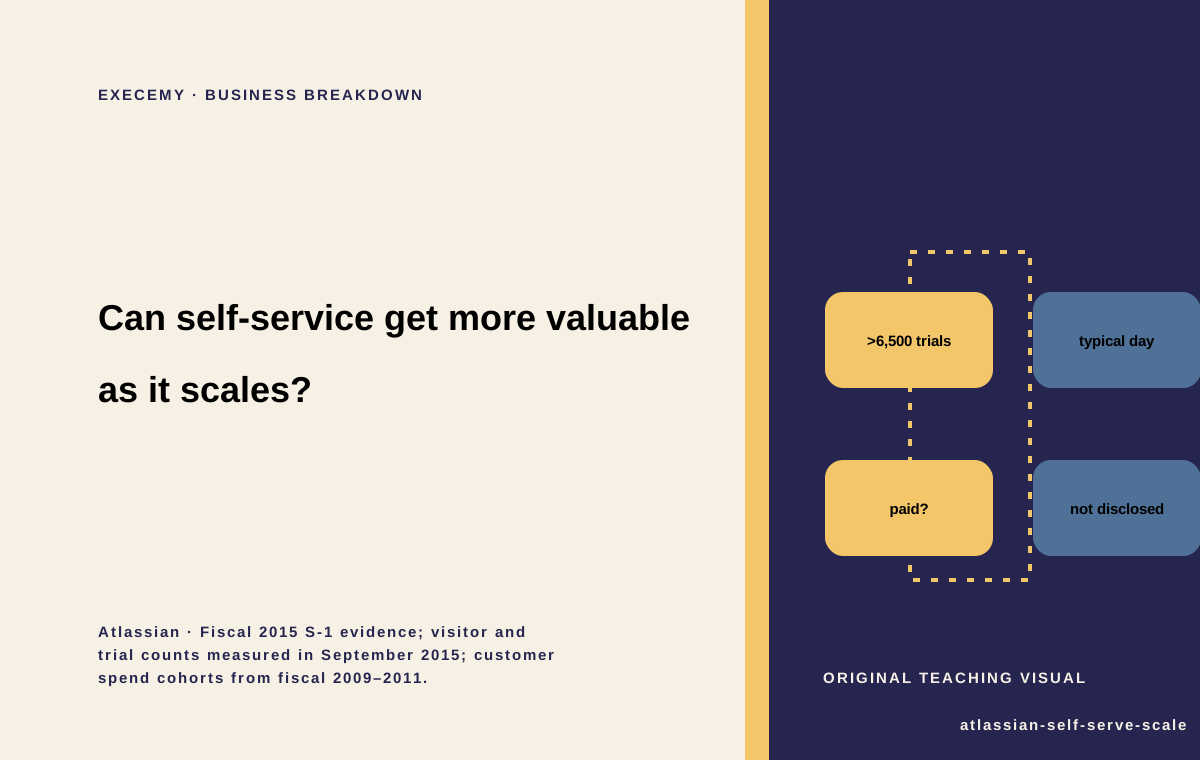
The company reported more than 70,000 daily visitors and more than 6,500 free evaluations per typical business day during September 2015. It defined visitors by unique IP-address visits and typical business days as Monday through Thursday. These thresholds describe observed activity under the company’s rules, not matched buyer cohorts. [Registration statement, Rapid and Efficient Acquisition](https://d1lge852tjjqow.cloudfront.net/CIK-0001650372/5a33e51e-347d-450a-9b16-942ef3aa60eb.pdf).
A visitor can have different purposes, and an evaluation can concern a different product or prior visit. Their ratio is not a defensible evaluation-conversion rate. Neither total tells the reader whether a team finished useful work, paid or remained a durable customer.
Mechanism 2 · Expansion spend has a different clock from the first p
Expansion spend has a different clock from the first purchase
For fiscal 2009–2011 customer cohorts, Atlassian reported average subsequent spend over the following five years of seven times the initial purchase. Renewals, more products and additional teams contributed to that spend. The multiple describes aggregate spend over the subsequent interval, not an annual run rate in its final year or customer profit. [Definitive prospectus, Continued Expansion](https://d1lge852tjjqow.cloudfront.net/CIK-0001650372/5a33e51e-347d-450a-9b16-942ef3aa60eb.pdf).
A cohort average can hide accounts that contract, leave or expand unusually far. The next investment decision needs the distribution, renewal pattern and incremental serving cost. The public multiple supplies useful context but cannot be assigned to every account or used as a payback calculation.
Mechanism 2 · Expansion spend has a different clock from the first p
Keep product demand and buyer support in the explanation
The strongest competing explanation is that a valuable offer, brand familiarity and the market’s growth produced demand alongside the web route. Lower transaction work may support adoption while a poor-fit product still fails to deliver a useful result. The source is management’s account of the operating model, not an isolated causal experiment.
The support disclosure also limits a simple opposition between product-led and sales-led growth. An initial buyer can evaluate independently while a wider deployment needs technical advice, purchase authority or a partner. The company must decide which work to automate and which work to supply, rather than attach a single label to every stage.
Mechanism 3 · Learn from a defined step
Learn from a defined step
In a hypothetical team product, many evaluations and few upgrades could reflect failed setup, insufficient value or a buying decision outside the evaluator’s authority. Observe the completed customer task and investigate the next obstacle. Improving the checkout would not remedy every one of those constraints.
The case establishes an actual route choice, a precisely bounded activity snapshot and a distinct expansion-spend measure. It leaves the causal and contribution questions open. The useful reader decision is where independent evaluation works, where assistance is needed and which evidence would justify the next investment.
Optional application · unscored
Find the step that needs learning
Hypothetical: Your product has many free trials but few upgrades. Choose one observable friction point in the first-use path and one experiment that can distinguish setup problems from weak product value.
Reveal: Instrument a specific first-value event, change one step, and compare a meaningful cohort. A visitor count or trial count alone is not a payback metric.
Teaching assumption: Fictional reader decision with no numerical inputs or measured company outcome.
The answer
Self-service changes transaction work while support and a durable customer outcome remain necessary; activity totals and interval spend use different populations and clocks.
Self-service changes transaction work while support and a durable customer outcome remain necessary; activity totals and interval spend use different populations and clocks. Self-service changes transaction work while support and a durable customer outcome remain necessary; activity totals and interval spend use different populations and clocks. The case is bounded to Online evaluation and purchase route with later support and expansion work during September 2015 acquisition snapshot; fiscal 2009–2011 cohorts’ subsequent five-year spend.
Sources and limitations
- Atlassian definitive IPO prospectus — Atlassian
Financial model, printed p. 63; Sales and marketing, pp. 75, 78; customer and partner services, p. 124
Bounded acquisition and cohort definitions, enterprise/channel support and disclosed customer services.
Company account and defined aggregate counts, not independent conversion, payback or causal attribution. Subsequent-five-year cohort spend is not final-year annual revenue.
- Atlassian definitive IPO prospectus — Atlassian
Financial model, printed p. 63; Sales and marketing, pp. 75, 78; customer and partner services, p. 124
Bounded acquisition and cohort definitions, enterprise/channel support and disclosed customer services.
Company account and defined aggregate counts, not independent conversion, payback or causal attribution. Subsequent-five-year cohort spend is not final-year annual revenue.
Original illustrative scenes are not documentary evidence.
New concepts and cases by email