Open visual reader →
Does a low-touch funnel mean customer acquisition pays back quickly?
Atlassian described its model as reducing customer acquisition costs by avoiding a traditional salesforce. The public evidence reviewed here does not report customer acquisition cost, contribution margin by cohort, or a payback period, so the central lesson is to separate acquisition efficiency from payback proof.
Explore Atlassian →
The question
Does a low-touch funnel mean customer acquisition pays back quickly?
Atlassian's online trial, low-touch sales approach, and reported customer expansion pattern. · Fiscal 2015 Form S-1 operating model and fiscal 2009–2011 customer spend cohort description. Atlassian described its model as reducing customer acquisition costs by avoiding a traditional salesforce. The public evidence reviewed here does not report customer acquisition cost, contribution margin by cohort, or a payback period, so the central lesson is to separate acquisition efficiency from payback proof. Atlassian’s December 2015 prospectus describes low-touch acquisition and later spend expansion. These establish different layers of the model; recovery still needs assigned acquisition spending and timed contribution from the same cohort.
- Atlassian December 9 2015 definitive prospectus, accession 0001047469-15-009143 — PDF index 66, printed p. 63, Rapid and efficient acquisition of new customers. Cover: Filed Pursuant to Rule 424(b)(4), registration 333-207879.
- Atlassian December 9 2015 definitive prospectus, accession 0001047469-15-009143 — PDF index 66, printed p. 63, Continued expansion, fiscal 2009/2010/2011 cohort and subsequent-five-year spend statement; index 111, printed p. 110, aggregate wording.
Mechanism 1 · Self-service changes the cost structure
Self-service changes the cost structure.
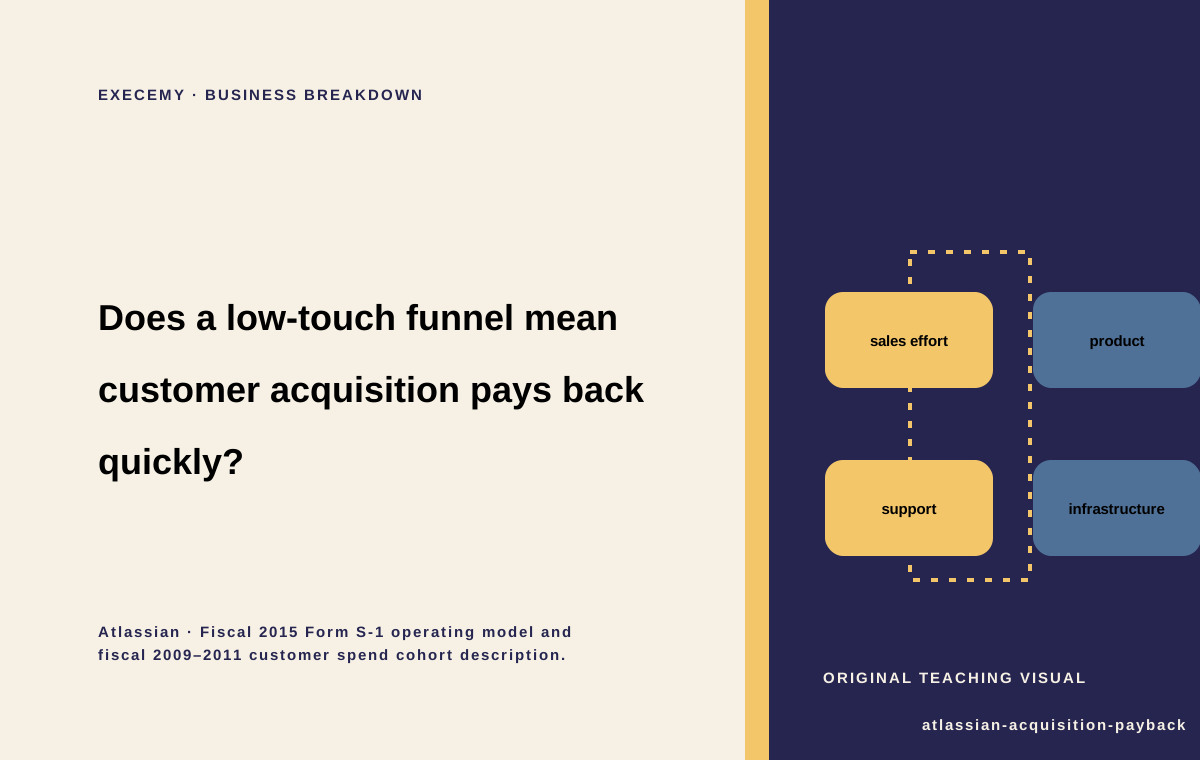
Atlassian said free evaluation and online purchase reduced the need for traditional sales coverage. That may remove some sales effort, but product, support, marketing, and infrastructure still cost money.
Mechanism 2 · Later spend is a signal, not acquisition recovery
Later spend is a signal, not acquisition recovery.
For fiscal 2009, 2010 and 2011 cohort groups, Atlassian reported spending seven times the initial purchase over the subsequent five years, on average. A later summary uses aggregate wording. Neither passage discloses an individual-customer averaging method or the contribution and cash timing needed for payback.
Mechanism 3 · Keep the missing recovery inputs visible
Keep the missing recovery inputs visible.
The filing supports a company-asserted acquisition mechanism and a reported spend pattern. It does not provide the matched acquisition cost and cumulative contribution needed to name a recovery date. A symbolic recovery comparison identifies the contribution and timing that must be measured.
- Atlassian December 9 2015 definitive prospectus, accession 0001047469-15-009143 — PDF index 66, printed p. 63, Rapid and efficient acquisition of new customers. Cover: Filed Pursuant to Rule 424(b)(4), registration 333-207879.
- Atlassian December 9 2015 definitive prospectus, accession 0001047469-15-009143 — PDF index 66, printed p. 63, Continued expansion, fiscal 2009/2010/2011 cohort and subsequent-five-year spend statement; index 111, printed p. 110, aggregate wording.
Optional application · unscored
Specify the recovery evidence
A software team reports growing customer spend after acquisition while service requirements and renewal patterns change.
Reveal: Let C be assigned acquisition cost and M(t) cumulative contribution from the same cohort through time t. Recovery requires M(t) to cover C under a stated cost and cash perimeter. Measure survival, delivery work and collection timing; no date follows from a spend multiple alone.
Teaching assumption: Original fictional situation without assigned numerical amounts, durations, probabilities or company outcomes.
The answer
Does a low-touch funnel mean customer acquisition pays back quickly?
Atlassian described its model as reducing customer acquisition costs by avoiding a traditional salesforce. The public evidence reviewed here does not report customer acquisition cost, contribution margin by cohort, or a payback period, so the central lesson is to separate acquisition efficiency from payback proof. A low-touch acquisition model can reduce selling effort without guaranteeing short payback. A slow-growing high-margin cohort could recover cost sooner than a faster-growing, low-margin cohort; the source does not supply the numbers to choose between them. The cohort paragraph says on average, while a later summary uses aggregate wording. The filing does not disclose the weighting needed to infer an arithmetic average of individual ratios. Reported spend over subsequent years is not year-end spending, contribution, retention or a payback curve. Product, support, marketing and infrastructure commitments remain. The case is bounded to Atlassian's online trial, low-touch sales approach, and reported customer expansion pattern. during Fiscal 2015 Form S-1 operating model and fiscal 2009–2011 customer spend cohort description..
Sources and limitations
- Atlassian December 9 2015 definitive prospectus, accession 0001047469-15-009143 — Atlassian / SEC-filed primary document; CloudFront PDF copy
PDF index 66, printed p. 63, Rapid and efficient acquisition of new customers. Cover: Filed Pursuant to Rule 424(b)(4), registration 333-207879.
Claims and observations identify the precise uses.
Exact primary filing copy inspected, not a secondary account. Company assertion that no traditional salesforce lowers acquisition cost; no matched CAC, contribution or payback curve disclosed.
- Atlassian December 9 2015 definitive prospectus, accession 0001047469-15-009143 — Atlassian / SEC-filed primary document; CloudFront PDF copy
PDF index 66, printed p. 63, Continued expansion, fiscal 2009/2010/2011 cohort and subsequent-five-year spend statement; index 111, printed p. 110, aggregate wording.
Claims and observations identify the precise uses.
The specified cohort passage says on average; another summary says in the aggregate. The averaging/weighting method is not disclosed here, so no individual-customer mean or universal cohort multiple is inferred. Spend is not contribution or cash recovery.
Original illustrative scenes are not documentary evidence.
New concepts and cases by email