Open visual reader →
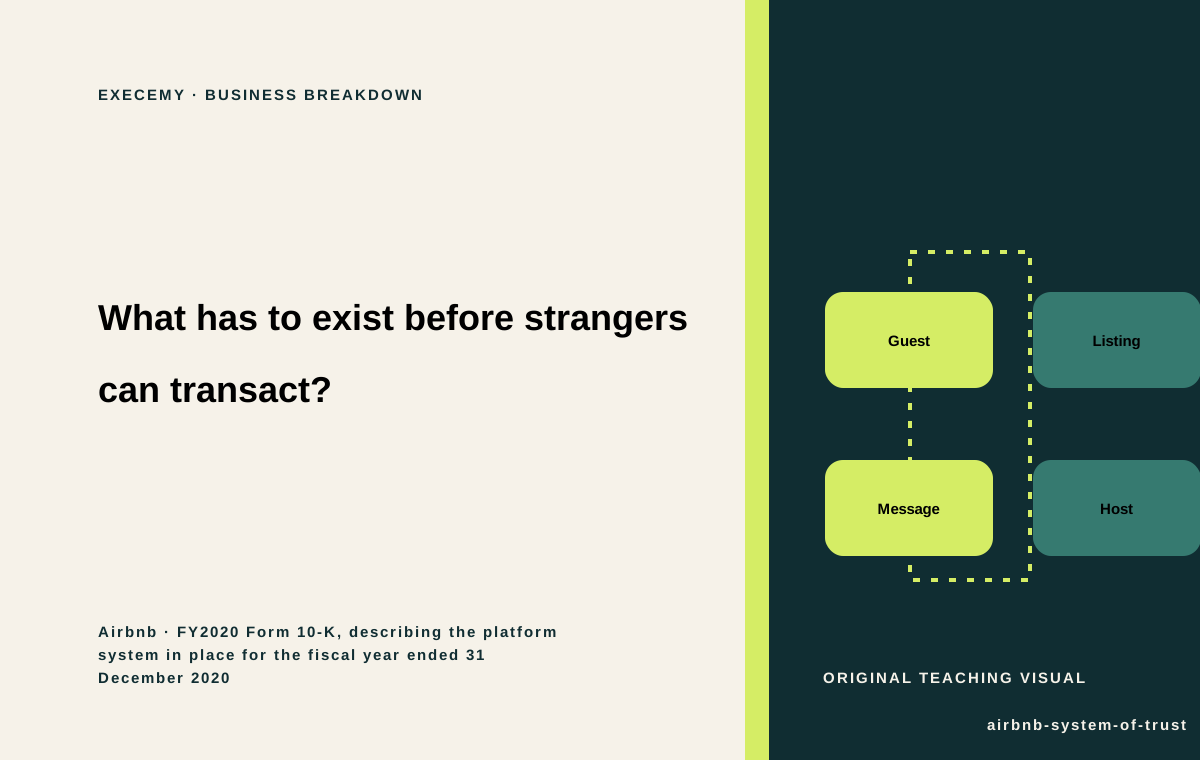
What has to exist before strangers can transact?
Assign each trust mechanism to a specific uncertainty; a conditional protection limit does not demonstrate safety or successful recovery.
Explore Airbnb →
The question
What has to exist before strangers can transact?
Information, prevention and recovery functions and expanded host protection · FY2020 trust system; November 9, 2021 AirCover launch. Assign each trust mechanism to a specific uncertainty; a conditional protection limit does not demonstrate safety or successful recovery.
Mechanism 1 · Airbnb combined information, screening and recovery me
Airbnb combined information, screening and recovery mechanisms
A stranger-to-stranger transaction involves information before booking and a recovery question after something goes wrong. A platform can address both while leaving material risk with participants. The decision is which uncertainty each mechanism handles and whether the operating promise is credible under its actual conditions.
Airbnb’s FY2020 filing described pre-booking communication, payments, reviews and risk or screening processes that could vary by region. In November 2021 it announced AirCover for hosts, adding protections such as pet damage, deep cleaning and income loss to its described host support. The announcement is an actual product-policy choice; it does not measure the incremental effect on hosting. [FY2020 Form 10-K, system of trust](https://www.sec.gov/Archives/edgar/data/1559720/000155972021000010/airbnb-10k.htm), [November 2021 AirCover announcement](https://news.airbnb.com/2021-winter-release).
The analytical alternatives include relying mainly on information and reviews, using screening, supporting recovery or combining them. They address different failures. The public accounts do not supply an internal alternatives memo or a comparison of their cost and effect.
Mechanism 1 · Airbnb combined information, screening and recovery me
A protection limit does not remove the underlying risk
The FY2020 Host Protections note distinguishes covered property damage from third-party liability. Property protection was limited to up to $1 million for covered guest-caused physical loss or damage during a confirmed booking, with conditions including an unresolved host–guest dispute. Liability coverage was up to $1 million per occurrence, subject to a $1 million cap per listing location and conditions, limitations and exclusions. These are separate programs. The limits are neither additive nor guaranteed payouts. [FY2020 Host Protections, printed p. 117](https://www.sec.gov/Archives/edgar/data/1559720/000155972021000010/airbnb-10k.htm).
The loss may still involve eligibility, evidence, exclusions and time spent obtaining support. A participant needs to understand which event is covered and what happens after reporting it. A headline limit is useful context but not an observation of successful recovery.
Mechanism 2 · Reviews inform choice and can shape enforcement
Reviews inform choice and can shape enforcement
The filing said reviews inform decisions and quality standards, and warned that unreliable reviews could weaken trust. That is management’s stated mechanism and risk. It does not independently validate review accuracy or show which signals users relied on. [FY2020 review and reputation risk discussion](https://www.sec.gov/Archives/edgar/data/1559720/000155972021000010/airbnb-10k.htm).
A trustworthy information signal can reduce uncertainty about a stay while leaving a different uncertainty about support. Adding a verification badge is therefore not a complete answer to recovery. Conversely, a recovery program does not tell a traveler whether the listing matches their needs before paying.
Mechanism 2 · Reviews inform choice and can shape enforcement
Make the rival explanation visible
The strongest rival account is that supply, demand and the quality of listings shape participation alongside the trust system. A richer protection package can be a useful response to a participant concern while having little effect where price, availability or local service is binding. The launch publicity does not separate those factors.
The company’s reassurance language is an objective, not an independent safety outcome. A full evaluation would examine what was prevented, how valid complaints were resolved, who could access the process and what burden remained. Those measurements are absent here and are not replaced by a diagram of an automatically self-reinforcing trust loop.
Mechanism 3 · Assign a mechanism to the actual uncertainty
Assign a mechanism to the actual uncertainty
For a hypothetical rental marketplace, a guest may understand the photos and price while having no credible complaint route. A host may face a different concern about damage and proof. Identify the uncertainty on each side and the party responsible for response before choosing a badge, a review rule or a protection promise.
The case documents a system and a later expansion of host protection. It does not establish that more protection always produces more participation, that every qualifying loss is paid or that the dated limits apply now. A useful design makes its information, prevention and recovery functions clear and tests the customer outcome each is meant to improve.
Optional application · unscored
Make the trust gap visible
Hypothetical: A new rental marketplace has many listings but little history. A guest can see photos and price but cannot verify who answers a complaint.
Reveal: Add the missing information and recovery path deliberately: identity, communication, payments, review quality, rules, and support. This scenario is hypothetical; adding a badge alone would not prove trust.
Teaching assumption: Fictional reader decision with no numerical inputs or measured company outcome.
The answer
Assign each trust mechanism to a specific uncertainty; a conditional protection limit does not demonstrate safety or successful recovery.
Assign each trust mechanism to a specific uncertainty; a conditional protection limit does not demonstrate safety or successful recovery. Assign each trust mechanism to a specific uncertainty; a conditional protection limit does not demonstrate safety or successful recovery. The case is bounded to Information, prevention and recovery functions and expanded host protection during FY2020 trust system; November 9, 2021 AirCover launch.
Sources and limitations
- Airbnb 2020 Form 10-K — Airbnb / SEC
Our System of Trust, printed p. 6; Host Protections, p. 117
Information, screening and recovery mechanisms; separately conditional property and liability limits; review risks
Company mechanism and risk account, not verified safety or payout performance. Historical terms do not certify current terms.
- Airbnb 2021 Winter Release — Airbnb Newsroom
November 9, 2021; Introducing AirCover paragraphs
Launch of expanded host protections; separately described damage and liability programs
Company announcement and reassurance objective, not incremental host uptake or risk reduction.
Original illustrative scenes are not documentary evidence.
New concepts and cases by email