Open visual reader →
Why can a subscription transition make revenue look worse first?
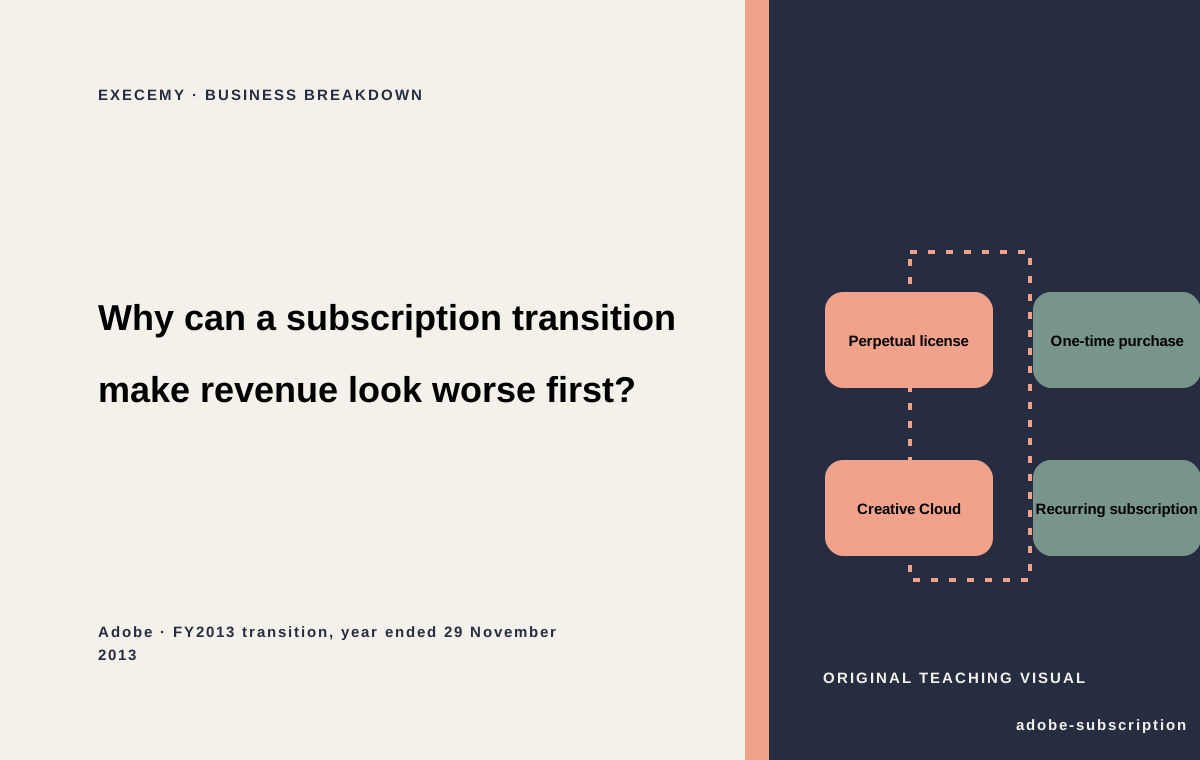
When customers move from occasional license purchases to recurring access, the product can be growing into a new model while reported revenue and earnings weaken during the handoff.
Explore Adobe →
The question
Why can a subscription transition make revenue look worse first?
Adobe Digital Media’s Creative Cloud and ETLA transition, keeping segment recognized revenue and company-defined year-end ARR distinct · May 2013 development/licensing choice and subsequent FY2013 results, year ended November 29, 2013; later evidence kept separate from the decision. Moving some sales from upfront license recognition to service revenue over time can reduce current recognized revenue while the recurring base accumulates; expenses and customer retention still determine whether the new model works.
Mechanism 1 · Adobe directed future creative innovation to subscribe
Adobe directed future creative innovation to subscribers
In May 2013 Adobe announced that new creative-product innovation would be delivered exclusively to Creative Cloud subscribers. CS6 would remain available under perpetual licensing, but as its last major perpetual update. This is the real product-development and licensing choice at the center of the case. [Overview of 2013, p. 39](https://www.sec.gov/Archives/edgar/data/796343/000079634314000004/adbe10kfy13.htm).
The documented arrangement offered a current perpetual product while directing future improvements into a recurring relationship. Continuing a future perpetual-update line is an analytical alternative, not a recorded rejected board proposal. No internal meeting or customer interview is invented.
The timing boundary is essential. FY2013 revenue and year-end ARR were later observations, not facts Adobe could know in full when making the May announcement. They help evaluate the first transition year; they cannot be used as foreknowledge to make the decision appear inevitable.
- Adobe FY2013 Form 10-K: May 2013 creative-product decision — Item 7, Overview of 2013, printed p. 39, paragraph beginning “In May 2013 we announced”: future creative innovation exclusive to subscribers; CS6 last major perpetual update, with CS6 still offered perpetually
- Business Model Theory — Definition, paragraphs 1–7: value proposition, resources, processes, profit formula and interdependence
- Adobe FY2013 Form 10-K: transition explanation — Item 7, Overview of 2013, printed pp. 38–40: Creative Cloud transition; paragraphs on declining perpetual revenue and expenses not declining with revenue; ARR definition and warning; Financial Performance Summary
Mechanism 1 · Adobe directed future creative innovation to subscribe
A continuing offer had to justify a continuing obligation
Adobe’s filed account described more frequent updates, cloud file access and services as parts of Creative Cloud’s value. That was a customer proposition as well as a revenue-model choice. Directing new features to subscribers gave customers a reason to migrate, but did not by itself establish that they valued the continuing relationship enough to stay.
The accounting mechanism followed a different clock. As subscription service revenue accumulated over time, displaced perpetual-license revenue could fall sooner. Adobe’s expectations about longer-term adoption remained expectations at the decision boundary.
The operating question was whether delivery, pricing, support and retention would make that recurring relationship viable. The remaining CS6 offer preserved a defined perpetual alternative in the disclosed arrangement. A reader should not turn the change into a claim that every Adobe product or every customer had the same migration path.
- Adobe FY2013 Form 10-K: transition explanation — Item 7, Overview of 2013, printed pp. 38–40: Creative Cloud transition; paragraphs on declining perpetual revenue and expenses not declining with revenue; ARR definition and warning; Financial Performance Summary
- Adobe FY2013 Form 10-K: May 2013 creative-product decision — Item 7, Overview of 2013, printed p. 39, paragraph beginning “In May 2013 we announced”: future creative innovation exclusive to subscribers; CS6 last major perpetual update, with CS6 still offered perpetually
- Business Model Theory — Definition, paragraphs 1–7: value proposition, resources, processes, profit formula and interdependence
- Adobe FY2013 Form 10-K: Digital Media ARR — Item 7, Overview of 2013, Financial Performance Summary, printed p. 40: total Digital Media ARR approximately $911.0m as of November 29, 2013 and approximately $204.0m as of November 30, 2012; ARR definition immediately above
Mechanism 2 · Compare the clocks without adding them
Compare the clocks without adding them
Digital Media revenue fell from $3,101.9 million in FY2012 to $2,625.9 million in FY2013, a decrease of $476.0 million or 15.35%. Total Digital Media ARR rose from approximately $204.0 million at the FY2012 end to approximately $911.0 million at the FY2013 end: about $707.0 million or 346.57%. [Segment Information and ARR summary](https://www.sec.gov/Archives/edgar/data/796343/000079634314000004/adbe10kfy13.htm).
The revenue values cover fiscal periods. ARR is the company’s annualized base at a date, incorporating current paid subscriptions and qualifying enterprise term license agreements. Adobe explicitly said to view it independently of revenue and related deferred measures. Adding $911 million of ARR to FY2013 revenue would manufacture an invalid total.
The segment also includes Document Services. These numbers cannot be relabeled as Creative Cloud-only revenue or profit. Their opposite movement is consistent with an accumulating recurring base during migration, but does not reveal renewals, support cost or the customer-level distribution of value.
- Adobe FY2013 Form 10-K: segment information — Item 7, Segment Information (dollars in millions), printed p. 42: Digital Media 2013 $2,625.9m / 2012 $3,101.9m; “Fiscal 2013 Revenue Compared to Fiscal 2012 Revenue / Digital Media”, paragraphs on units and perpetual unit average selling price
- Adobe FY2013 Form 10-K: Digital Media ARR — Item 7, Overview of 2013, Financial Performance Summary, printed p. 40: total Digital Media ARR approximately $911.0m as of November 29, 2013 and approximately $204.0m as of November 30, 2012; ARR definition immediately above
- Adobe FY2013 Form 10-K: transition explanation — Item 7, Overview of 2013, printed pp. 38–40: Creative Cloud transition; paragraphs on declining perpetual revenue and expenses not declining with revenue; ARR definition and warning; Financial Performance Summary
Mechanism 2 · Compare the clocks without adding them
An accounting explanation is not the whole explanation
Adobe attributed the Digital Media decline primarily to subscription and ETLA adoption. The same discussion also reported fewer perpetual units and lower perpetual unit average selling prices. It said expenses did not decline in correlation with revenue. [Digital Media comparison; Overview](https://www.sec.gov/Archives/edgar/data/796343/000079634314000004/adbe10kfy13.htm).
These are meaningful challenges to a pure timing account. The filing does not give a bridge isolating the recognition effect from price, volume and product mix. It would be unjustified to assign the full $476 million decline to accounting alone. Expenses that persist during migration also keep the funding problem real even if adoption grows.
An alternative commercial explanation could include customer inertia, promotional terms or the existing product’s strengths. Those mechanisms can coexist with a model change. The year-end run-rate is not evidence that each customer is better off, that all adoption is incremental or that retained revenue will cover future obligations.
- Adobe FY2013 Form 10-K: segment information — Item 7, Segment Information (dollars in millions), printed p. 42: Digital Media 2013 $2,625.9m / 2012 $3,101.9m; “Fiscal 2013 Revenue Compared to Fiscal 2012 Revenue / Digital Media”, paragraphs on units and perpetual unit average selling price
- Adobe FY2013 Form 10-K: transition explanation — Item 7, Overview of 2013, printed pp. 38–40: Creative Cloud transition; paragraphs on declining perpetual revenue and expenses not declining with revenue; ARR definition and warning; Financial Performance Summary
- Adobe FY2013 Form 10-K: Digital Media ARR — Item 7, Overview of 2013, Financial Performance Summary, printed p. 40: total Digital Media ARR approximately $911.0m as of November 29, 2013 and approximately $204.0m as of November 30, 2012; ARR definition immediately above
Mechanism 3 · Require evidence that can change the next decision
Require evidence that can change the next decision
For the editorial evaluation, seek the cohorts moving from the prior offer, customers newly acquired, actual renewal or departure, realized prices and cost to serve. Compare cash requirements with the resources needed to keep delivering the promise. This is the evidence that could justify maintaining the pace, slowing it or changing the offer.
A falling revenue line should not automatically trigger reversal if the underlying relationship is viable. A rising ARR line should not automatically trigger acceleration if the relationship is expensive, fragile or unattractive to the customer. Each signal needs its own definition and an operating explanation.
The case demonstrates a model-transition mechanism and a limit to the available evidence. Adobe’s FY2013 record makes the timing issue visible, while its price and expense disclosures prevent a simple victory narrative. A business-model innovation remains a proposal whose customer and financial consequences must be tested.
- Adobe FY2013 Form 10-K: transition explanation — Item 7, Overview of 2013, printed pp. 38–40: Creative Cloud transition; paragraphs on declining perpetual revenue and expenses not declining with revenue; ARR definition and warning; Financial Performance Summary
- Adobe FY2013 Form 10-K: segment information — Item 7, Segment Information (dollars in millions), printed p. 42: Digital Media 2013 $2,625.9m / 2012 $3,101.9m; “Fiscal 2013 Revenue Compared to Fiscal 2012 Revenue / Digital Media”, paragraphs on units and perpetual unit average selling price
- Business Model Theory — Definition, paragraphs 1–7: value proposition, resources, processes, profit formula and interdependence
- Adobe FY2013 Form 10-K: Digital Media ARR — Item 7, Overview of 2013, Financial Performance Summary, printed p. 40: total Digital Media ARR approximately $911.0m as of November 29, 2013 and approximately $204.0m as of November 30, 2012; ARR definition immediately above
Optional application · unscored
Read a transition dashboard
Hypothetical: a software business has rising year-end recurring run-rate, falling period revenue and no retention or service-cost data. Is faster migration justified by that dashboard alone?
Reveal: No. The directions are consistent with a timing transition, but do not establish ongoing value or economics. Keep the two clocks separate and obtain retention, realized pricing, servicing cost and funding evidence before changing pace.
Teaching assumption: Fictional decision dashboard.
Teaching assumption: The recurring measure and revenue cover different time definitions.
Teaching assumption: No favorable retention or cost assumption is supplied.
The answer
Require evidence that can change the next decision
Moving some sales from upfront license recognition to service revenue over time can reduce current recognized revenue while the recurring base accumulates; expenses and customer retention still determine whether the new model works. A revenue decline can accompany a growing recurring base during migration, but price, volume, persistent cost and retention still determine whether the changed model is viable. The case is bounded to Adobe Digital Media’s Creative Cloud and ETLA transition, keeping segment recognized revenue and company-defined year-end ARR distinct during May 2013 development/licensing choice and subsequent FY2013 results, year ended November 29, 2013; later evidence kept separate from the decision.
Sources and limitations
- Business Model Theory — Christensen Institute
Definition, paragraphs 1–7: value proposition, resources, processes, profit formula and interdependence
Business Model Theory connects a value proposition with resources, processes and a profit formula.
Foundational theoretical account. Its predictive claims are not adopted as measured guarantees.
- Adobe FY2013 Form 10-K: transition explanation — Adobe / SEC
Item 7, Overview of 2013, printed pp. 38–40: Creative Cloud transition; paragraphs on declining perpetual revenue and expenses not declining with revenue; ARR definition and warning; Financial Performance Summary
Adobe described a move from perpetual creative licenses toward Creative Cloud subscriptions and anticipated more ratably recognized recurring revenue.; Adobe reported approximately $204.0m and $911.0m of total Digital Media ARR at the respective FY2012 and FY2013 year ends and said ARR should be viewed independently of revenue.; Adobe attributed the revenue decline primarily to subscription and ETLA adoption, also reporting fewer perpetual units and lower perpetual unit average selling prices.; Adobe said expenses did not decline in correlation with the revenue decline during the transition.
Management explanation and expectations, not an independently identified causal effect or proof of later success.
- Adobe FY2013 Form 10-K: segment information — Adobe / SEC
Item 7, Segment Information (dollars in millions), printed p. 42: Digital Media 2013 $2,625.9m / 2012 $3,101.9m; “Fiscal 2013 Revenue Compared to Fiscal 2012 Revenue / Digital Media”, paragraphs on units and perpetual unit average selling price
Digital Media revenue was $3,101.9m in FY2012 and $2,625.9m in FY2013.; Adobe attributed the revenue decline primarily to subscription and ETLA adoption, also reporting fewer perpetual units and lower perpetual unit average selling prices.
Digital Media includes Creative and Document Services; decline cannot be assigned wholly to Creative Cloud.
- Adobe FY2013 Form 10-K: Digital Media ARR — Adobe / SEC
Item 7, Overview of 2013, Financial Performance Summary, printed p. 40: total Digital Media ARR approximately $911.0m as of November 29, 2013 and approximately $204.0m as of November 30, 2012; ARR definition immediately above
Adobe reported approximately $204.0m and $911.0m of total Digital Media ARR at the respective FY2012 and FY2013 year ends and said ARR should be viewed independently of revenue.
Approximate company-defined run-rate; includes subscriptions and ETLAs, not recognized annual revenue or guaranteed receipts.
- Adobe FY2013 Form 10-K: May 2013 creative-product decision — Adobe / SEC
Item 7, Overview of 2013, printed p. 39, paragraph beginning “In May 2013 we announced”: future creative innovation exclusive to subscribers; CS6 last major perpetual update, with CS6 still offered perpetually
Adobe announced in May 2013 that new creative innovation would be delivered exclusively to Creative Cloud subscribers, while CS6 remained available on a perpetual basis as the last major perpetual update.
Retrospective filing reports the announced May choice; no internal debate or contemporaneous future outcome is inferred.
Original illustrative scenes are not documentary evidence.
New concepts and cases by email